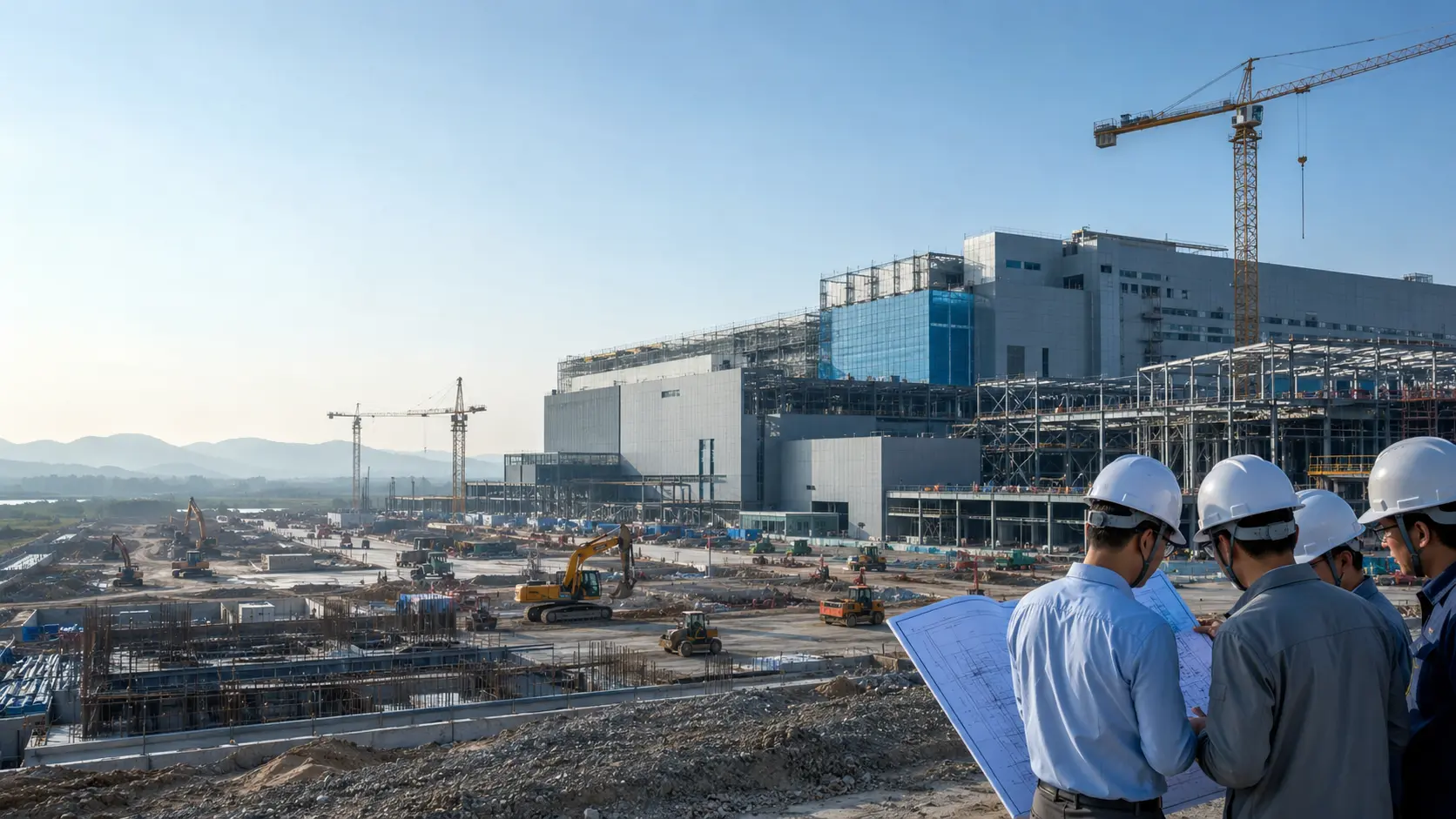
Samsung Vietnam would gain its first semiconductor testing plant under a $1.5 billion proposal reviewed by Reuters, a move that would deepen the country’s role in the memory-chip supply chain as artificial-intelligence demand keeps tightening capacity across the industry.
According to Reuters, the proposal sent to local authorities in April says Samsung Electronics plans to invest 39 trillion dong in Thai Nguyen province, about 60 kilometres north of Hanoi, with operations targeted for November 2027. Reuters also reported that construction activity is already visible on the site, even though some permitting questions appear to remain unresolved.
The project matters beyond one factory. If it proceeds on the timeline outlined in the proposal, Samsung would be adding new back-end capacity at a point when the memory market is being reshaped by AI data centres, while manufacturers of smartphones, laptops, and automobiles are still competing for mature DRAM and NAND supply.
Why Samsung Vietnam Matters Now
The immediate reason this proposal stands out is scale. Reuters reported that the previously undisclosed plan would involve 39 trillion dong, or about $1.5 billion, for a plant dedicated to semiconductor testing, with annual capacity listed at 153.3 billion gigabits of DRAM and 255.6 billion gigabits of NAND.
That makes the story more than a routine site expansion. It points to a deliberate effort by Samsung to widen its footprint in the part of the semiconductor chain that comes after fabrication, where chips are assembled, packaged, tested for defects, and prepared for shipment into commercial markets.
Samsung Vietnam Would Expand the Memory Back End
Reuters said the factory would focus on legacy chips rather than the most advanced AI components. That distinction matters because the current semiconductor squeeze is no longer limited to the flashiest parts of the market. When producers commit more resources to premium AI-oriented memory, pressure can shift onto mature products that still power a broad range of consumer and industrial devices.
Testing is the final checkpoint before chips leave the production chain. A facility designed around DRAM and NAND validation would not solve the most advanced bottlenecks in high-bandwidth memory, but it could still improve throughput and reliability in categories that remain essential to computing, storage, and electronics manufacturing at scale.
The proposal reviewed by Reuters suggests Samsung sees enough demand durability to justify that bet well ahead of 2027. It also suggests the company wants more flexibility in where it completes the final stages of memory production as customers absorb the effects of an AI-led capacity reshuffle.
Legacy Chips Still Matter in an AI Market
Much of the AI conversation has centred on frontier chips, hyperscaler capex, and specialist suppliers. Yet the broader electronics economy still runs on mature memory products that do not receive the same headlines. Reuters explicitly linked the Vietnam plan to shortages affecting smartphones, laptops, and automobiles, underscoring how tight memory availability can ripple through multiple industries.
That dynamic gives the proposed Thai Nguyen plant a more strategic role than its “legacy chips” label might initially suggest. Mature DRAM and NAND do not sit outside the AI boom. They are being repriced by it, because the same manufacturers must decide how much capacity goes to advanced memory, how much stays with mainstream products, and how quickly the back end can keep shipments moving.
For Samsung, whose memory operations remain central to its semiconductor business, extra testing capacity in Vietnam could help protect delivery discipline in categories that still generate enormous volume even as investor attention stays fixed on top-tier AI infrastructure.
Vietnam Becomes More Central to Semiconductor Logistics
The second reason the story clears the editorial bar is that it fits a broader regional shift. Vietnam has been building out its place in electronics manufacturing for years, and this proposal would push the country further into the semiconductor back end rather than only basic device assembly.
Reuters reported that Vietnam already hosts assembly, packaging, and testing operations for companies including Intel, Amkor Technology, and Hana Micron. A Samsung testing plant of this size would strengthen that clustering effect and give Hanoi a bigger claim on one of the most labour-intensive but commercially vital stages of chip production.
A Testing Hub Next to Samsung’s Existing Complex
Location is part of the appeal. Reuters said the proposed plant is being built next to a large Samsung complex that already produces smartphones and tablets, which means the company would be adding semiconductor capability beside an established manufacturing base instead of starting from scratch in a new geography.
That existing footprint helps explain why Vietnam remains attractive for incremental supply-chain investment. Reuters said Samsung has already committed more than $23 billion to Vietnam over decades, making it the country’s largest foreign investor. Expanding from consumer electronics into chip testing builds on that embedded operating base.
It also gives Samsung room to move more value into the same ecosystem. A test facility connected to an existing industrial campus can shorten handoffs, simplify supplier coordination, and support faster scaling if downstream demand remains strong into the second half of the decade.
Why Vietnam Fits the Back-End Strategy
Back-end semiconductor work is generally less technologically complex than wafer fabrication, but it is still indispensable. Testing determines whether packaged chips meet quality standards before shipment, and failures at that stage can interrupt volumes even when upstream production is healthy.
Vietnam’s comparative advantage in this layer has been strengthened by its manufacturing workforce, export orientation, and growing relevance to electronics groups that want more capacity outside a single-country concentration model. Even when companies do not describe their strategy in geopolitical terms, the practical effect is a more diversified final-stage network.
The April Reuters report on Samsung’s preliminary discussions in Vietnam already signalled that the company and Vietnamese authorities were working toward a semiconductor project. The May 27 Reuters report now adds concrete numbers, a location, a proposed production profile, and a visible construction site, making the story materially stronger than a generic investment rumour.
What Remains Unclear About the Project
The proposal is detailed, but it is not the same as a final public launch. That is why the article has to stay precise about what is confirmed, what comes from the reviewed document, and what remains uncertain.
Reuters reported that Samsung declined to comment and that Thai Nguyen’s People’s Committee did not respond to a request for comment. Reuters also said it was not clear whether the factory had obtained all necessary permits or whether discussions with authorities were still ongoing.
The Proposal Is Detailed but Not Fully Public
Those caveats matter because semiconductor projects often move in stages. Companies can begin preliminary works while environmental and local approvals are still being processed, especially in large industrial parks. Reuters noted that this is common practice in Vietnam, which helps explain why construction appears to be underway even though the permitting picture is not yet fully transparent.
At the same time, Reuters reported that the investment had already been approved by Vietnamese authorities in March and that Samsung may reinvest profits from the project, if any, up to about $2.5 billion for a possible second factory. If that language survives into a final buildout, the current plant could become the first step in a larger semiconductor expansion rather than a one-off site.
For now, the cleanest editorial approach is to frame the project as a planned investment backed by a proposal document reviewed by Reuters, with physical activity observed at the site, but without a full public confirmation from Samsung itself.
What the Investment Could Mean for Supply Chains
If the plant enters service in November 2027 as outlined in the proposal, Samsung would gain a new node in a country that is already becoming harder to ignore in electronics and semiconductor manufacturing. That would not eliminate global memory shortages, but it could improve resilience in the flow of mature DRAM and NAND products into end markets that still need dependable volume.
It could also reinforce a larger business pattern. As AI keeps pulling capital toward high-end compute and premium memory, manufacturers are being forced to protect the rest of the electronics economy from second-order shortages. More back-end capacity is one of the few ways to do that without waiting for entirely new fabrication plants to come online.
For Berrit Media readers, the significance is straightforward: this is a supply-chain story disguised as a factory story. Samsung’s proposed Vietnam plant shows how the AI boom is reshaping not only where advanced chips are designed and fabricated, but also where mainstream memory gets tested, cleared, and delivered into the global market.
Whether the project proceeds exactly as the proposal describes or evolves through the approval process, Samsung Vietnam is already a sign of how semiconductor geography is shifting. Continue reading related coverage at Berrit Media for more on memory chips, manufacturing strategy, and the global AI infrastructure buildout.
Discover more from Berrit Media
Subscribe to get the latest posts sent to your email.