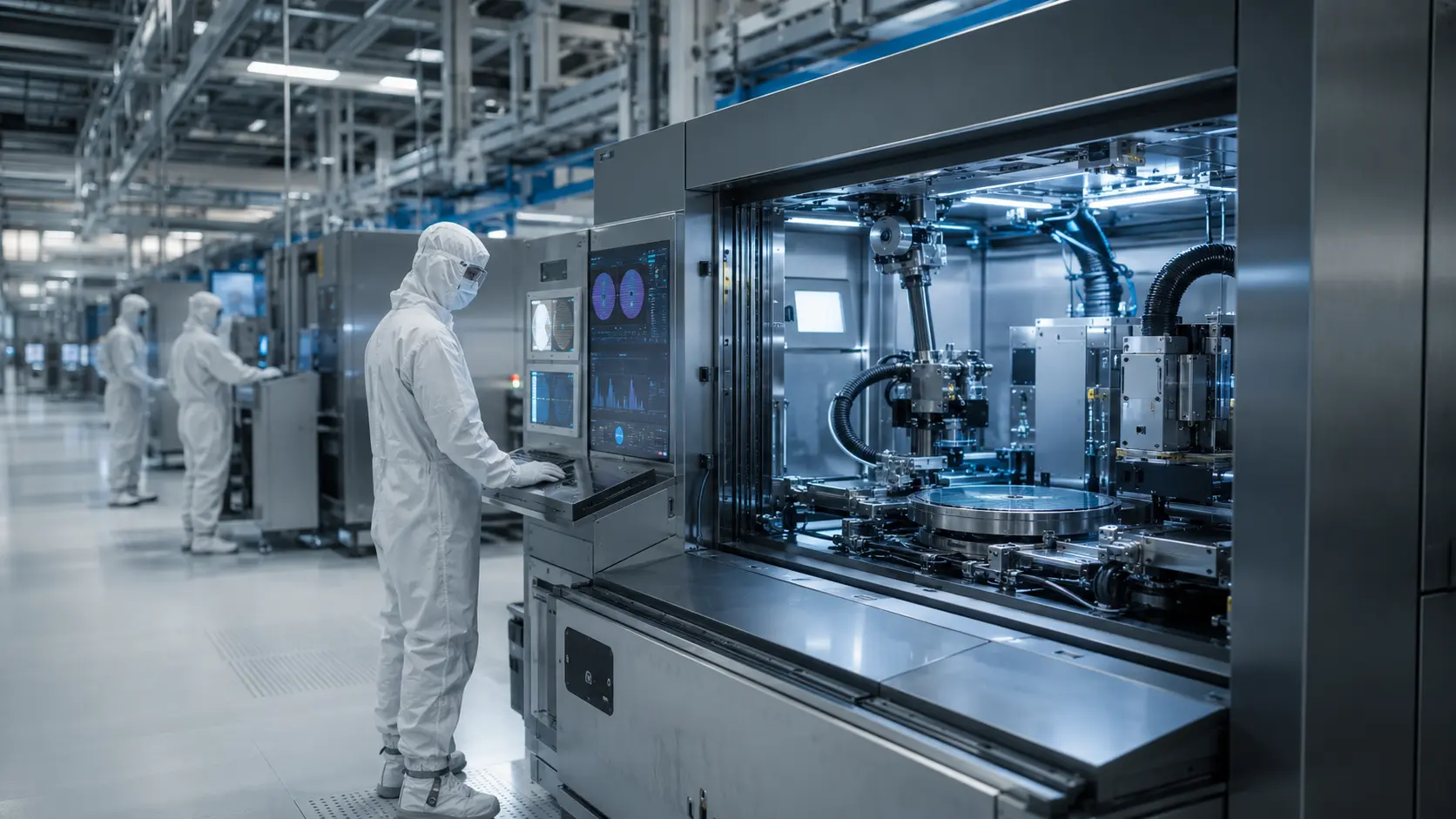
Lam Research is pushing deeper into AI inside semiconductor factories, pairing smarter chipmaking tools with a new round of U.S. expansion as customers demand more output from already stretched fabrication lines. In an interview published by Reuters on May 21, chief executive Tim Archer said the company is adding more sensing and AI capabilities to its manufacturing tools while planning expanded operations in Arizona and California.
The move matters because Lam sits in one of the most strategically valuable layers of the AI supply chain. It does not sell the finished chips that capture most of the headlines, but it supplies the deposition, etch, and support systems used by major chipmakers including Micron Technology and Taiwan Semiconductor Manufacturing Co. When companies like Lam change what their tools can do, the effects can ripple through yield, production speed, and capital spending plans across the semiconductor industry.
Why Lam Research Wants Smarter Tools
Lam’s current push is not just about adding a fashionable software layer to factory equipment. It reflects a larger shift in semiconductor manufacturing, where the challenge is no longer simply building more tools, but making those tools more aware of what is happening inside the fab so problems can be detected earlier and corrected faster.
That logic has become more urgent as AI demand drives more complex chip architectures, tighter process tolerances, and higher customer expectations for speed. Lam has already been telling investors that AI-driven demand is reshaping its market. In its March-quarter 2026 results, the company reported record revenue of $5.84 billion and said that strategic investments were helping it outperform during what it described as a critical phase of industry growth.
Lam Research and the Data Loop
According to Reuters, Archer said Lam’s strategic focus over the next two years is to equip more machines with sensors that generate data which can then be analyzed by AI systems. The practical goal is straightforward: find inefficiencies and defects earlier, improve wafer output, and help customers make more good chips from every production cycle.
Lam’s own materials show that this is already becoming a formal product direction rather than an isolated experiment. In a company explainer published on May 19, Lam described its Equipment Intelligence portfolio as a set of on-tool and off-tool technologies using sensors, data, algorithms, artificial intelligence, and automation to make semiconductor tools more autonomous, productive, and reliable.
The same explainer says those systems are designed to reduce downtime, control variability across larger tool fleets, speed new installations, and shorten troubleshooting cycles. That framing helps explain why Archer is emphasizing AI as an operating improvement story. For fabs spending heavily on next-generation memory, logic, and packaging capacity, better process control can be as valuable as buying another machine.
Lam Research Inside the Fab
Reuters also tied Lam’s comments to a venture competition at the company’s Fremont headquarters, where Lam awarded a $250,000 investment to Lightfinder, a startup spun out of the Massachusetts Institute of Technology. The startup’s technology shrinks a standalone chip-measurement tool so it can be integrated into existing equipment instead of sitting in a separate inspection step.
That detail is important because it shows the direction of travel for semiconductor equipment makers. The industry has long relied on separate metrology and inspection stages to check whether process steps are working. Folding more measurement capability into the production tool itself could reduce delays between making, checking, and correcting wafers.
For customers, that means the value proposition is expanding beyond raw hardware performance. The winning equipment platform in the AI era may be the one that produces more data, reacts faster to small deviations, and helps fabs squeeze more output from each expensive line without waiting for faults to become visible further downstream.
U.S. Expansion Follows Customer Geography
Lam’s AI-tool strategy is arriving alongside a clearer physical expansion plan in the United States. That is not incidental. Semiconductor equipment companies increasingly need engineering, support, and manufacturing footprints close to their largest customers as Washington pushes for more domestic chip capacity and as advanced fabs cluster around a smaller number of major sites.
Archer told Reuters that Lam intends to open an additional facility in the Phoenix area to support customers such as TSMC and that the company also plans more investment at its California headquarters, where it still carries out manufacturing work. The Reuters report noted that the Phoenix Business Journal had previously reported Lam spent more than $45 million on a 148,000-square-foot building near TSMC’s Arizona factories, though Lam had not yet detailed its exact plans for that site.
Lam Research Near TSMC in Arizona
Phoenix has become one of the most visible symbols of the U.S. semiconductor reshoring effort, largely because of TSMC’s expanding presence there. For Lam, being physically closer to that ecosystem can improve service speed, technical collaboration, and installation support at a moment when chipmakers are under pressure to ramp advanced production with fewer delays.
Closer proximity also gives equipment suppliers a better vantage point on how customer needs are changing. As AI systems push demand for more advanced packaging, memory performance, and process precision, suppliers that can work alongside fabs in real time may be better positioned to secure follow-on tool orders, service contracts, and long-term process-development roles.
The expansion case is not only about Arizona. It is also about building a denser service map around the largest U.S. production hubs. That can matter in semiconductors because the commercial relationship often extends far beyond the initial equipment sale into process tuning, maintenance, software updates, and customer-specific optimization.
Lam Research in Boise and California
Lam has already been building that map elsewhere. In February, the company opened a new office in Boise, Idaho, saying the site would initially support about 150 employees focused on collaborative research, development, and high-volume manufacturing work tied to Micron’s leading-edge memory technology. Lam said the office was part of a multi-year strategy to increase operational and innovation velocity for chipmakers serving the AI era.
That Boise announcement matters because it shows the current Reuters interview is part of a broader expansion pattern rather than a one-off comment. Lam described its Idaho footprint as critical infrastructure near one of its largest customers, underscoring how equipment makers are increasingly organizing around customer geography instead of relying only on distant centralized support.
California still remains central to the company as well. Archer’s comments that Lam will keep investing around its Fremont headquarters suggest the company is not shifting away from its established manufacturing and engineering base, but layering new regional capacity onto it. That combination could help Lam stay close to both its domestic customer hubs and its internal R&D capabilities.
What the Move Says About the AI Supply Chain
Lam’s latest steps also say something broader about where the semiconductor race is heading. The AI boom has been widely framed around GPU designers, hyperscaler capital spending, and giant data center buildouts. But the next phase increasingly looks like an industrial systems story, where advantage comes from the companies that improve yield, packaging, process control, and throughput behind the scenes.
Lam is positioning itself squarely in that industrial layer. The company said this week that it was opening a new Panel-Level Packaging Center of Excellence in Salzburg, Austria, to expand research and development for advanced packaging as AI and high-performance computing push the industry toward larger and more complex chip packages. That is consistent with a strategy aimed at shortening the path from lab innovation to manufacturing readiness.
Lam Research and the Economics of Yield
The economics behind this are compelling. As advanced fabs become more expensive, even small improvements in uptime, defect detection, and process stability can have meaningful effects on returns for both equipment suppliers and chipmakers. AI-enabled sensing becomes attractive not because it is novel, but because it can protect the productivity of very costly assets.
Lam’s March-quarter results offer a useful backdrop. Alongside record revenue, the company reported operating margin of 35.0% and said customer support-related revenue and other revenue reached more than $2.11 billion for the quarter. That mix suggests Lam’s opportunity is not limited to shipping new systems. It also includes extracting more value from installed tools and surrounding them with recurring support and intelligence layers.
In that sense, smarter chipmaking tools are also a business-model story. They can deepen customer dependence, lengthen service relationships, and make equipment performance harder to separate from data and analytics. For investors, that may be one reason Lam’s strategy is worth watching beyond the usual quarterly order cycle.
Lam Research Beyond GPU Headlines
The Reuters interview also arrives at a moment when semiconductor investors are trying to understand how durable the AI buildout will be once the first wave of data center buying matures. Equipment suppliers like Lam offer one clue. If the next growth phase depends on making fabs more adaptive and efficient, then the AI story is moving further into factory operations rather than staying confined to end products and model training clusters.
There are still risks. Lam disclosed in its March-quarter report that China accounted for 34% of revenue, far ahead of any other geography, which means export controls, tariffs, and geopolitical tensions remain meaningful variables for the business. The company’s own forward-looking statements also repeatedly flag trade restrictions and supply chain disruptions as potential headwinds.
Even so, the strategic direction is becoming clearer. Lam is using the current upcycle to bind AI, automation, customer proximity, and advanced packaging into a single operating agenda. That does not guarantee a straight line of growth, but it does show how the semiconductor equipment business is evolving from a hardware race into a productivity race shaped by data, software, and engineering presence close to the fab floor.
Lam Research is turning AI from a chip-demand story into a manufacturing-control story, and that shift may prove just as important for the semiconductor industry as the next headline product launch. For more analysis on technology, industry, and market-moving developments, continue reading related coverage at Berrit Media.
Discover more from Berrit Media
Subscribe to get the latest posts sent to your email.