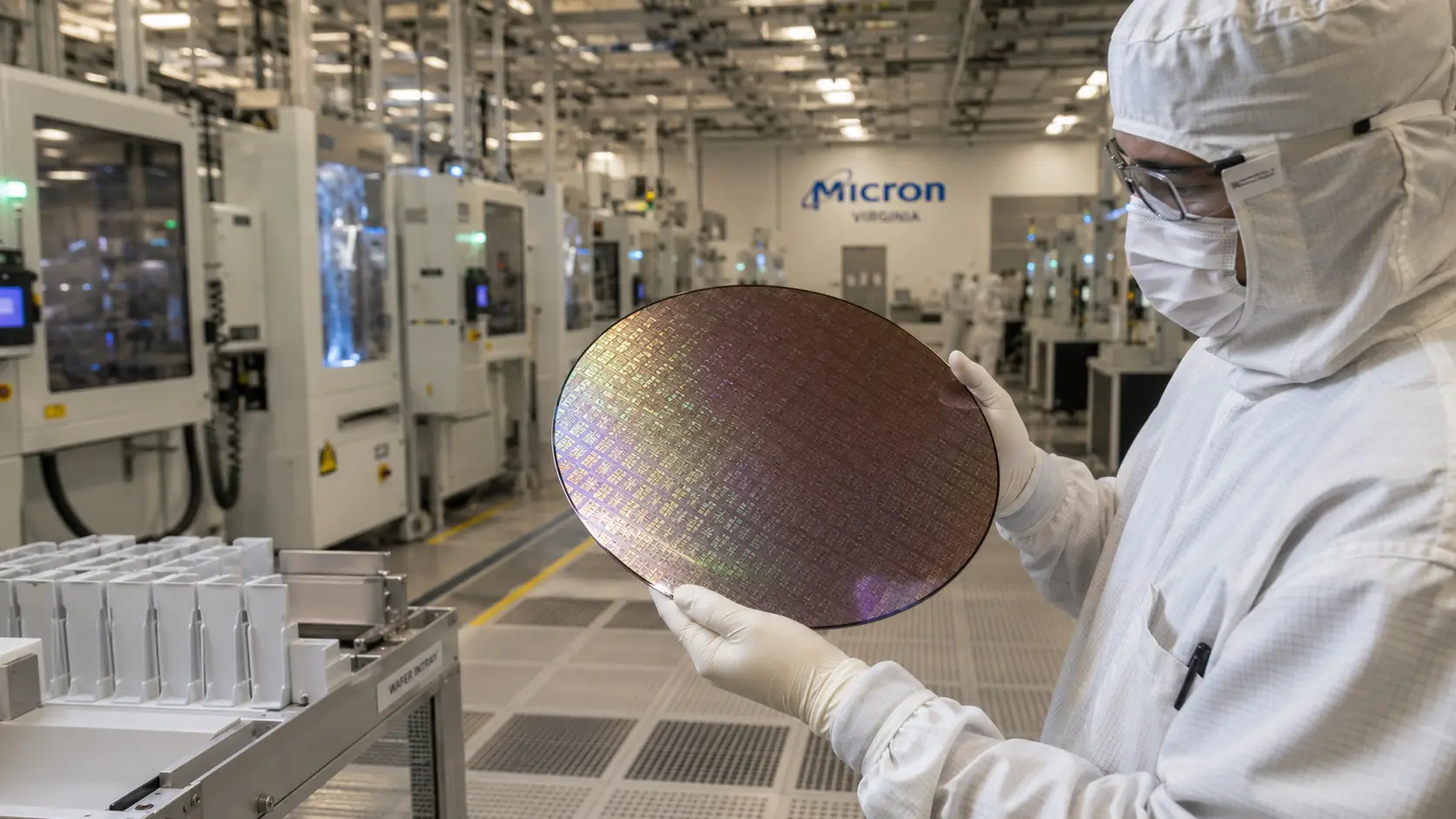
Micron DRAM moved deeper into the center of U.S. industrial policy on May 22 after the company said it had started 1-alpha DRAM wafer manufacturing in Manassas, Virginia, while U.S. Trade Representative Jamieson Greer said no immediate new semiconductor tariffs were expected.
Taken together, the announcements give investors, suppliers and industrial customers a clearer read on Washington’s semiconductor playbook: expand domestic capacity first, then calibrate trade barriers around it. The timing matters because memory is a basic component in cars, industrial systems, communications equipment, defense platforms and the broader computing stack that supports artificial intelligence.
Micron DRAM Turns Manassas Into a Strategic Memory Site
Micron’s announcement was not simply a factory update. The company said its Manassas site has started manufacturing 1-alpha DRAM, which it described as the most advanced memory technology ever produced in the United States. That turns a long-running Virginia expansion into a sharper signal about how memory manufacturing is being pulled into the country’s supply-chain and national-security agenda.
The broader project also has scale behind it. Micron said it has invested more than $2 billion in the expansion and modernization of the Manassas fab, part of an approximately $200 billion U.S. investment plan that also includes new projects in Idaho and New York. The company said the Virginia site supports more than 3,100 direct manufacturing and community jobs.
What Micron DRAM Is Starting to Produce
According to Micron, the Virginia facility has begun 1-alpha DRAM wafer manufacturing intended for long-lifecycle DDR4 and LP4 memory products. Those products are not the highest-profile AI memory category in public markets, where high-bandwidth memory often draws the headlines, but they remain essential to a wide range of industrial and embedded systems that need dependable supply over long product cycles.
Micron said the 1-alpha node is the world’s most advanced DDR4 technology and that the Manassas expansion will quadruple its DDR4 wafer supply at the site. The company added that qualified 1-alpha DRAM production from the fab is expected by the end of calendar 2026, an important distinction for readers watching the difference between the start of manufacturing and the point at which output is fully qualified for customers.
That nuance matters commercially. Automotive, aerospace, defense, medical-device and industrial buyers usually care less about hype and more about reliability, validation timelines and secure sourcing. Micron is positioning the site as a domestic source for those customers at a time when many manufacturers are trying to reduce operational risk in critical components.
Why Manassas Matters to U.S. Supply Chains
The U.S. government has already framed the Manassas project as strategically important. NIST’s CHIPS program materials say the funding attached to the Virginia project is intended to help Micron onshore 1-alpha DRAM technology, which had previously been manufactured only in Asia, while improving supply-chain resilience for automotive and industrial markets and securing critical memory capacity for aerospace and defense.
That gives the Virginia fab an importance that extends beyond Micron’s own production network. Domestic memory capacity is harder to replace quickly than many downstream buyers would like, especially when a component is designed into regulated or mission-critical products. In that context, even so-called legacy or long-lifecycle memory can carry outsized strategic value.
The company is also linking Manassas to a wider domestic build-out. Micron said it broke ground on its New York memory manufacturing complex in January and still expects initial wafer output from its first Idaho fab in mid-2027. The picture emerging is not of a single site, but of a longer effort to rebuild U.S. memory depth across multiple nodes and customer segments.
Chip Tariffs Enter the Micron DRAM Picture
The other reason Friday’s development matters is that it came with a same-day signal from Washington on trade policy. Speaking at the Micron event, Greer said there were no imminent new U.S. tariffs expected on semiconductors, even while arguing that tariffs remain important for helping reshore production.
That combination may look contradictory at first glance, but it points to sequencing rather than retreat. The administration appears to be saying that it still wants trade protection for semiconductors, yet does not want to impose it so abruptly that domestic producers or reshoring projects are disrupted during a build-out phase that still depends on imported inputs and complex global supply chains.
Why Officials Are Delaying Chip Tariffs
Reuters reported that Greer said any tariffs emerging from the U.S. Section 232 national-security investigation into semiconductors needed to be applied with the right timing and in the right amount. He also said the government wanted to avoid hitting companies that are producing semiconductors while they are still in a reshoring phase.
That reflects a practical constraint. The United States is trying to increase semiconductor self-reliance, but the industry still relies on international equipment, materials, specialty components and offshore production links. A blunt tariff move can raise input costs or create new bottlenecks before replacement capacity is actually ready.
The administration’s own argument underscores the gap it is trying to close. Reuters said officials noted in January that the United States fully manufactures only about 10% of the chips it requires. If that assessment is the starting point, then a phased approach to chip tariffs becomes easier to understand even for companies that would prefer clearer long-term rules.
How Micron DRAM Fits the Reshoring Argument
Micron’s Virginia milestone gives policymakers a live example of the manufacturing shift they say they want. Greer used the event to argue that tariff policy is encouraging companies to build on American soil, and Micron’s release leaned into the same logic by tying the site to domestic supply security, workforce expansion and national competitiveness.
Still, the economics are more complicated than a simple tariff story. Micron’s expansion has also depended on direct public support, with U.S. government funding under the CHIPS and Science Act and additional state and local incentives. In other words, the domestic-memory push is being built through a combination of subsidies, industrial planning and trade leverage rather than tariffs alone.
That mix is likely to remain central to the semiconductor policy debate. If Washington keeps tariff threats active while simultaneously underwriting new domestic capacity, companies may interpret that as a durable signal that the government wants more chipmaking, more packaging and more long-term supply-chain localization inside the United States.
Micron DRAM Signals a Broader Memory Bet
For Berrit Media readers, the deeper story is not just one company’s plant milestone. It is that memory has become a more visible strategic layer in the AI and industrial economy. Logic chips usually capture the spotlight, but memory determines how efficiently modern systems store, move and process data across servers, vehicles, factories and defense equipment.
That makes Micron’s Virginia progress relevant beyond the company’s own stock. It offers a window into where policy and capital are converging: not only at the frontier of AI accelerators, but also in the less glamorous component categories that keep advanced systems functioning once the headline chips leave the lab and enter real-world supply chains.
The Link Between Micron DRAM and AI Infrastructure
Reuters noted that DRAM chips sit inside personal computing, cars, industrial operations, wireless communications and AI systems, while Micron said AI-driven demand is reshaping every market it serves. Those two points belong together. Even when a Virginia fab is not producing the flagship high-bandwidth memory used in cutting-edge AI servers, it is still part of the same broader memory economy that has become strategically constrained.
Micron itself drew that connection by describing advanced memory as a strategic asset in the AI era. The company’s argument is that long-lifecycle products made in Manassas complement leading-edge memory work underway in Idaho and New York, allowing Micron to cover both critical industrial uses and the higher-performance segments that matter most to future compute systems.
For customers, that matters because memory bottlenecks can show up in multiple ways. Some buyers need the newest performance profile for AI servers. Others need guaranteed supply of validated components for regulated or safety-critical equipment. A more domestic U.S. memory footprint helps address both concerns, even if not all at once.
What Investors and Customers May Watch Next
The next questions are likely to focus on execution. Investors will want to see whether Micron reaches qualified 1-alpha production on schedule by the end of 2026, how quickly the site ramps useful output, and whether the company’s broader U.S. timeline in Idaho and New York stays on track.
Policy watchers, meanwhile, will be watching for the administration’s next semiconductor trade step. Greer’s remarks suggest tariffs remain on the table, but not immediately. That leaves a window in which manufacturers can expand while import-dependent parts of the ecosystem continue to operate, although the lack of a final tariff structure also preserves uncertainty for planning.
For industrial buyers, the biggest issue may be whether domestic memory supply becomes meaningfully more resilient over the next two years. If Micron’s Virginia build-out, its Idaho fabs and the wider CHIPS-backed push all land close to plan, the U.S. will have a firmer base in a part of the semiconductor stack that has long depended heavily on Asia.
Micron DRAM in Virginia does not settle the debate over tariffs, subsidies or the right shape of semiconductor policy, but it does make one thing clearer: Washington is trying to build trade protection around real manufacturing capacity rather than the other way around. Keep following Berrit Media for more coverage on semiconductors, industrial policy and the businesses reshaping global technology supply chains.
Discover more from Berrit Media
Subscribe to get the latest posts sent to your email.