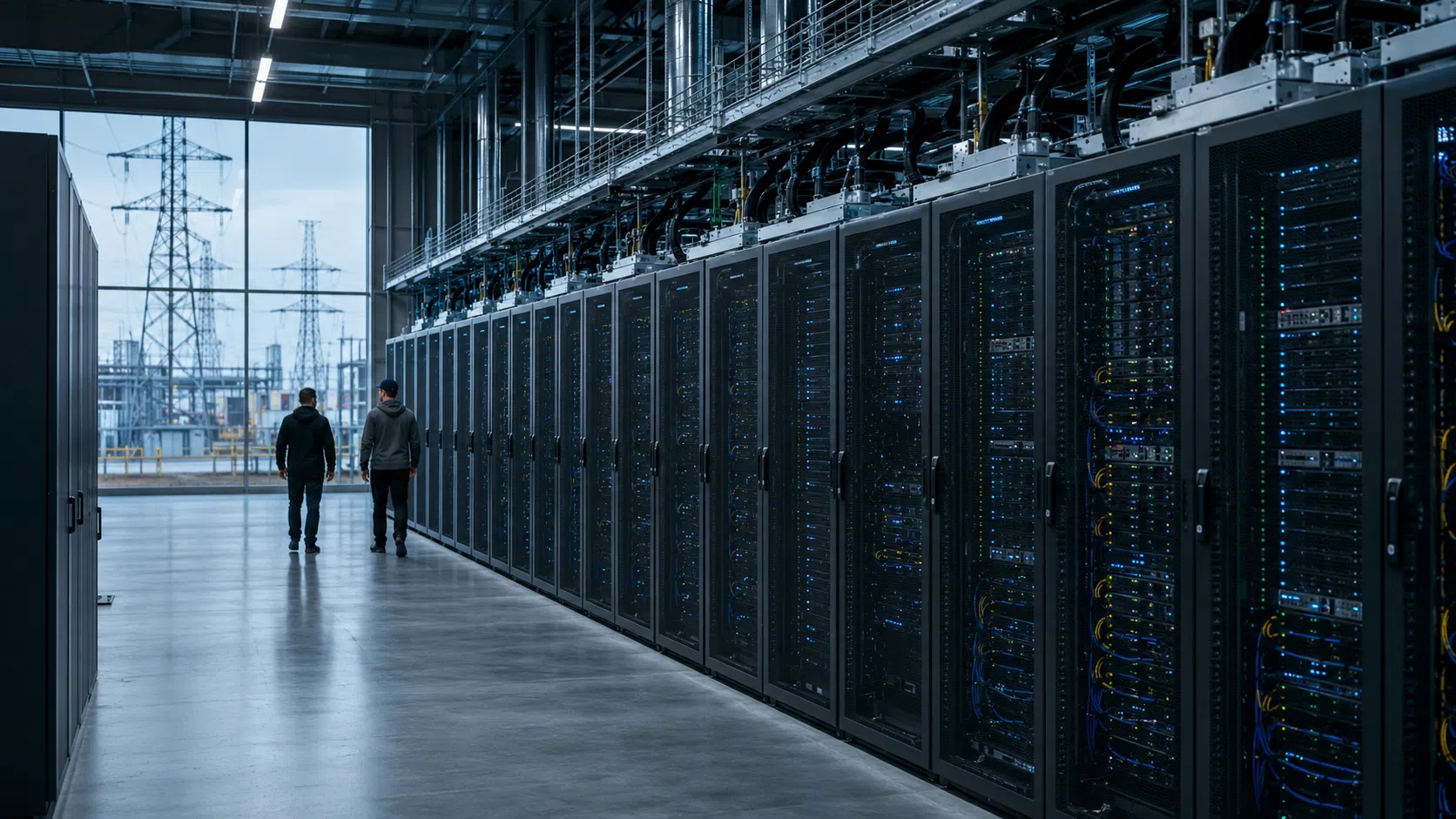
AI compute is becoming the central economic variable of the generative artificial intelligence industry after Anthropic agreed to pay SpaceX up to $1.25 billion a month for access to large-scale data center capacity, according to current reporting tied to SpaceX’s public offering filing. The arrangement turns infrastructure spending into the main lens for understanding how fast leading AI companies can grow and how expensive that growth is becoming.
The significance goes beyond one contract. Anthropic said on May 6 that it had signed a partnership with SpaceX to use all of the compute capacity at the Colossus 1 data center, giving it access to more than 300 megawatts of new capacity and over 220,000 NVIDIA GPUs within the month. Axios then reported on May 20, citing SpaceX’s filing, that the deal calls for payments through May 2029 and can be exited by either side with 90 days’ notice, while Reuters reported Anthropic is nearing its first quarterly operating profit even as its infrastructure commitments keep rising.
Together, those disclosures show that the AI race is entering a phase where the key question is no longer only who has the best model, but who can secure enough power, chips, and financing to keep models available at commercial scale. They also show why investors are starting to treat AI compute as a strategic market in its own right rather than a hidden cost sitting behind the software layer.
AI Compute Becomes a Boardroom Issue
The latest Anthropic disclosures matter because they move AI compute from a technical discussion inside engineering teams into a capital-allocation issue that boards, investors, and regulators can now measure more directly. Once monthly commitments reach into the billions, compute is no longer an invisible input. It becomes a strategic dependency with consequences for margins, product access, and pricing discipline.
That change is especially important for a company like Anthropic, whose products sit at the center of enterprise AI, coding tools, and API usage. As demand rises, the company has to guarantee not only model quality but also reliable throughput. In that environment, AI compute capacity determines whether a popular product can keep serving customers without rationing, outages, or delayed rollouts.
AI Compute Spending Moves Into View
Anthropic’s own May 6 announcement was the first strong signal that the company was willing to make unusually large infrastructure commitments. The company said the SpaceX partnership would substantially increase compute capacity and directly improve availability for Claude Pro and Claude Max subscribers. That was already a meaningful commercial clue, because it linked backend infrastructure directly to consumer and developer access.
The official announcement also placed the SpaceX arrangement alongside several other very large compute commitments. Anthropic said it had an agreement with Amazon for up to 5 gigawatts of capacity, including nearly 1 gigawatt of new capacity by the end of 2026. It also cited a 5 gigawatt agreement with Google and Broadcom beginning in 2027, a strategic partnership with Microsoft and NVIDIA that includes $30 billion of Azure capacity, and a $50 billion investment in American AI infrastructure with Fluidstack.
Those figures show that AI compute has become the operating foundation of the model business. Companies are no longer buying capacity in incremental steps. They are assembling portfolios of long-duration supply deals across hyperscalers, chip ecosystems, and specialized data center operators. In practical terms, that means infrastructure commitments are beginning to look more like industrial procurement programs than traditional cloud budgets.
AI Compute Demand Is Outrunning Simple Cloud Capacity
The SpaceX deal also suggests that standard cloud relationships are no longer enough for the biggest model developers. Anthropic’s decision to add Colossus capacity on top of agreements with Amazon, Google, Broadcom, Microsoft, NVIDIA, and Fluidstack indicates a market where demand is large enough to require multiple parallel supply channels. AI compute is therefore becoming a diversification problem as much as a scaling problem.
That helps explain why the market has moved beyond conventional assumptions about how AI companies will buy infrastructure. Instead of relying on one cloud provider, frontier model developers are spreading commitments across dedicated GPU clusters, partner-designed systems, and purpose-built facilities. The strategic aim is not just lower cost. It is continuity of service when demand spikes and when competitors are chasing the same scarce hardware at the same time.
For customers, that matters because AI compute shortages can translate into rate limits, slower product launches, or higher prices. Anthropic explicitly connected its new SpaceX capacity to higher usage limits for Claude Code and higher API limits for Claude Opus models. That makes the supply story visible at the product layer: compute capacity is now one of the clearest explanations for why AI services expand, tighten, or reprice.
SpaceX Recasts Colossus as a Commercial Infrastructure Asset
The story is equally important for SpaceX. The company has long been understood as a space launch and satellite business with growing communications revenue from Starlink. Yet the Anthropic arrangement shows that SpaceX is also trying to turn large-scale AI infrastructure into a meaningful commercial line of business, using its Colossus assets as revenue-generating platforms rather than internal strategic experiments.
That shift matters because it broadens how investors may value the company. A launch provider with a satellite network is already a rare combination. A company that also sells access to massive AI compute clusters enters a different category, closer to digital infrastructure operators and cloud-adjacent platforms. The public filing disclosures tied to Anthropic suggest SpaceX wants investors to see that optionality clearly.
SpaceX Turns AI Compute Into Contracted Revenue
Axios reported that Anthropic’s payments could reach $1.25 billion a month through May 2029, although either side can terminate the agreement with 90 days’ notice. Even with that caveat, the scale of the disclosed arrangement is unusually large for a compute contract and points to why SpaceX sees AI infrastructure as an attractive business extension. Long-duration enterprise-style commitments can provide more predictable revenue than experimental AI projects that have not yet found paying customers.
Reuters added another important layer by reporting that SpaceX’s filing showed its AI segment lost about $2.5 billion from operations in the March quarter on revenue of $818 million. That context helps explain why a contract like Anthropic’s matters so much. It suggests SpaceX is still absorbing heavy upfront costs as it builds out its AI infrastructure ambitions, and that large customer commitments are essential to justifying those investments.
In that sense, the deal is not just about headline scale. It is about business model conversion. SpaceX appears to be trying to transform compute capacity from a capital-intensive burden into contracted commercial output. If that works, the company gains a new argument for investors: its AI build-out is not simply a cost center, but a platform capable of monetizing demand from rivals, partners, and perhaps other enterprise customers over time.
Colossus Expansion Ties AI Compute to Power and Capex
The official Anthropic announcement described Colossus 1 as delivering more than 300 megawatts of new capacity and more than 220,000 NVIDIA GPUs. Those numbers highlight a deeper truth about AI compute economics. The contest is no longer only about software innovation. It is also about access to electricity, cooling, hardware integration, and the ability to finance large physical systems fast enough to meet demand.
That is why the AI compute story increasingly overlaps with industrial policy and energy planning. Large clusters require not just chips, but land, power delivery, construction timelines, and specialized operations teams. The more frontier AI adoption grows, the more data centers begin to resemble strategic infrastructure projects rather than ordinary corporate IT assets. This is one reason governments have become more active in semiconductor subsidies, export frameworks, and domestic capacity programs.
It also means the economics of AI compute are likely to stay volatile. If clusters scale quickly but customer revenue lags, operators carry heavy fixed costs. If demand remains strong, however, those same assets become bottleneck infrastructure that can command premium pricing. The Anthropic-SpaceX arrangement shows both sides of that equation at once: enormous spending obligations for the buyer, and the possibility of very large recurring revenue for the seller.
What the Deal Says About the Next Phase of the AI Race
The most important takeaway is that AI competition is maturing into a contest over sustainable economics, not only technical leadership. Model companies still need product differentiation, brand strength, and developer adoption. But they also need a credible path to securing enough AI compute without allowing infrastructure costs to overwhelm the revenue generated by subscriptions, APIs, and enterprise deployments.
That is why Reuters’ report that Anthropic is nearing its first quarterly operating profit, citing a person familiar with the matter, drew so much attention alongside the SpaceX disclosure. Profitability and infrastructure scale are usually treated as competing goals in frontier AI. Anthropic’s position suggests the industry may be reaching a stage where very large revenue lines can begin to support very large compute obligations, even if the margin structure remains under pressure.
AI Compute Now Shapes Product Strategy
Anthropic’s May 6 post made clear that new infrastructure was being used to raise limits for Claude Code and improve access for API customers. That is a notable signal because it ties AI compute directly to product design and customer segmentation. Access policies are no longer just pricing decisions. They are ways of allocating scarce infrastructure across power users, enterprises, and the broader customer base.
As more companies follow this path, AI compute will shape how features are launched and how subscriptions are structured. Premium plans may increasingly be defined by guaranteed access to scarce model capacity. Enterprise contracts may place more value on reserved throughput and latency commitments. In that environment, infrastructure reliability becomes a selling point rather than a backstage technical metric.
The same logic could affect competition among model providers. A company with superior AI compute access can sustain higher usage caps, launch heavier reasoning models more confidently, and support more enterprise workloads at once. By contrast, a company with weaker access may still have strong models but struggle to commercialize them at the same pace. That makes compute supply a strategic differentiator in its own right.
AI Compute Concentration Creates New Dependencies
The deal also highlights a risk that is easy to overlook in the excitement around scale. When a small group of AI developers relies on a small group of infrastructure providers, concentration risk rises across the sector. If a large supplier suffers delays, power constraints, or financing stress, the impact can ripple into product availability and customer experience across multiple companies at once.
Anthropic has tried to reduce that risk by building relationships across several major providers, but the overall market remains concentrated around a handful of companies that can secure chips, power, and capital at unusual scale. That can strengthen competitive moats for leaders while making it harder for smaller challengers to reach similar performance levels. In turn, that could shape future antitrust debates, cloud negotiations, and government interest in domestic AI capacity.
For investors and industry observers, the emerging lesson is straightforward. AI compute is no longer a background input buried inside cost of goods sold. It is becoming one of the clearest indicators of who can keep building, serving, and monetizing frontier AI at scale. The Anthropic-SpaceX relationship does not settle that race, but it provides one of the sharpest disclosures yet of what participation now costs.
Anthropic’s expanding AI compute commitments and SpaceX’s attempt to monetize Colossus at scale show how quickly the economics of artificial intelligence are hardening into an infrastructure contest. For more reporting on the companies, policies, and capital flows shaping that contest, continue reading Berrit Media.
Discover more from Berrit Media
Subscribe to get the latest posts sent to your email.