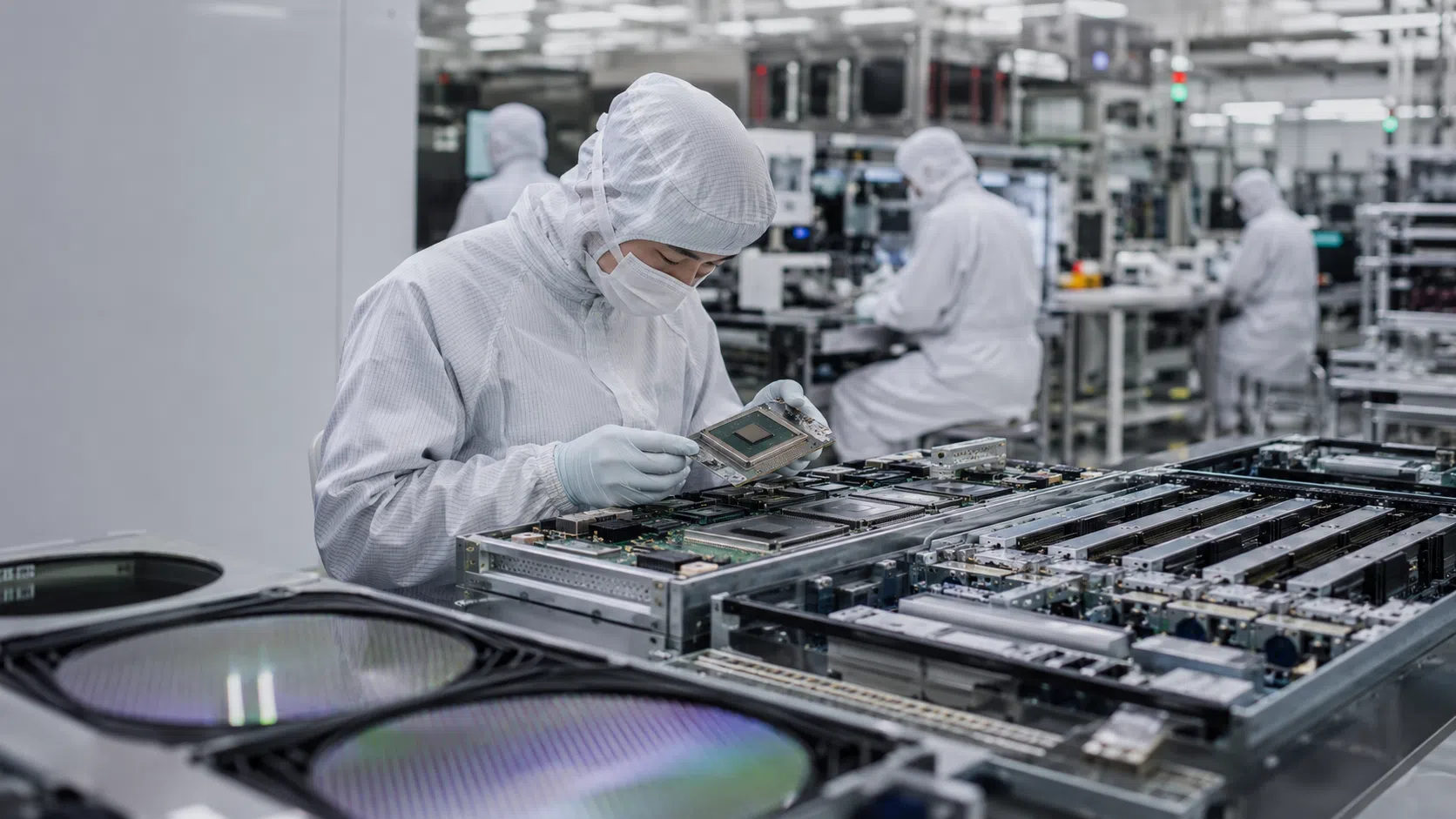
AMD Taiwan investment moved from ambition to execution on May 21 after Advanced Micro Devices said it would commit more than $10 billion across Taiwan’s AI ecosystem, deepen manufacturing partnerships, and widen the capacity behind its next generation of data-center chips. The announcement gave the market a fresh signal that the race for artificial-intelligence infrastructure is increasingly being fought not only through model performance and chip design, but also through packaging, assembly, and the practical ability to ship rack-scale systems in volume.
The company paired that investment announcement with a separate statement that its next-generation EPYC server processor, codenamed Venice, has started ramping production in Taiwan on TSMC’s advanced 2-nanometer process technology. Reuters, citing AMD’s statement, also reported that the company will work with Taiwanese partners including ASE and SPIL to develop more power-efficient technologies for AI systems and processors, reinforcing the idea that this is a supply-chain story as much as a product story.
That combination matters because Taiwan remains the center of gravity for the advanced chip supply chain. For AMD, the spending plan is not simply a regional expansion. It is a bid to lock in the packaging, testing, and system-integration resources required to challenge Nvidia more aggressively as AI customers demand larger, more power-hungry, and more tightly integrated computing clusters.
Why AMD Taiwan Matters Beyond a Headline Number
The headline figure of more than $10 billion is large, but the deeper significance lies in where AMD is placing that money. The company said the investment is aimed at strategic partnerships and advanced packaging manufacturing, both of which have become critical bottlenecks as AI hardware grows more complex and harder to assemble at scale.
In that sense, AMD is responding to a structural change in the chip market. Designing a competitive processor is no longer enough. Companies now need guaranteed access to advanced wafer fabrication, high-bandwidth memory integration, sophisticated packaging, board-level manufacturing, and final rack deployment, all within a timetable customers can actually use.
AMD Taiwan and the Packaging Bottleneck
Packaging has become one of the least glamorous but most decisive parts of the AI boom. The newest AI systems rely on dense interconnects, advanced memory, and tightly engineered thermal and power designs, which means the packaging layer can limit how quickly a chipmaker turns silicon into usable computing systems.
AMD said its Taiwan investment will help expand the ecosystem around next-generation wafer-based 2.5D bridge interconnect technology. According to the company’s announcement, that work is being developed with ASE, SPIL, and other partners to raise interconnect bandwidth and improve power efficiency, two issues that directly affect how much performance customers can extract from a rack within real-world power and cooling limits.
For Berrit Media readers, the business implication is straightforward. If packaging capacity stays scarce, even strong chip demand does not automatically convert into shipped systems and recognized revenue. By investing earlier and more deeply in this layer, AMD is trying to reduce one of the biggest execution risks in the AI supply chain.
AMD Taiwan and the Venice Roadmap
The second pillar of the announcement is timing. AMD’s separate statement on Venice says the processor has entered production ramp in Taiwan on TSMC’s 2-nanometer technology, which the company described as the first high-performance computing product in the industry to do so.
That matters because CPUs still play a central role inside AI infrastructure even when GPUs dominate the headlines. In large data-center clusters, CPUs manage data movement, networking, storage, security, and orchestration. As AI workloads become more distributed and agentic, those control and coordination functions become more important rather than less.
AMD also said it plans a future production ramp at TSMC’s Arizona fabrication facility, suggesting the company is trying to balance Taiwan’s manufacturing advantages with a broader geographic footprint. Even so, the immediate center of gravity remains Taiwan, where the ecosystem depth still gives chipmakers their fastest path from design to volume output.
How the Taiwan Ecosystem Fits Into AMD’s AI Strategy
AMD’s announcement was notable for the number of partners attached to it. Beyond ASE and SPIL, Reuters said the company is also working with partners including PTI, Sanmina, Wiwynn, Wistron, and Inventec, underscoring that the investment is not limited to one factory, one supplier, or one part of the value chain.
That partner list shows AMD is trying to assemble a broader production network around its upcoming AI systems. The goal appears to be less about one-off capacity additions and more about reducing friction across the entire process of packaging, board assembly, system manufacturing, and deployment for customers building large AI clusters.
AMD Taiwan and Its ASE-SPIL Push
Reuters reported that AMD will collaborate with ASE and its unit SPIL to develop more power-efficient technologies for AI systems and processors. That fits neatly with the company’s own emphasis on packaging innovation and on improving the bandwidth and efficiency of the interconnect layer around next-generation products.
ASE is a meaningful partner in this context because advanced packaging and testing have become strategic capabilities rather than back-end commodity services. For AI hardware, the way chips, memory, and substrates are assembled can shape performance-per-watt, system density, and delivery timelines. Those are commercial factors, not just engineering details.
From AMD’s perspective, closer alignment with ASE and SPIL could help narrow one of Nvidia’s practical advantages, which has been its ability to bring integrated systems to market at enormous scale. AMD still needs software and customer momentum, but stronger packaging partnerships can improve the operational side of that contest.
AMD Taiwan and Panel-Based Expansion
AMD also said it achieved a milestone with PTI by qualifying what it described as the industry’s first 2.5D panel-based EFB interconnect. The company presented that as a way to support high-bandwidth interconnect at scale while improving the economics of deploying AI systems.
The significance here is not just technical novelty. Panel-based methods matter because the AI market increasingly rewards suppliers that can manufacture advanced systems in larger volumes without letting cost, yields, or thermal limits spiral out of control. In other words, the winning architecture is the one customers can buy and deploy, not merely the one that looks best in a product keynote.
AMD said these technologies will support its Helios rack-scale platform, which combines Venice CPUs with Instinct MI450X GPUs and is on track for multi-gigawatt deployments beginning in the second half of 2026. That creates a clearer through-line from ecosystem investment to actual system shipments, which is what customers and investors ultimately care about.
What This Means for the Broader AI Chip Market
Reuters noted that analysts and investors see AMD as one of the leading challengers to Nvidia’s dominance in AI chips. The latest announcement does not settle that contest, but it does show where AMD believes the next phase of competition will be won: securing enough advanced manufacturing depth to deliver integrated infrastructure, not just individual chips.
It also shows why Taiwan remains strategically central to the AI economy. Reuters said the island plays a pivotal role in the global AI supply chain, anchored by TSMC. That is true not only for AMD and Nvidia, but also for a wider group of technology companies whose product roadmaps depend on the same constrained ecosystem of foundry, packaging, and hardware manufacturing partners.
AMD Taiwan in the Nvidia Challenge
For several quarters, the market debate around AMD has centered on whether it can convert technical credibility into durable share gains against Nvidia. The Taiwan investment does not answer the software question on its own, but it does address a separate concern: whether AMD can secure the industrial base required to fulfill larger AI commitments.
That point matters because the AI market is moving toward rack-scale and even campus-scale deployments, where customers care about availability, serviceability, power efficiency, and deployment speed as much as benchmark performance. AMD’s emphasis on integrated infrastructure suggests it is trying to compete on the total system rather than just on chip specifications.
If the strategy works, AMD could present itself as a more complete second source for customers that want alternatives in AI infrastructure procurement. If it falls short, the investment will still highlight how difficult it has become for even a major chip company to expand in AI without anchoring itself deeply inside Taiwan’s manufacturing network.
AMD Taiwan and Geographic Risk
The announcement also carries a geopolitical subtext. By confirming that Venice is ramping in Taiwan while also pointing to future plans in Arizona, AMD is acknowledging both the irreplaceable value of Taiwan’s ecosystem and the growing pressure to diversify advanced manufacturing geographically.
That does not mean Taiwan is losing strategic relevance. If anything, the opposite is true. The immediate production ramp, the packaging investment, and the partner network all show that the fastest path to AI hardware scale still runs through Taiwan, even as U.S. and allied governments push for more domestic capacity.
For markets, the takeaway is that supply-chain resilience in AI remains a matter of concentration management rather than rapid relocation. AMD is broadening its footprint at the margins, but its latest move makes clear that Taiwan still sits at the center of next-generation compute manufacturing. Readers can continue following related technology and semiconductor coverage at Berrit Media.
Discover more from Berrit Media
Subscribe to get the latest posts sent to your email.