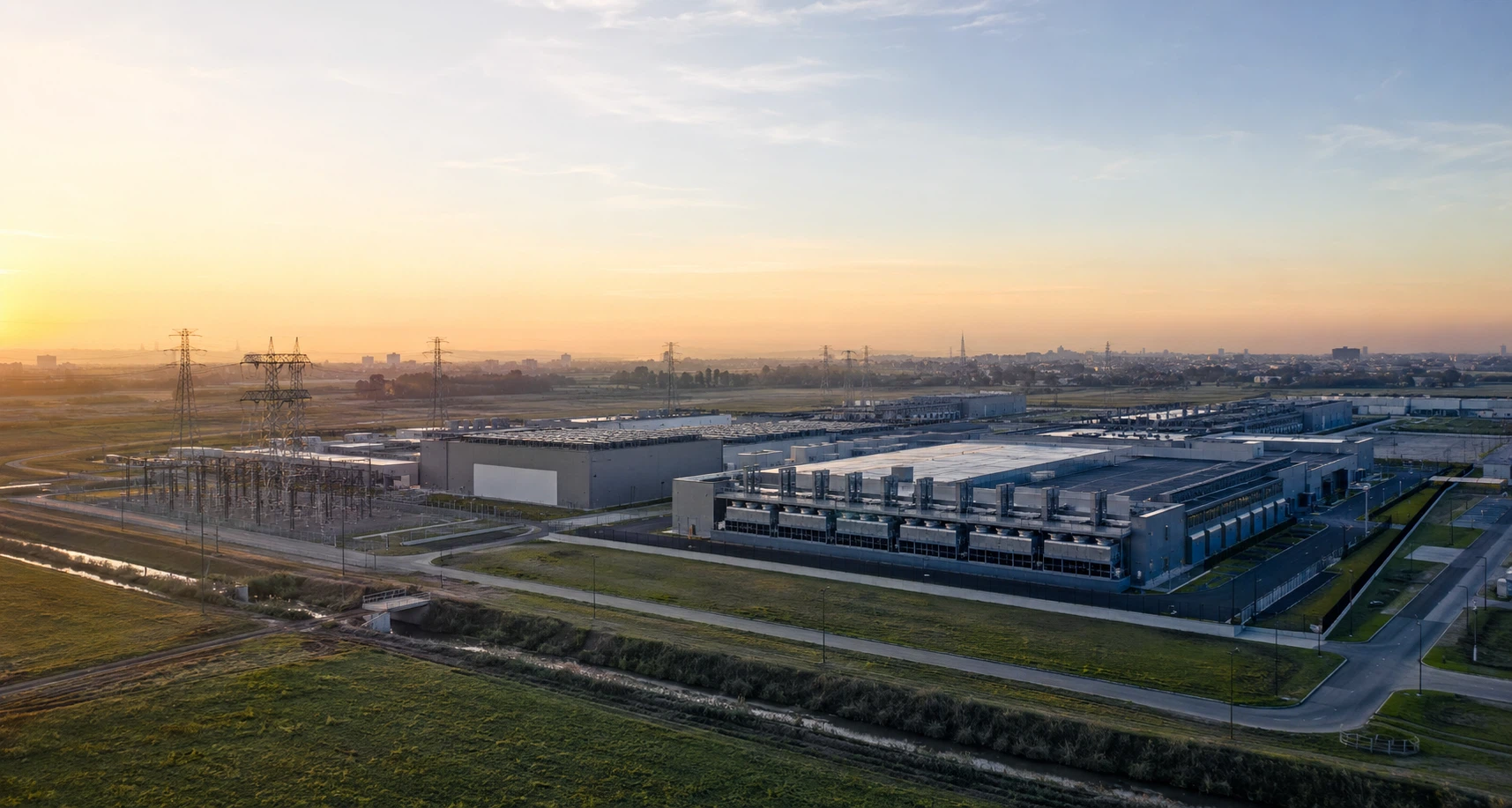
EdgeConneX Italy has moved to the center of Rome’s digital-industrial strategy after the Italian government granted strategic national interest status to a major Lombardy data center program tied to artificial intelligence capacity, permitting speed, and foreign investment. The decision gives the project a higher-priority route through the Italian system at a moment when European governments are trying to attract the next wave of AI infrastructure without losing years to fragmented approvals.
According to a statement cited by Reuters from Prime Minister Giorgia Meloni’s office, the project involves about 3 billion euros of direct investment to build three data center campuses in Lombardy by 2031, with more than 300 megawatts of capacity and an expected 5 billion euros in additional indirect investment. Separate statements from Industry Minister Adolfo Urso’s office described a broader 6 billion euro value for three new facilities in the Lodi area and south of Milan, showing that Italian officials are emphasizing not only the direct capital outlay but also the wider industrial footprint around the buildout.
The distinction matters because the story is not simply about another server farm announcement. It is about whether Italy can turn AI-era infrastructure demand into a nationally coordinated investment program, with faster authorizations, stronger grid and energy planning, and a clearer pitch to multinational operators that need scale in Europe.
Why EdgeConneX Italy Matters for Europe’s AI Capacity
The EdgeConneX Italy project arrives as Europe faces a practical question that now sits behind nearly every major AI strategy: where will the compute actually run, and how quickly can capacity be added? Governments can promote AI research, software ecosystems, and semiconductor diplomacy, but large-model deployment ultimately depends on power, cooling, land, networking, and permitting discipline.
That is why the Italian cabinet’s strategic designation stands out. Rather than treating data centers as a routine local planning matter, Rome is signaling that compute infrastructure deserves the same national attention once reserved for transport, energy, or heavy industry projects with long economic tails.
Strategic status changes the permitting equation
Italian market reports summarizing the cabinet decision said the program was declared of strategic national interest under Article 13 of a 2023 decree designed for large foreign investments. That framework allows the government to appoint an extraordinary commissioner, working with the region, to coordinate the process and issue a unified authorization when necessary.
For operators, that matters as much as the headline investment number. Large data center campuses often stumble not because demand disappears, but because environmental reviews, municipal coordination, transmission planning, water questions, and construction sequencing do not move at the same pace.
If the Italian process works as described, EdgeConneX Italy could become a demonstration case for how European governments accelerate digital infrastructure without abandoning oversight. If it bogs down, the episode would reinforce a familiar market concern that Europe talks faster about AI than it builds for AI.
Capacity and capital are meaningful at national scale
The capacity figure also gives the announcement weight. More than 300 megawatts across three campuses is large enough to matter in regional infrastructure planning, especially when one of the sites, according to Urso’s ministry, is intended to support AI-related development and processing and could rank among the biggest in Europe.
The direct and indirect investment totals suggest a broader ecosystem effect. Reuters cited the prime minister’s office saying the campuses could catalyze an additional 5 billion euros of indirect investment, while the ministry framed the total value more expansively, pointing to the industrial activity that tends to follow major digital nodes.
That does not mean every euro will arrive at once or on the original timeline. However, it does show why governments increasingly view hyperscale and AI-focused campuses as magnets for contractors, energy upgrades, cloud tenants, fiber routes, and downstream enterprise activity rather than as isolated real-estate projects.
Italy Uses EdgeConneX Italy to Signal a Data Center Push
Rome is also using the announcement to tell a wider story about Italy’s place in the European technology map. Urso’s ministry said the country had already recorded more than 7 billion euros of data center investment between 2023 and 2025 and that a further 25 billion euros had been announced for 2026 through 2028.
Those figures do not guarantee execution, but they show how policymakers want investors to read the moment. Italy is trying to present itself not as a peripheral market for digital infrastructure, but as a serious destination for AI-era capacity tied to industrial demand, enterprise workloads, and cross-border connectivity.
Government policy is reaching beyond promotion
The cabinet’s decision suggests that Italy wants to move beyond generic investment promotion and into active project facilitation. By elevating EdgeConneX Italy to a strategic file, the government is effectively saying that time-to-permit is now part of national competitiveness.
That approach aligns with a broader shift across Europe, where countries are balancing data sovereignty goals, energy constraints, and AI adoption targets. Winning data center investment is no longer only about tax or location advantages; it is also about whether public institutions can coordinate grid access, land approvals, and infrastructure sequencing at the speed global operators expect.
In that sense, Italy is trying to compete on state capacity as much as on geography. The market implication is straightforward: countries that can reduce uncertainty around approvals may capture a larger share of AI infrastructure capital even when electricity and construction costs remain high.
The project will test Italy’s delivery discipline
Official summaries of the cabinet decision said work is expected to start in the third quarter of 2026 and continue on a schedule running to 2031. That creates a long execution window in which policy credibility will be measured by actual progress on the ground, not just by the initial announcement.
Employment targets help explain the political appeal. Italian reports tied to the decision said the project could support roughly 1,500 annual construction workers and about 300 direct jobs once the campuses are operating, giving the government a tangible regional-development argument alongside the technology narrative.
Yet execution risk remains real. AI infrastructure projects face pressure from electricity pricing, substation timing, equipment lead times, local opposition, and the possibility that demand forecasts shift as model efficiency improves. Strategic status can shorten bottlenecks, but it cannot erase those underlying operating constraints.
What Investors Should Watch in EdgeConneX Italy
For investors and industry executives, the most interesting part of EdgeConneX Italy may be what it reveals about the next phase of digital infrastructure competition. The sector is moving from headline enthusiasm to a more operational test in which land, power, and government coordination determine which markets convert AI demand into durable assets.
That makes this story relevant beyond Italy. If Rome can bring a multibillion-euro, AI-linked campus program through approvals and into construction on time, it will strengthen the case that second-wave European markets can still win capacity despite fierce competition from more established hubs.
Execution will matter as much as the announcement
Investors should watch whether the government quickly names the extraordinary commissioner referenced in Italian reporting and whether the promised unified-authorization pathway genuinely reduces friction. Those details will show whether the strategic designation is mostly symbolic or whether it changes project economics in practice.
They should also watch how consistently officials describe the size of the investment. The Reuters account based on the prime minister’s office pointed to roughly 3 billion euros of direct spending, while Urso’s ministry referred to a 6 billion euro overall value. The gap is not necessarily contradictory, but it does underline the need to separate direct capex from wider economic spillovers when assessing the real scale.
For Berrit Media readers, that distinction is central. In AI infrastructure, the biggest numbers often mix construction budgets, ecosystem benefits, tenant spending, and multiplier effects. Serious analysis requires keeping those layers apart instead of treating every government headline figure as the same kind of capital commitment.
Energy, timelines and customer demand will define returns
The other variables are more physical than financial. Can the campuses secure enough power on schedule, especially if one site is meant to support high-intensity AI processing? Can the sustainability promises cited by Urso’s office be translated into a workable energy model rather than a policy slogan?
Customer demand is another watchpoint. A 300-plus-megawatt platform is substantial, but returns depend on how quickly cloud, colocation, and AI customers absorb that capacity. In a market where operators are racing to build, utilization and tenant mix can matter as much as the speed of groundbreaking.
Still, the broader direction is clear. Italy is trying to turn data centers from a narrow real-estate story into a national technology and industrial-policy story, and EdgeConneX Italy is now the clearest live test of whether that strategy can hold under real execution pressure.
For now, the project gives Italy a credible AI infrastructure signal, but the harder part starts after the announcement. Readers can follow how this buildout, and others like it, reshape the technology and investment landscape in Berrit Media’s related coverage.
Discover more from Berrit Media
Subscribe to get the latest posts sent to your email.