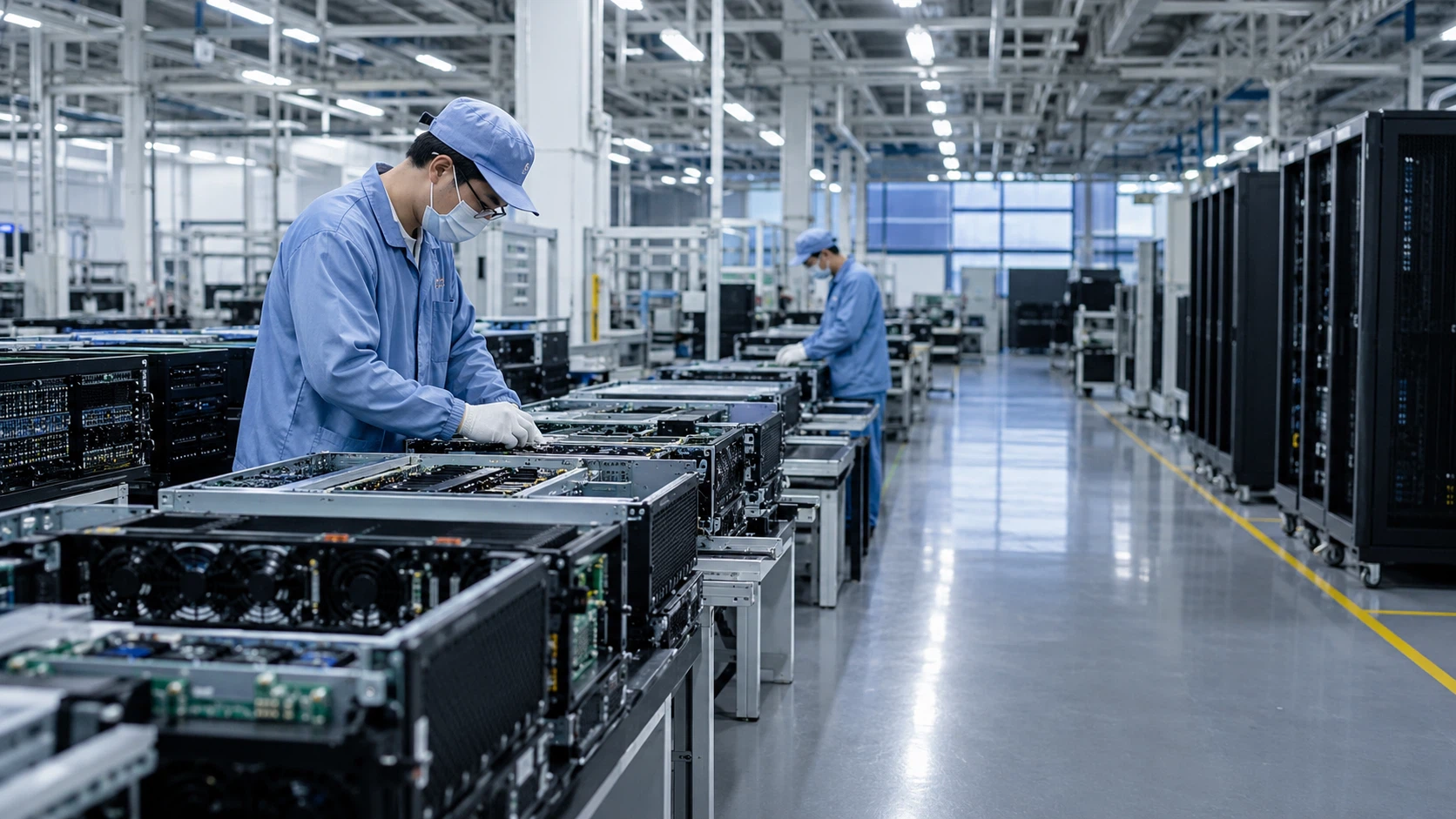
Foxconn AI demand helped lift first-quarter profit above market expectations, giving the world’s largest contract electronics manufacturer a fresh signal that the AI infrastructure boom is moving beyond chip designers and deeper into the companies that actually assemble systems at scale.
Hon Hai Precision Industry, better known globally as Foxconn, reported net profit of NT$49.92 billion for the January-to-March period, while quarterly revenue reached NT$2.12 trillion. The company kept its outlook for strong revenue growth this year and said demand for AI servers remains robust even as broader electronics cycles stay mixed.
The result matters beyond one quarter of earnings. Foxconn sits at a crucial intersection of the technology supply chain, serving as Apple’s main iPhone assembler while also building servers and racks for the AI data center buildout. That gives its results unusual value as a readout on where demand is actually strengthening and where executives are willing to keep investing.
Foxconn AI Growth Is Changing the Earnings Story
For years, Foxconn was most commonly discussed through the lens of consumer electronics and low-margin assembly. That framing is becoming less complete as cloud and networking systems take a bigger share of the business and as AI hardware turns into a more durable spending category.
Management’s latest commentary suggests the company no longer sees AI as a useful side business. Instead, it is treating the segment as the main engine of growth for 2026, with capital allocation, factory geography and product mix increasingly organized around that reality.
Why Foxconn AI Demand Beat Estimates
Foxconn’s first-quarter net profit of NT$49.92 billion came in above the LSEG consensus estimate cited by Reuters, which stood at NT$48.88 billion. The company linked that performance to strong global demand for AI products, especially in cloud and networking lines tied to server deployments.
Executives also reiterated that AI remains the company’s most important growth driver this year. That language matters because Foxconn does not usually present itself as a high-drama story stock. When management leans this clearly into one demand trend, it usually reflects a strong order picture from major customers rather than a marketing flourish.
The company’s quarterly revenue base also reinforces that point. At more than NT$2.1 trillion for the quarter, Foxconn is operating at a scale where shifts in mix are meaningful. A stronger AI contribution at that size suggests enterprise and hyperscale spending is beginning to change the economics of manufacturing, not just the narrative around semiconductors.
Cloud and Networking Move Toward the Center
At the investor conference, Foxconn said its cloud and networking division accounted for 48 percent of first-quarter sales. That is a notable figure for a company long associated with smartphones and consumer devices, because it shows infrastructure products are now nearly half of the revenue story.
Management added that AI servers made up more than 50 percent of total server revenue in the quarter. In practical terms, that means the AI wave is no longer limited to prototype systems or selective customer pilots. It is large enough to reshape the product mix inside one of the world’s biggest electronics manufacturers.
The shift also changes how investors and industry partners should read Foxconn. The company is still central to consumer hardware, but its earnings are increasingly tied to cloud buildouts, custom AI systems and data center ordering patterns. That makes it a manufacturing proxy for broader AI capital expenditure rather than only an Apple supply-chain stock.
Capacity Plans Follow the Orders
Foxconn’s message was not only about what already happened in the quarter. It also offered a roadmap for how management plans to scale around AI demand, and that roadmap points to higher spending, more regional production and a larger physical footprint for server manufacturing.
Those plans are important because supply-chain confidence is often revealed through capex more clearly than through slogans. Companies can praise AI all day, but when they commit more cash to plants, automation and component capacity, they are signaling that customer demand looks durable enough to justify the investment.
Foxconn AI Servers Are Driving Higher Capex
Foxconn said capital expenditure is set to rise by more than 30 percent in 2026, after Reuters reported the company expects spending to climb from last year’s NT$174 billion. Management said the increase will go toward regional production, automation and strengthening core manufacturing capacity.
The same investor conference also reaffirmed that AI server rack shipments should more than double for the full year, with second-quarter growth expected at a high double-digit pace. Those are ambitious targets, but they line up with management’s argument that AI is a structural industry shift rather than a short-lived procurement cycle.
Foxconn added that demand remains strong for both GPU-based servers and ASIC-based systems built around custom chips designed by major cloud providers. That is a useful detail because it shows the opportunity is broadening across multiple AI computing architectures instead of depending on a single product category.
Production Geography Is Tilting Toward North America
Foxconn said the United States and Mexico will continue to serve as AI server production hubs as North American demand stays strong. Reuters separately reported that the company is building factories in Mexico and Texas to make AI servers for Nvidia, adding another layer to that regional shift.
The geographic point matters because AI infrastructure is increasingly shaped by policy, logistics and customer preference, not only labor costs. Building closer to end customers can shorten delivery cycles, reduce trade friction and help hyperscale buyers secure capacity in a market where lead times still matter.
Foxconn’s broader manufacturing map also shows how the company is splitting product categories across regions. Most iPhones sold in the United States are now assembled in India, according to Reuters, while AI server production is being emphasized in North America. That is a sign of a more diversified supply-chain strategy rather than a single-country manufacturing model.
The Supply Chain Signal Extends Beyond Foxconn
Foxconn’s quarter is worth watching not just because of its size, but because it offers a rare operational window into the hardware layer underneath the AI race. Chipmakers often capture the headlines, yet the physical buildout also depends on contract manufacturers, cooling systems, rack integration and data center deployment schedules.
In that sense, Foxconn’s results help confirm that AI spending is spreading through more of the stack. Profitability is still modest by software or semiconductor standards, but the order flow and capacity plans suggest the infrastructure cycle is becoming broader and more industrial.
Foxconn AI Momentum Reaches Beyond iPhones
Foxconn has spent years trying to prove it could become more than the world’s best-known device assembler. The latest quarter suggests that transition is gaining traction because AI servers, cloud hardware and related infrastructure are now big enough to influence both earnings and long-term strategy.
That does not mean consumer electronics have stopped mattering. New product launches still supported smart consumer electronics growth, and Foxconn remains deeply tied to Apple. However, the fastest strategic momentum now appears to be coming from enterprise and cloud customers that are expanding AI capacity.
Focus Taiwan reported that Foxconn currently holds roughly 40 percent of the global AI server market. Even if that share changes over time, the figure underlines how central the company has become to the infrastructure side of the AI economy. For B2B readers, that makes Foxconn a useful bellwether for how quickly AI budgets are translating into physical deployments.
Risks Still Sit Beside the Opportunity
The quarter was strong, but the company did not present the year as risk-free. Management said global political and economic volatility still needs close monitoring, while Reuters reported that Foxconn also flagged geopolitical developments, supply-chain adjustments and raw-material cost swings as potential headwinds.
There are also execution questions inside the growth story. Foxconn said some cloud and networking products, especially ASIC servers, are shifting to a consignment model in which customers provide key components directly. That may reduce working-capital strain in some cases, but it also changes how revenue mix and margins should be interpreted.
Investors have already shown some caution. Reuters noted that Foxconn shares have risen only 6 percent so far this year, well behind the broader Taiwan index. That suggests the market still wants proof that bigger AI volumes can translate into sustained margin improvement, not just higher revenue and heavier capital spending.
Foxconn’s latest quarter does not settle every debate about who will capture the most value from the AI boom, but it does show that manufacturing scale, server integration and regional capacity are becoming more important to the story. Readers can continue following Berrit Media for more reporting on AI infrastructure, supply chains and the business shifts shaping global technology.
Discover more from Berrit Media
Subscribe to get the latest posts sent to your email.