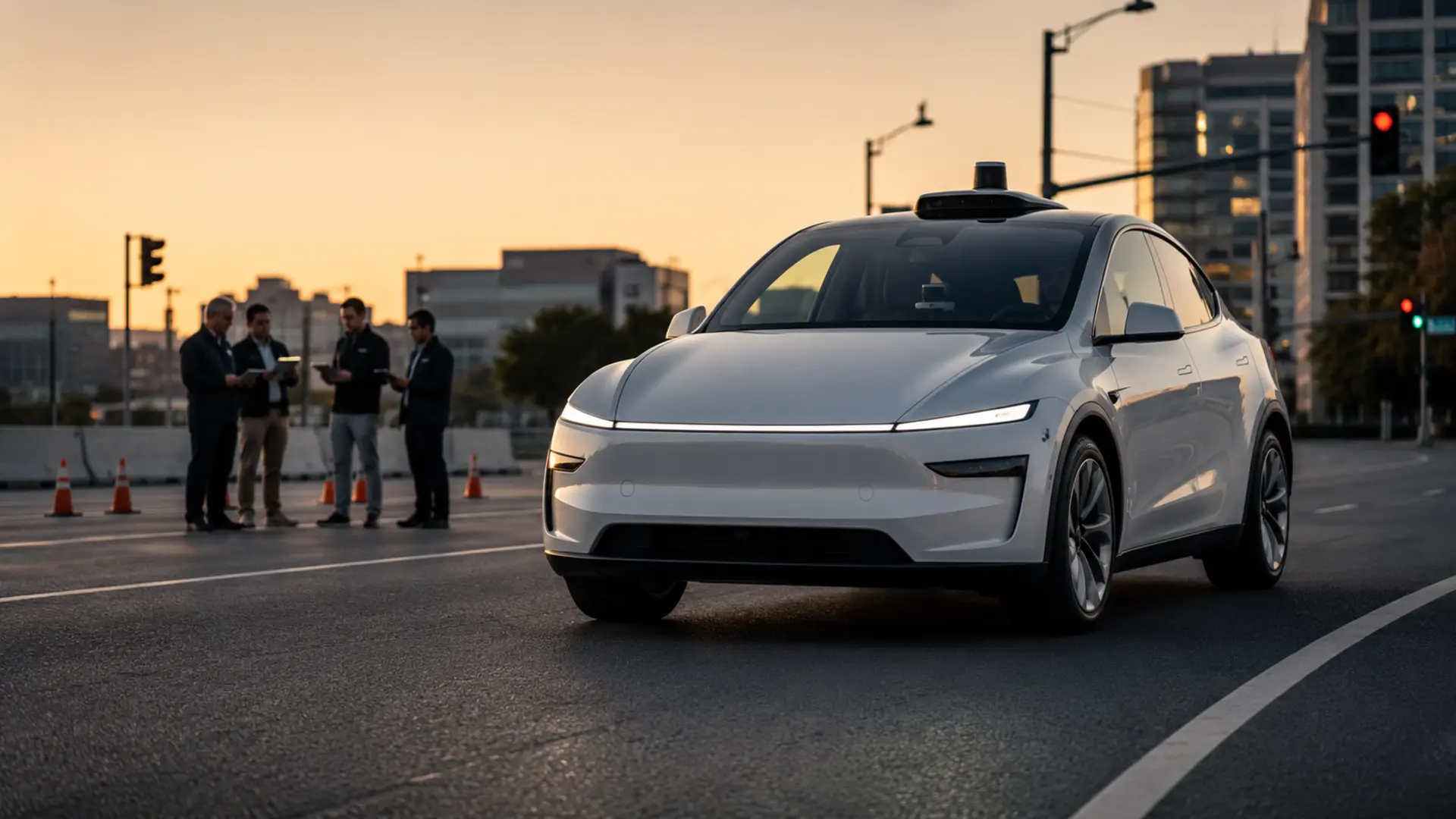
FSD safety claims are facing a sharper credibility test after a Reuters investigation questioned how Tesla compares crash data for its driver-assistance system with broader U.S. road-safety benchmarks, adding a new layer of scrutiny to one of the company’s most important technology narratives.
The issue matters beyond a dispute over statistics. Tesla has tied its long-term valuation story to software-led autonomy, robotaxi deployment and the possibility that millions of existing vehicles could become more capable through updates. If the public safety case for Full Self-Driving, or FSD, is seen as overstated, the company faces not only regulatory pressure but also a harder task convincing investors, customers and policymakers that its approach can scale safely.
FSD Safety Claims Meet A Harder Evidence Test
Reuters reported on May 28 that its examination of Tesla’s safety methodology, interviews with former Tesla data labelers and input from traffic-safety researchers raised questions about whether the company’s public claims provide a fair comparison with human driving. The investigation said Tesla did not respond to detailed questions for the report.
Tesla’s own safety page says its Vehicle Safety Report relies on vehicle telemetry, including collision-related event data, miles driven and driving mode. The company says FSD (Supervised) requires active driver supervision and does not make the vehicle autonomous, but executives have also promoted the system as dramatically safer than ordinary driving.
FSD Safety Depends On The Comparison
The central question is not whether Tesla collects large amounts of real-world driving data. It does. Tesla says its connected fleet sends extensive telemetry, and the company argues that this gives it a more direct view of crash events than automakers that rely more heavily on customer reports, insurance claims or later investigations.
The harder question is whether the data are being compared with the right external baseline. Reuters reported that researchers reviewing Tesla’s method objected to comparing airbag-deployment crashes in Tesla vehicles against broader federal crash categories that include less severe incidents. That type of mismatch can make a technology appear safer than it would under an apples-to-apples comparison.
Tesla’s safety page explains that it distinguishes major collisions, where airbags or other non-reversible restraint systems deploy, from lower-severity collisions. It also says its U.S. average baseline uses federal sources including the Federal Highway Administration and National Highway Traffic Safety Administration databases. Tesla acknowledges that those comparisons involve assumptions because the public datasets and its internal telemetry are not directly equivalent.
Internal Views Add Pressure To The Numbers
Reuters also reported that former data labelers, whose work involved reviewing footage from Tesla vehicles using FSD, described repeated failures in areas such as emergency-vehicle response, construction zones, motorcyclist clearance and some pedestrian scenarios. Reuters said the account came from former workers’ descriptions of footage they viewed, not from Reuters reviewing the video itself.
That distinction is important for editorial discipline. The former employees’ accounts are not the same as a public crash database or a completed regulatory finding. Even so, they are newsworthy because they come from workers who were close to the system’s training process and because they speak directly to Tesla’s claim that its technology is approaching broad autonomous capability.
The report also said some staff worked intensively on routes and hazards before public demonstrations or robotaxi launches. If accurate, that would complicate Tesla’s long-running message that its camera-and-AI approach can scale faster than systems that depend on detailed local mapping. A limited robotaxi zone can look impressive while still leaving unanswered questions about national or global deployment.
Regulatory Scrutiny Already Surrounds Tesla FSD
The Reuters investigation lands while U.S. regulators are already examining Tesla’s driver-assistance systems. NHTSA materials show an active probe into traffic-safety violations involving vehicles operating with FSD engaged, including red-light incidents and wrong-way or opposing-lane behavior.
In its investigation resume, NHTSA describes FSD as a Level 2 partial automation system, meaning the driver remains responsible for supervision and intervention. That framing is critical: Tesla markets the system as Full Self-Driving, but regulators evaluate it as a driver-assistance feature that must leave enough time and clarity for a human driver to respond.
FSD Safety Questions Over Red Lights And Lanes
NHTSA’s October 2025 investigation into FSD traffic violations identified reports involving vehicles proceeding into intersections against red traffic signals. The agency also described complaints and reports involving vehicles entering opposing lanes, crossing double-yellow markings or moving in the wrong direction after turns.
The agency said its review would assess whether drivers received adequate warning or enough time to intervene when unexpected behavior occurred. That goes to the heart of supervised automation. A system can legally require driver oversight, but if it acts suddenly or unpredictably, supervision becomes harder in practice.
NHTSA’s materials also noted crashes and injuries in some reported red-light scenarios. Those documents do not settle the broader safety debate, but they show why regulators are unlikely to treat public crash-rate claims as sufficient on their own. For a system used on public roads, the operational details matter: detection, warning timing, lane interpretation, traffic-signal handling and driver takeover windows.
Tesla’s Own Methodology Creates A Policy Debate
Tesla’s safety methodology states that if FSD was active within five seconds before a collision, the event counts as FSD engaged for reporting purposes. The company says that window captures cases where a driver disengages or the system aborts shortly before impact.
Regulatory crash-reporting rules can use different windows. NHTSA’s Standing General Order for certain automated-driving and advanced driver-assistance crash reporting looks at whether an ADS or ADAS feature was engaged within 30 seconds before a crash, among other criteria. That difference can affect how incidents are counted and interpreted.
Tesla says airbag deployments are a reliable proxy for severity and that its telemetry allows objective measurement across millions of vehicles. NHTSA, in a separate Autopilot investigation closing document, has noted that airbag or pyrotechnic deployments represent only a minority of police-reported crashes. That means investors and policymakers need to understand exactly what each statistic includes before using it to judge safety performance.
Investor Expectations Now Face A Credibility Test
For Tesla, the FSD debate is also a capital-market issue. The company’s stock-market story has long included expectations that autonomy could transform margins, create recurring software revenue and open a robotaxi business with economics far beyond vehicle sales.
That makes the safety narrative central to valuation. Investors are not only buying current electric-vehicle deliveries or energy storage growth; many are also pricing in a future where Tesla software turns vehicles into higher-value autonomous assets. Any credible challenge to the safety evidence behind that future can change how the market discounts the opportunity.
FSD Safety Is Now Part Of The Valuation Debate
Reuters described autonomous driving as a central promise underpinning Tesla’s market value. That is a fair framing because the company’s most ambitious forecasts depend on scale, trust and regulatory permission, not only on improved driver-assistance performance.
If FSD remains a supervised system, the revenue opportunity is different from a fully autonomous robotaxi network. A paid driver-assistance product can still be valuable, especially if customers perceive it as useful. But a robotaxi platform requires a higher evidentiary threshold, more predictable performance and a regulatory framework that allows driverless operation in many jurisdictions.
That gap between supervised convenience and autonomous commercial deployment is where the current scrutiny becomes market-moving. Investors must decide whether Tesla’s progress is evidence of an approaching platform shift or evidence that the system still depends on drivers, route preparation and carefully managed deployment zones.
Rivals And Regulators May Benefit From Tighter Standards
The debate also matters for autonomous-driving competitors. Companies such as Waymo have pursued more constrained deployment models, often relying on detailed operational design domains, mapped service areas and extensive validation before expansion. Tesla has argued that its fleet, cameras and AI model can scale more broadly.
If regulators demand clearer methodology, more comparable safety reporting or stronger disclosure around driver-assistance claims, Tesla may have to provide more granular evidence. That could help investors compare different autonomy strategies more rigorously, rather than relying on headline crash-rate claims that may not measure the same thing.
For the wider industry, the likely direction is more transparency. Autonomous systems are no longer experimental curiosities; they are entering consumer products, ride-hailing pilots and insurance-risk models. Public confidence will depend on safety reporting that is understandable, comparable and resistant to marketing spin.
The Broader Business Risk For Tesla
The immediate impact of the Reuters report is reputational. It gives regulators, plaintiff lawyers, safety advocates and skeptical investors a fresh set of questions about Tesla’s FSD evidence base. It also gives competitors a clearer way to argue that autonomy should be judged by verified operating performance, not fleet scale alone.
The longer-term impact depends on Tesla’s response. The company could seek to strengthen its reporting, add more third-party validation, publish clearer breakdowns by road type and driving condition, or maintain that its existing telemetry-based approach already shows meaningful safety gains. Each path carries trade-offs.
What Tesla Can Still Prove
Tesla has advantages that few rivals can match. Its fleet is large, connected and widely distributed. Its vehicles can collect data from real-world driving at scale, and software updates can improve performance after sale. Those strengths are real and remain strategically important.
The company can also argue that FSD is improving over time and that crash statistics should be viewed dynamically rather than as a fixed verdict. A system that is not yet fully autonomous could still reduce certain types of crashes if used properly under supervision. That possibility is why the debate should not collapse into a simple claim that the technology is either safe or unsafe in every context.
But Tesla now faces a higher burden of proof. If it wants regulators and investors to accept broad claims about FSD safety, it will need comparisons that are clean enough for outside experts to evaluate. The market will increasingly ask not only whether FSD can drive well in many conditions, but whether Tesla can prove that performance with transparent and comparable evidence.
Why The Next Phase Matters
The next phase of the story will turn on three things: regulatory findings, Tesla’s own disclosures and the real-world pace of robotaxi expansion. A limited launch with careful oversight may not answer the scaling question. A broader launch without stronger evidence may invite a tougher regulatory response.
For customers, the practical issue is simpler. Tesla’s own materials say FSD (Supervised) requires active driver supervision and does not make the car autonomous. That warning remains essential, especially if drivers become more comfortable with the system as performance improves.
For investors, the question is whether Tesla can turn a driver-assistance product into a validated autonomy platform without losing credibility along the way. The Reuters investigation does not end that debate, but it makes the evidence standard harder to ignore.
Tesla’s FSD safety claims now sit at the intersection of technology performance, regulatory oversight and market valuation. Readers can continue following related coverage on autonomous vehicles, AI governance and technology strategy at Berrit Media.
Discover more from Berrit Media
Subscribe to get the latest posts sent to your email.