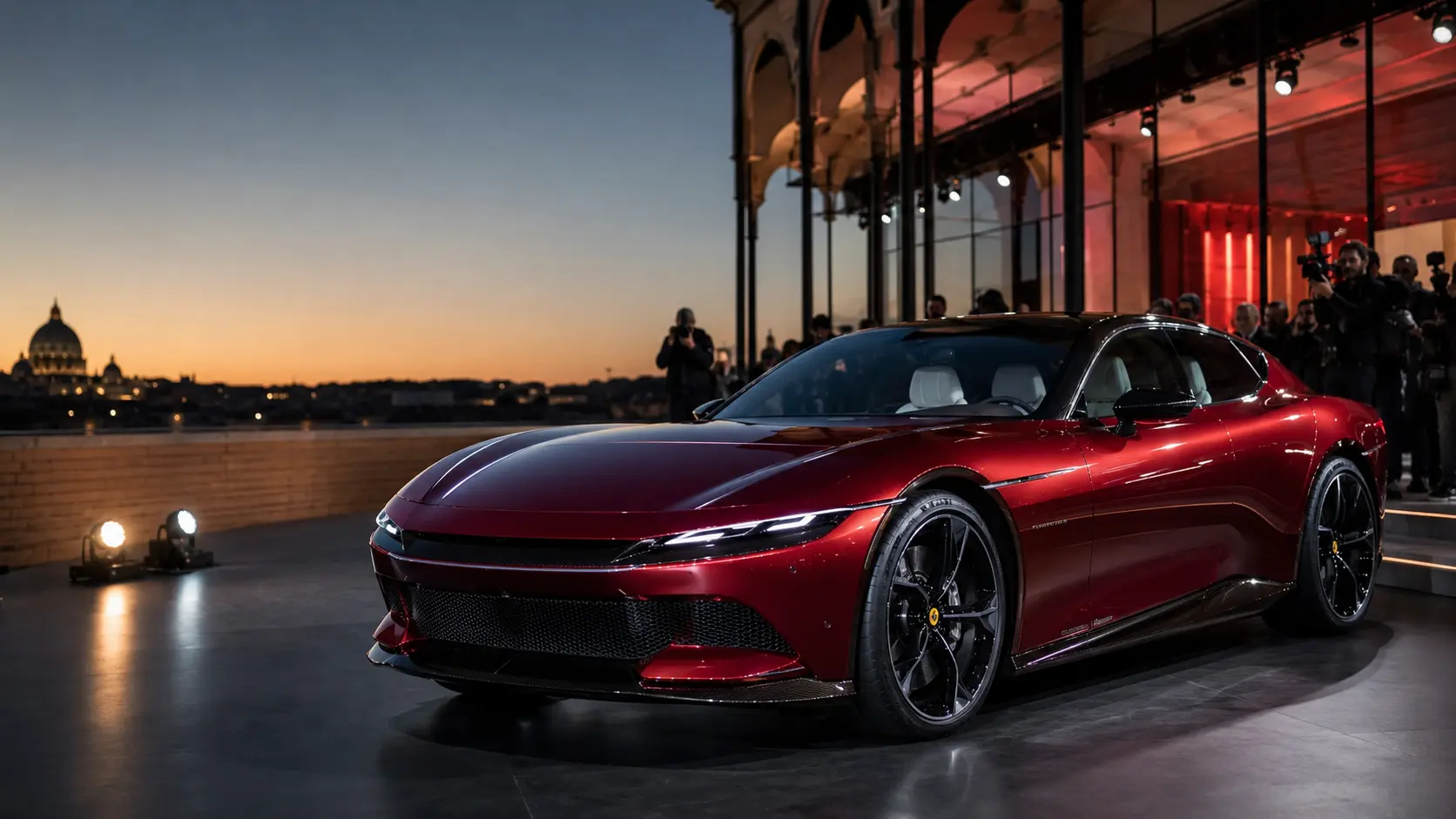
Ferrari EV is no longer a future promise. With the launch of the five-seat Luce in Rome on May 25, Ferrari has turned a long-signaled electrification plan into a commercial product that will test whether one of the world’s strongest luxury brands can carry its pricing power and emotional appeal into the battery era.
The debut matters well beyond a single new model. Reuters reported that the Luce is Ferrari’s first fully electric car, its first five-seater, and a deliberate attempt to reach wealthy buyers who want Ferrari performance in a format better suited to family use, daily driving, and a more technology-centered idea of prestige.
Ferrari EV Moves From Showcase to Product
Ferrari had prepared investors and customers for this step for months, but the world premiere changes the story from concept planning to execution. In its February 10, 2026 results release, Ferrari said the Luce represented the start of a new chapter and confirmed that the final reveal would take place in Rome on May 25.
That earlier disclosure also showed why the timing matters to the company’s broader strategy. Ferrari ended 2025 with net revenues of 7.146 billion euros, operating profit of 2.11 billion euros, and guidance for roughly 7.5 billion euros of revenue in 2026, giving it room to invest in digital transformation and new-model production while protecting margins.
A Price Tag Built for Scarcity
Reuters said the Luce is priced at 550,000 euros, or about $640,000, with deliveries due to begin in the fourth quarter of 2026. That price places the Ferrari EV firmly in the upper end of the luxury market, where scarcity, brand discipline, and high-margin customization matter as much as raw unit volume.
Ferrari’s business model has long relied on limited supply rather than scale. The company said in its February results release that demand remains strong and that its order book stretches toward the end of 2027, a signal that management still believes exclusivity can carry over even as the powertrain changes.
That gives Ferrari a buffer that most mainstream EV makers do not have. It does not need the Luce to win a price war or unlock mass adoption. Instead, it needs the car to prove that customers will pay Ferrari-level prices for an electric vehicle without assuming the badge has lost its meaning.
Ferrari EV Specs Signal a Full Commitment
The technical package suggests Ferrari is trying to avoid the impression of a symbolic launch. Reuters reported that the Luce uses four electric motors, one per wheel, produces more than 1,000 horsepower, can exceed 310 kilometers per hour, and offers a driving range of more than 500 kilometers.
Ferrari’s own Elettrica materials add to that picture. The company says the front axle was designed in house, delivers 210 kilowatts of power with 93% efficiency at full output, and sits inside a broader architecture built around four independent motors and an advanced control system intended to preserve precision and responsiveness.
Those details matter because Ferrari is selling a driving experience, not only a sustainability story. The company is trying to show that electrification can expand performance options rather than dilute them, which is why the Luce’s messaging leans so heavily on handling, control, engineering depth, and the emotional side of acceleration.
Why Ferrari Thinks Luxury Buyers Will Follow
The Luce is also a market-shape bet. Reuters said the model was developed with Jony Ive and LoveFrom, comes with a larger body and a 600-liter boot, and is positioned to attract wealthy buyers looking for something different from Ferrari’s two-seat and four-seat internal-combustion icons.
That reflects a broader change in how luxury carmakers think about customer behavior. For Ferrari, the question is not simply whether traditional enthusiasts will swap a V12 for a battery. It is whether a newer group of buyers, already comfortable with software, AI, and electrified products, will see an electric Ferrari as the most advanced expression of the brand rather than a compromise.
A Ferrari EV for Families and New Use Cases
Ferrari has not hidden the fact that the Luce expands the brand’s use cases. Reuters said the car is designed to appeal to families with deep pockets by combining comfortable seating, high-end technology, and more usable storage capacity than buyers would expect from the marque.
That has strategic value because it opens a slightly different ownership logic. A Ferrari EV can become the car a household uses more often, in more settings, without stepping down from the luxury tier. In business terms, that means Ferrari is not only selling powertrain innovation; it is widening the number of moments in which a client might choose a Ferrari.
The move also fits the company’s long-running effort to broaden revenue quality without becoming common. Ferrari has spent years strengthening personalization, lifestyle, and brand-led monetization. A more practical electric model could support that playbook by drawing in buyers who want the brand more frequently integrated into daily life.
China Could Become a Ferrari EV Test Market
Reuters said Ferrari sees additional opportunity in markets such as China, where electric vehicles are already widespread and taxes on large gasoline-powered cars are heavier. That makes the Ferrari EV more than a European product launch. It is also a test of whether the company can use electrification to sharpen its relevance in markets where regulatory and consumer trends already favor battery-powered vehicles.
China matters because it is both a luxury market and a technology market. Premium buyers there are already familiar with digital interfaces, software-defined features, and rapid EV innovation. If Ferrari can make the Luce feel distinct in that environment, it would strengthen the argument that the company can compete on emotion and brand without falling behind on technology.
At the same time, the opportunity comes with risk. Chinese buyers have many premium EV choices, including domestic brands that move quickly on software, design, and in-car features. Ferrari therefore has to prove that its engineering, heritage, and exclusivity can justify a vastly higher price point even in a market where EV familiarity is no longer rare.
The Risk Behind Ferrari EV Timing
Ferrari’s move comes at an awkward moment for the wider luxury car industry. Reuters framed the Luce launch as a high-stakes shift precisely because rivals including Porsche and Lamborghini have pulled back from some EV ambitions after weaker-than-expected demand.
That contrast could work in Ferrari’s favor if the company reads the market better than peers, but it could also expose the brand if customers still prefer hybrid or combustion Ferraris for longer than management hopes. The significance of the launch lies in that tension: Ferrari is stepping in where others have become more cautious.
Rivals Are Pulling Back From Luxury EV Plans
The softer luxury EV backdrop means Ferrari is not launching into a simple momentum trade. Consumer appetite for expensive electric vehicles has proved less predictable than early industry forecasts suggested, especially when buyers worry about charging convenience, residual values, and the emotional trade-off of quieter powertrains.
That makes Ferrari’s confidence noteworthy. Rather than delay further, it has chosen to present a fully formed flagship-style product with distinctive design, high output, and an unmistakably premium price. The company appears to be betting that if any brand can persuade buyers to make an emotional leap, it is one whose identity has always rested on desire more than utility.
It is also possible Ferrari benefits from moving later than some rivals. It has had more time to watch what worked, where demand softened, and how battery technology, charging expectations, and buyer psychology evolved. In that sense, the Ferrari EV is arriving into a more difficult market, but perhaps with a more realistic product brief.
Ferrari EV Must Protect Margins and Brand Value
The most important business question is not whether Ferrari can build an electric car. It is whether the Ferrari EV can protect the company’s margin structure and brand aura at the same time. Ferrari’s financial model depends on disciplined volumes, strong personalization, and the perception that each vehicle remains special even as the product range evolves.
If the Luce succeeds, it could validate Ferrari’s broader multi-energy strategy and give management a template for future electric launches. It would also show investors that electrification can support growth without forcing the company into the margin compression that has hurt more volume-driven EV makers.
If it stumbles, the consequences would still be manageable in the near term because Ferrari remains profitable, supply constrained, and diversified across sports cars, racing, and lifestyle. Even so, the symbolic cost would be higher. A weak response would raise harder questions about how far even elite luxury brands can push customers toward full electrification before hybrids become the preferred bridge technology.
For now, Ferrari has chosen to meet that question directly. The Luce gives the Ferrari EV story a real price, a real launch date, and a real customer proposition, and readers can continue following related business and technology coverage at Berrit Media.
Discover more from Berrit Media
Subscribe to get the latest posts sent to your email.