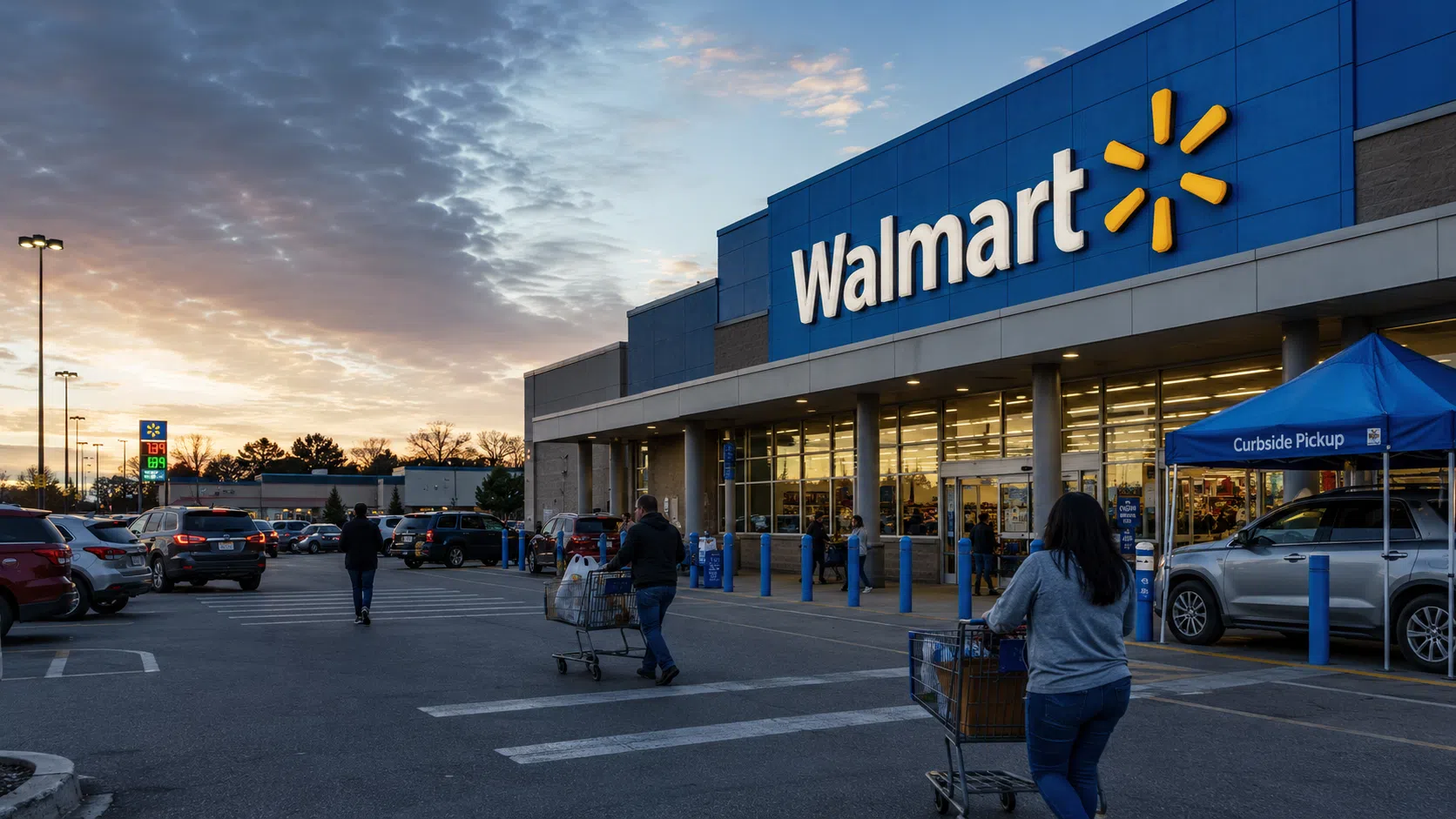
Walmart earnings offered a revealing snapshot of the U.S. consumer on May 21, showing that the world’s largest retailer is still gaining share through low prices, faster delivery, and digital convenience even as household budgets come under heavier strain. The company reported strong first-quarter fiscal 2027 growth across revenue, eCommerce, advertising, and membership, but its weaker second-quarter guidance and comments on fuel costs showed that demand is becoming more uneven beneath the surface.
That matters beyond one retailer’s quarter. Walmart reaches more than 150 million customers each week, giving its results unusual weight as a read on spending behavior, pricing pressure, and margin resilience. In the same set of results, investors could see both the strength of Walmart’s operating model and the limits of that strength when gasoline, freight, and broader living costs begin to squeeze lower-income shoppers more directly.
Walmart Earnings Show a Stronger Retail Engine
The headline numbers were solid. Walmart said total revenue rose 7.3% in the quarter, while operating income increased 5.0%, supported by steady customer traffic, strong online demand, and continued growth in businesses that sit alongside core merchandise sales.
Just as important, the quarter showed that Walmart is no longer relying only on grocery volume to defend performance. Advertising, membership, marketplace activity, and automation are giving the company a broader profit mix, which helps explain why it has remained more resilient than many rivals in a choppier consumer environment.
Walmart Earnings Benefited From Digital Scale
Walmart’s own release said global eCommerce grew 26% in the quarter, while global advertising rose 37%. In the U.S., Walmart Connect revenue climbed 44% excluding Vizio, reinforcing how much the company now benefits from the digital tools built around shopping rather than only the goods sold in stores.
The company also highlighted how its physical footprint is reinforcing that digital growth. Store-fulfilled delivery has more than doubled over the past two years, and more than 36% of those orders were delivered in under three hours during the quarter. That is a meaningful strategic edge because it lets Walmart compete on convenience without building a distribution model from scratch.
Seen this way, Walmart earnings were not simply a retail update. They were evidence that the company’s long-running push to turn stores into fulfillment nodes, media inventory, and membership hubs is producing a sturdier operating model than traditional big-box retail once offered.
Higher-Income Shoppers Widened the Walmart Earnings Cushion
Another notable point in the quarter was the mix of customers driving growth. Walmart said market-share gains came from both grocery and general merchandise, led by upper-income households. The Associated Press separately reported that households earning more than $100,000 were contributing the biggest gains in market share.
That shift matters because it gives Walmart more flexibility than a pure value chain would have in a stressed economy. Wealthier shoppers can support discretionary categories and larger baskets, while lower-income customers still come for essentials and price perception. The mix does not eliminate pressure, but it broadens the company’s base of demand.
For strategy watchers, this is one of the clearest takeaways from Walmart earnings. The company is no longer winning only when consumers are under pressure. It is increasingly winning when convenience, speed, assortment, and integrated services persuade higher-income shoppers to consolidate more spending inside the Walmart ecosystem.
Consumer Pressure Is Starting to Change the Mix
The caution in the quarter came from what management said about the customer backdrop. Reuters reported that Walmart kept its full-year targets unchanged even as executives described a consumer that is feeling strain and becoming more value-conscious in an environment of higher fuel costs and broader inflation pressure.
That contrast is the heart of the story. Walmart can still post strong top-line growth while telling the market that the underlying consumer is behaving more carefully. When a company with Walmart’s scale starts describing stress in daily spending habits, that becomes a broader business signal rather than a company-specific footnote.
Fuel Costs Became a Direct Walmart Earnings Drag
Fuel was the most concrete pressure point. Reuters said higher fuel costs reduced Walmart’s first-quarter operating income by about $175 million, while the company tried to absorb those costs inside its delivery and fulfillment network rather than pass them through immediately to shoppers.
Management also warned that if the current cost environment persists, retail price inflation could run somewhat higher in the second quarter and the second half of the year. That comment matters because it suggests the margin buffer created by advertising, memberships, and digital scale is helpful, but not unlimited when logistics and transport costs move sharply.
There is also a second-order effect on demand. Higher gasoline prices do not only raise Walmart’s own costs. They reduce what shoppers have left to spend after filling their cars, which can weaken discretionary purchases even if food and household essentials remain relatively stable.
Smaller Baskets Made Walmart Earnings Guidance Harder to Lift
Executives gave another clue about pressure in customer behavior. Reuters reported that average transactions rose 3% in the quarter, while growth in average ticket slowed to 1.1% from 2.8% a year earlier. In plain terms, more people came to Walmart, but the amount spent on each visit grew much more slowly.
The Associated Press added an even more vivid signal: at Walmart and Sam’s Club gas stations, the number of gallons customers bought per visit fell below 10 for the first time since 2022. Chief Financial Officer John David Rainey described that as a sign of stress, and it is hard to find a clearer real-time indicator of how closely some households are managing cash flow.
That is why Walmart earnings can look strong and cautious at the same time. Traffic gains show the chain is taking share, yet smaller baskets and more selective spending show the broader consumer backdrop is not healthy enough to support an easy guidance raise.
Why the Market Wanted More Than Steady Walmart Earnings
Investors did not react as though the quarter were weak, but they also did not treat it as a straightforward beat. The market was looking for proof that Walmart’s scale advantages would translate into a stronger near-term outlook, especially after a run in the shares and a period when the company has outperformed much of the retail field.
Instead, management held to its full-year framework and guided more cautiously for the current quarter. That left investors balancing strong structural progress against the possibility that macro pressure is beginning to cap how much operating leverage Walmart can show in the near term.
Investors Focused on Second-Quarter Walmart Earnings Power
Reuters reported that Walmart maintained its full-year net sales growth target of 3.5% to 4.5% and its adjusted earnings-per-share outlook of $2.75 to $2.85. Yet the company also forecast second-quarter net sales growth of 4% to 5% and adjusted earnings per share of 72 cents to 74 cents, both below what analysts had expected.
That guidance gap helps explain the stock reaction. Reuters said the shares were down in premarket trading, while AP later reported that the stock slipped about 7% on Thursday. The message from investors was not that Walmart had lost momentum, but that steady full-year guidance was less impressive than the market had hoped after such a strong quarter on the surface.
This is the challenge embedded in Walmart earnings at the moment. The company has become good enough operationally that investors increasingly expect not just resilience, but upside. When management points to cost pressure and a more cautious short-term demand outlook, even strong quarterly execution can produce a muted or negative market response.
Walmart Earnings Now Frame the Wider Retail Outlook
The broader implication is that Walmart is helping set the tone for the retail sector’s next phase. If a company with its purchasing power, grocery exposure, and fulfillment density is still talking about consumer stress and fuel-driven cost inflation, smaller or less diversified retailers are likely facing a more difficult balancing act.
At the same time, Walmart’s quarter also showed what relative advantage looks like in this environment. The company is gaining from value positioning, taking share with higher-income households, growing its digital businesses quickly, and using advertising and memberships to cushion pressure elsewhere. Those are not temporary supports; they are part of a structural redesign of the business.
For that reason, the most important reading of Walmart earnings may be that retail leadership in 2026 is no longer just about low prices. It is about having enough scale, fulfillment speed, ancillary revenue, and customer trust to keep growing even when the consumer is visibly under pressure. Readers can follow more reporting on retail strategy, consumer behavior, and market-moving business shifts in related coverage at Berrit Media.
Discover more from Berrit Media
Subscribe to get the latest posts sent to your email.