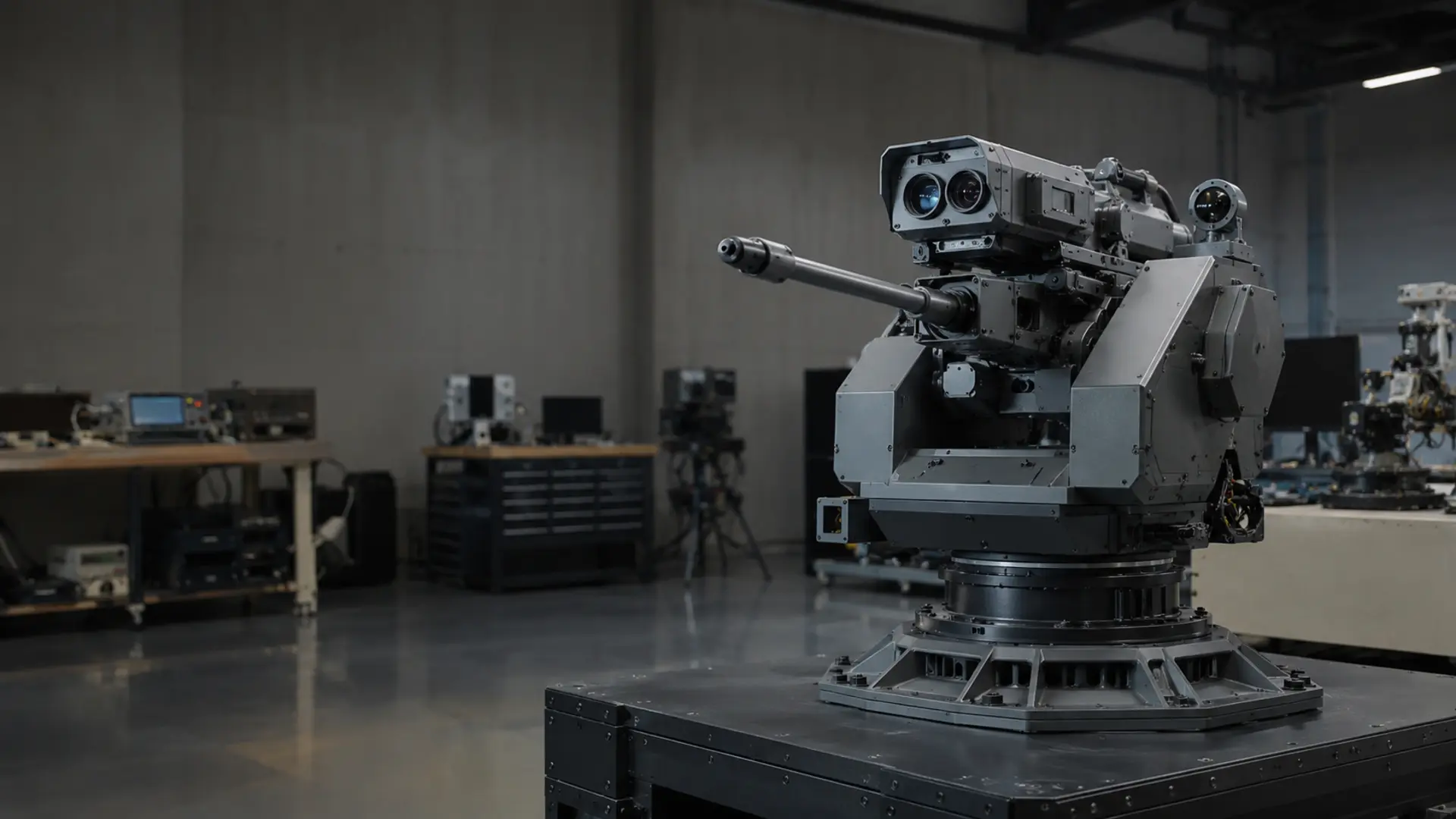
Defense Robotics has moved further into the venture-capital mainstream after Allen Control Systems said it raised $200 million in Series B funding at a $2.2 billion post-money valuation to scale production of Bullfrog, its autonomous counter-drone weapon station.
The Austin-based company announced the round on June 5, saying Smash Capital led the financing with participation from existing investors Craft Ventures, Rally Ventures, Inspired Capital and others. The new capital is meant to expand manufacturing, accelerate deployment for the United States and allied militaries, and support additional product lines.
The deal is notable because it links three fast-moving investment themes: the battlefield lessons of cheap unmanned aircraft, the defense sector’s renewed appetite for autonomous systems, and the willingness of private investors to back hardware-heavy military startups at software-style valuations. It also arrives shortly after Berrit Media covered a separate counter-drone acquisition involving Motorola Solutions and D-Fend Solutions, making this funding round a related but distinct signal about capital formation in defense hardware.
Defense Robotics Moves From Prototype To Production
Allen Control Systems is trying to turn Defense Robotics from a specialist demonstration category into a deployable manufacturing business. The company describes Bullfrog as a robotic weapon station that uses artificial intelligence, computer vision and precision control systems to improve the effectiveness of widely used weapons, including the M240 machine gun.
The company said the system is aimed at unmanned aircraft threats up to Group 3 UAS, a category that can include larger, more capable drones than the small commercial systems often associated with battlefield reconnaissance. That positioning matters for investors because counter-drone demand is no longer confined to experimental units; it is becoming a procurement, manufacturing and sustainment problem.
Why Defense Robotics Capital Is Accelerating
Venture funding for defense startups has grown as governments look for faster ways to respond to low-cost drones, loitering munitions and autonomous surveillance systems. Traditional air-defense missiles can be expensive, scarce and slow to replenish, while drone threats can be produced cheaply and deployed in large numbers.
Allen Control Systems is pitching Bullfrog into that cost imbalance. The company’s public framing emphasizes the use of existing weapons and ammunition, making the system less dependent on limited missile inventories. That message is designed for military buyers, but it is also designed for investors who want to see a route from prototype to repeatable deployments.
The $200 million Series B gives Allen Control Systems room to build manufacturing capacity before demand fully hardens into long-term programs of record. That is a familiar risk in defense technology: companies must invest ahead of procurement certainty, but moving too slowly can leave them behind faster competitors when governments accelerate buying cycles.
Bullfrog Gives Defense Robotics A Concrete Test Case
The funding announcement gives Defense Robotics a tangible business case rather than a broad technology slogan. Allen Control Systems said Bullfrog has received contracts through Joint Interagency Task Force 401 and allied military customers, and that it is already deployed with the U.S. Army and U.S. Navy.
Those deployment claims are significant, but they should be read carefully because they come from the company announcement. Axios separately reported that the Austin-based startup has more than $120 million of U.S. government contracts tied to different Bullfrog variants, adding an independent market signal around demand.
Allen Control Systems also said Bullfrog achieved a 100 percent success rate during Technology Readiness Experiment 2026, known as T-REX 26-1, one of the U.S. government’s counter-drone testing events. Testing success does not automatically translate into scaled procurement, but it can help a defense startup move from demonstrations toward broader customer confidence.
Investors Are Repricing The Counter-Drone Market
The Allen Control Systems round shows how investors are repricing the counter-drone market as a core security infrastructure category. The $2.2 billion valuation is large for a company founded in 2022, especially in a field where manufacturing, safety, testing and government procurement cycles can be more demanding than software deployment.
For backers, the argument is that drone warfare has created a durable market rather than a temporary procurement spike. Conflicts in Ukraine and the Middle East have shown how inexpensive unmanned systems can threaten tanks, ships, bases, logistics nodes and civilian infrastructure, forcing militaries to look for cheaper defensive layers.
Defense Robotics Valuations Meet Hardware Reality
Defense Robotics companies can command high valuations when investors believe a platform can scale across weapon types, services and allied customers. Axios reported that Bullfrog is becoming a platform, with some contract activity tied to different effectors, including lighter systems such as lasers and sensors.
That platform idea is central to the bull case. If Bullfrog is only a single turret tied to one weapon, its market may be narrower. If it becomes a control, targeting and stabilization layer that can be adapted across multiple counter-drone payloads, the addressable market becomes larger and more strategically important.
The hard part is execution. Defense hardware companies must qualify systems, manage export restrictions, satisfy safety requirements, protect sensitive software and expand production without sacrificing reliability. Those constraints can slow growth even when customer urgency is high.
Counter-Drone Demand Is Pulling In New Capital
The round also reflects a wider shift in venture capital. Investors that once avoided military hardware are now more willing to fund defense startups, partly because governments are signaling demand for faster, cheaper and more autonomous systems.
Smash Capital’s role as lead investor adds another layer to the story. Axios noted that Smash founder Kevin Mayer, better known for his media and Disney background, previously studied mechanical engineering at MIT and worked on battlefield radar and signal processors. That makes the round an example of generalist capital moving deeper into defense technology.
Still, counter-drone startups face a crowded field. Large defense contractors, electronic-warfare vendors, sensor companies, directed-energy developers and software firms are all trying to solve different parts of the same problem. Allen Control Systems’ advantage will depend on whether Bullfrog can be manufactured, integrated and trusted quickly enough to hold its lead.
Policy And Market Risks Remain Close To The Story
Defense Robotics sits at the intersection of investment, procurement policy and AI governance. A system that can identify, track and engage drones raises different questions from a back-office AI tool or an autonomous warehouse robot, especially when the technology is attached to live weapons.
Allen Control Systems presents Bullfrog as a response to urgent unmanned threats and says its systems are intended for U.S. and allied forces. Even with that framing, investors and policymakers will keep watching how autonomous targeting, human oversight, rules of engagement and battlefield accountability are handled as these systems scale.
Defense Robotics Must Navigate Autonomy Scrutiny
The phrase Defense Robotics can cover everything from logistics machines to armed autonomous systems. Bullfrog falls on the sensitive end of that spectrum because the company describes it as capable of executing the full kill chain against specified unmanned systems.
That does not mean the system operates outside military command structures, and public materials do not provide a complete account of operational controls. It does mean the company is likely to face a higher level of scrutiny than startups selling analytics software, drone detection tools or non-lethal infrastructure protection systems.
For buyers, the policy question is whether autonomy can reduce reaction time and improve accuracy without weakening command responsibility. For investors, the question is whether regulatory or reputational risk could slow adoption after early enthusiasm.
Manufacturing Scale Will Decide The Business Case
The new funding is explicitly tied to production scale. Allen Control Systems said it recently expanded its manufacturing footprint in Austin and is advancing additional autonomous battlefield systems. That makes factory execution one of the most important parts of the story.
Defense startups often win attention with engineering breakthroughs, but long-term value depends on delivery discipline. Customers need spare parts, training, software updates, integration support and reliability under harsh operating conditions. Those requirements can turn a promising device into a full industrial company.
The valuation gives Allen Control Systems the capital to build toward that model, but it also raises expectations. A $2.2 billion post-money price implies that investors expect Bullfrog to move beyond limited deployments and become a meaningful part of the counter-drone market for the United States and allied militaries.
Allen Control Systems’ financing does not settle the future of autonomous weapons or the economics of counter-drone defense, but it shows that Defense Robotics is becoming a serious capital market category. Readers can continue following related coverage on defense technology, AI governance and startup funding at Berrit Media.
Discover more from Berrit Media
Subscribe to get the latest posts sent to your email.