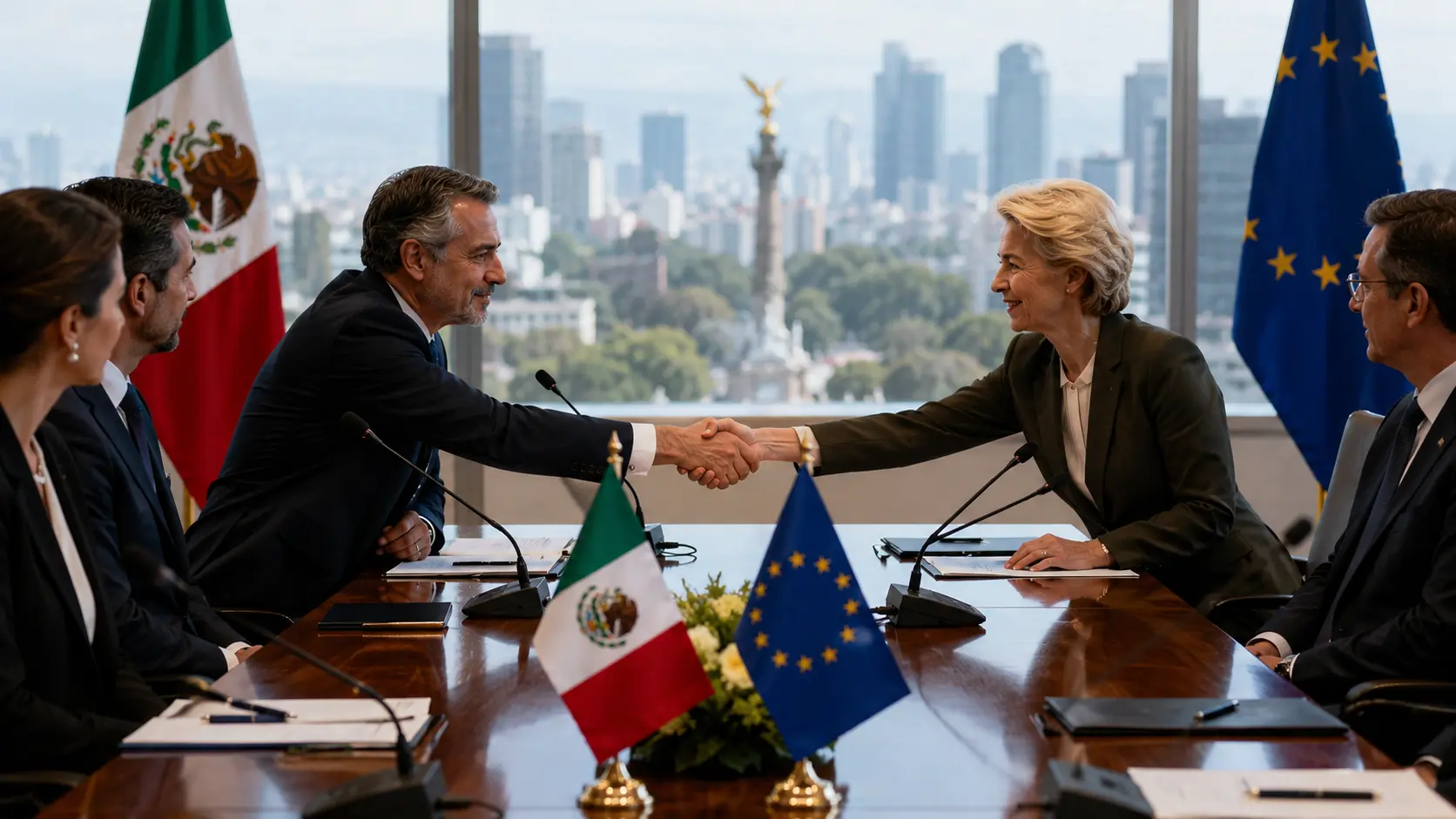
EU-Mexico trade policy moved into a new phase on May 22 when Mexico and the European Union signed a long-delayed modernized trade agreement in Mexico City, adding a fresh diversification tool for both sides as tariff pressure from the United States continues to reshape commercial strategy.
Reuters reported that the updated accord expands a 2000 agreement that mainly covered industrial goods. The new framework adds services, government procurement, digital trade, investment and farm products, while official EU materials say it is meant to deepen long-term economic ties and support more resilient supply chains.
Why the EU-Mexico Deal Matters Now
The timing matters as much as the text. Mexico and Europe are both trying to reduce strategic vulnerability to a more protectionist U.S. trade environment without pretending they can simply replace the American market.
That makes the signing more than a ceremonial summit outcome. It is a practical signal to manufacturers, agricultural exporters, investors and service providers that both governments want more policy room, more counterparties and a broader map for future growth.
EU-Mexico and the Search for Tariff Insurance
According to Reuters, Mexico has been hit by U.S. tariffs on automotive, steel and aluminum exports, while the European Union still faces elevated U.S. tariff pressure even after talks eased some tensions. In that context, the EU-Mexico agreement looks less like a routine update and more like a hedge against concentration risk.
Mexico still sends more than 80% of its exports to the United States, so no trade agreement with Europe can rewrite that reality overnight. But policymakers do not need a full substitution story for the deal to matter. They need additional channels for trade, investment and negotiating leverage, and this agreement clearly supports that objective.
The same logic applies in Europe. A deeper EU-Mexico trade corridor gives European companies another platform in North America at a moment when supply-chain resilience, industrial security and tariff exposure have all become boardroom issues rather than abstract policy concerns.
Trade Architecture Goes Beyond Goods
One reason the agreement stands out is that it extends well beyond tariffs on manufactured products. Reuters said the revised pact adds services, government procurement, digital trade, investment and agricultural trade, which gives it a broader commercial footprint than the 2000 framework it updates.
The European Commission describes Mexico as a strategic partner and says the deal should make it easier for EU companies to bid for contracts, invest and provide services in a wider range of sectors. That matters because modern trade relationships are increasingly shaped by data rules, procurement access and the ability to operate inside local business ecosystems, not just by customs duties.
For Mexico, that broader architecture could help support sectors the country has identified as growth priorities, including technology, electric mobility, pharmaceuticals and advanced manufacturing. President Claudia Sheinbaum said after the signing that the agreement opens substantial opportunities in those areas, according to Reuters.
What the EU-Mexico Agreement Changes for Business
The commercial case for the agreement rests on scale, certainty and flexibility. Businesses usually respond to trade agreements not because every tariff disappears at once, but because the legal and political environment becomes more predictable for investment, sourcing and market entry.
That is especially relevant now because companies are reassessing where to place production, how to structure inventory and which trade routes can stay viable if geopolitical friction lasts. The EU-Mexico framework gives corporate planners another route to evaluate at a time when redundancy has become a strategic asset.
EU-Mexico Access Broadens for Services and Procurement
The services and procurement pieces may be among the most commercially important parts of the package. The European Commission says the new arrangement should make it easier for companies to compete for government contracts and deliver services across a wider set of activities in Mexico.
That can influence far more than trade volumes. Procurement access often shapes who builds transport systems, energy projects, health infrastructure and digital platforms. When those rules become clearer, multinational groups and mid-sized suppliers alike gain more confidence about whether to commit capital and local operating resources.
Mexico also gains from that opening if stronger competition and more bidders improve access to expertise, financing and technology. The practical effect may build gradually, but the policy signal is immediate: the agreement is trying to move bilateral commerce further up the value chain.
Supply Chains and Investment Get a New Policy Signal
The official joint summit statement goes further than tariff relief and explicitly says the modernization should strengthen trade, investment, science, technology and innovation while supporting industrial complementarities and more resilient, sustainable, higher-value supply chains.
That wording is important because it frames the deal as part of a competitiveness agenda, not just a diplomatic one. Companies deciding where to place advanced production or regional hubs look for exactly these kinds of signals: market access, policy continuity, political support and some evidence that both sides view the relationship as strategic.
Reuters also cited Mexico’s economy ministry estimate that Mexican exports to the EU could rise from roughly $24 billion annually to $36 billion by 2030. Forecasts should always be treated cautiously, but the magnitude shows how officials are trying to position the agreement: as an active growth platform rather than a symbolic refresh.
What Comes Next for EU-Mexico Ratification and Strategy
Signing the agreement is significant, but it is not the same as full implementation. The European Commission says the modernized framework and the interim trade agreement were signed on May 22 and will replace the current arrangement once ratification is complete.
That means investors and operating companies should read the event as a milestone in execution, not the final endpoint. The direction is now clearer, but the pace of business impact will depend on ratification, follow-through by regulators and the wider political climate around North American and European trade.
EU-Mexico Still Needs Political Follow-Through
There are encouraging signals on that front. Reuters reported that the European Parliament is expected to vote on the agreement within a few months and is likely to approve it. Official EU trade materials already present the signing as a major step forward in the relationship.
Still, companies have seen trade politics change quickly in recent years. Even a strong agreement can face delays, compliance questions or uneven implementation if domestic politics shift or if geopolitical tensions redirect priorities. That is why businesses will watch the ratification process almost as closely as they watched the signing ceremony.
The summit joint statement suggests both sides want the relationship to extend well beyond market access. It links the agreement to energy, digital dialogue, health cooperation, research, innovation and economic security, which could make the trade pillar more durable if those adjacent areas continue to advance.
USMCA Review Will Shape the Next Test
The next strategic test may come from outside Europe. Mexico is also preparing for the 2026 review of the U.S.-Mexico-Canada Agreement, and that process will influence how confidently the country can diversify without provoking renewed pressure from Washington.
In that sense, the EU-Mexico agreement can be read as both economic policy and negotiating posture. It tells the market that Mexico is not waiting passively for North American trade terms to settle before building alternatives, even though those alternatives remain far smaller than its U.S. channel today.
For Europe, the message is similar. If the bloc wants a more resilient global trade network, it needs functioning agreements with partners that matter in manufacturing, agriculture, logistics and industrial transition. Mexico checks all of those boxes, which is why this agreement carries more strategic weight than a standard tariff headline.
The EU-Mexico trade deal will not instantly redraw global commerce, but it does widen the choices available to companies and policymakers at a moment when dependence itself has become a risk. Readers can continue following related trade, policy and investment coverage across Berrit Media.
Discover more from Berrit Media
Subscribe to get the latest posts sent to your email.