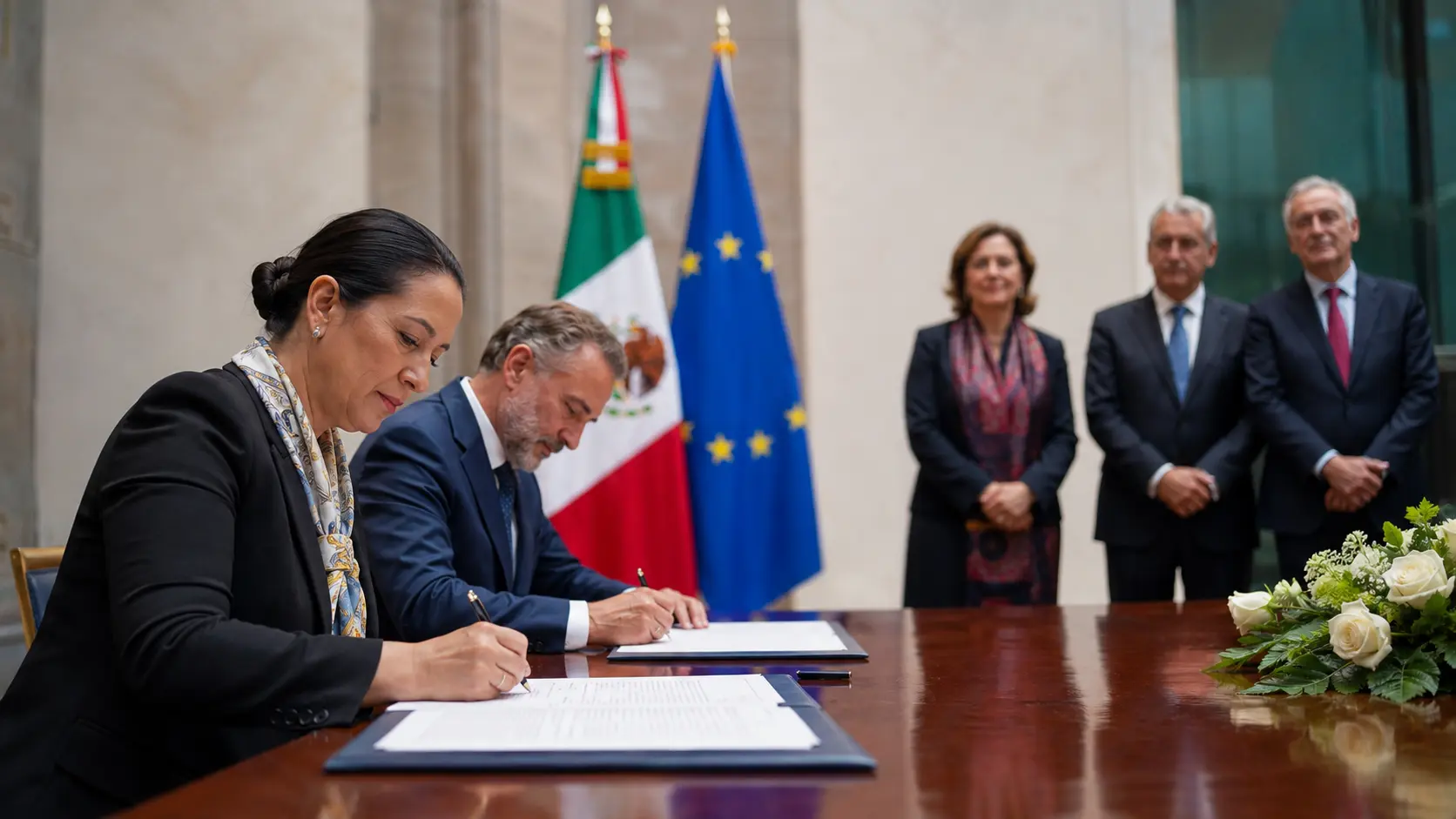
EU-Mexico relations entered a new trade phase on May 22, 2026, when leaders from Mexico and the European Union signed the Modernised Global Agreement and the Interim Trade Agreement at their summit in Mexico City. The signing turned a long-running negotiation into a concrete policy shift with direct implications for trade access, investment flows, and supply-chain planning on both sides of the Atlantic.
The official joint statement described the package as a new chapter in the strategic partnership and said it would strengthen flows of trade, investment, science, technology, and innovation while enhancing economic security. Reuters reported before the signing that both sides were also trying to reduce dependence on the United States at a moment when tariff pressure and broader geopolitical volatility have made diversification more urgent.
Why the EU-Mexico Deal Matters Now
The timing of the deal matters as much as the paperwork itself. Mexico is negotiating the next phase of its economic relationship with Washington through the USMCA review, while the EU is still navigating a more protectionist U.S. trade environment and a volatile global outlook shaped by war, energy insecurity, and supply-chain stress.
Against that backdrop, the EU-Mexico deal gives both parties a fresh way to broaden commercial options without waiting for clarity elsewhere. It also shows how governments are using trade architecture not only to lower barriers, but to create strategic room when relations with larger partners become less predictable.
EU-Mexico Trade Was Already Large Enough to Matter
This is not a small bilateral corridor being built from scratch. The Council of the European Union said goods trade between the two sides exceeded 82 billion euros in 2024, while services trade was nearly 26 billion euros in 2023. In the same release, the Council said trade in goods and services has expanded sharply since 2013.
The summit joint statement added that bilateral trade has quadrupled over the past 25 years, underlining how much the relationship has matured since the original framework entered into force in 2000. That history is important because the latest package is less about creating a new partnership than about updating one that had outgrown its legal structure.
For business leaders, scale changes the meaning of policy. When a trade relationship already spans machinery, transport equipment, chemicals, fuels, mining products, services, and cross-border investment, a modernization package can affect procurement strategy, customer access, financing decisions, and where future capacity gets built.
Why the EU-Mexico Deal Was Revived in This Moment
The political environment gave the agreement new urgency. Reuters reported that Mexico and the EU were seeking to partially insulate themselves from U.S. tariff pressure, while EU foreign policy chief Kaja Kallas said ahead of the summit that the agreement carried geopolitical weight beyond commerce alone.
That framing matches the official texts. The joint statement repeatedly ties the new agreements to economic security, resilient supply chains, and support for a rules-based trading system. Those phrases are not decorative. They reflect how trade policy now sits closer to industrial policy, technology policy, and diplomatic risk management than it did when the original pact was signed.
Mexico has its own reasons to move. The country remains deeply integrated with the United States, but officials have increasingly talked about opening more commercial channels beyond North America. For Europe, Mexico offers both a large market and a manufacturing partner with relevance to automotive components, industrial goods, raw materials, and future nearshoring strategies.
What the New EU-Mexico Agreements Change
The package is structured in two layers. The Modernised Global Agreement creates the broader political, economic, and cooperation framework, while the Interim Trade Agreement is designed to put the trade and investment liberalization elements into effect sooner, before the full broader accord completes every ratification step.
That design is commercially important because it separates long-term institutional ambition from near-term business benefits. In practical terms, it means companies do not have to wait for the full political agreement to be fully ratified before some of the negotiated economic effects start moving through the system.
How EU-Mexico Market Access Is Supposed to Expand
The Council said the interim agreement is expected to remove most remaining customs duties, improve access to public procurement markets, and open additional services and investment opportunities. It specifically highlighted lower barriers for agri-food exports and better conditions for sectors such as machinery, pharmaceuticals, and transport equipment.
The same release said the agreement also protects hundreds of European geographical indications on the Mexican market, strengthens rules around digital trade, customs facilitation, competition, and intellectual property, and includes binding commitments on labor rights, environmental protection, and climate action. That combination matters because it shows the agreement is not limited to tariff-cutting. It is meant to shape how market access works across a much broader operating environment.
Kallas said ahead of the signing that the update would remove remaining barriers in strategic sectors including raw materials, agriculture, and services. For executives, that signals where governments expect the commercial upside to emerge first: not only in headline trade volumes, but in sectors tied to industrial resilience and the next wave of cross-border investment.
Why the Interim Trade Agreement Comes First
The interim structure solves a familiar trade-policy problem. The broader Modernised Global Agreement still requires the consent of the European Parliament and ratification by all EU member states before it can fully enter into force. That can take time, especially when agreements touch politics, security, cooperation, and domestic sensitivities across multiple capitals.
By contrast, the Interim Trade Agreement falls within the EU’s exclusive competence, so it can function as a stand-alone bridge until the full partnership is completed. The Council said its purpose is to deliver the economic benefits of the negotiated trade commitments as early as possible.
That sequencing reduces the gap between diplomacy and business planning. Exporters, investors, logistics groups, and procurement teams often respond more confidently when they can see an implementation path rather than only a ceremonial signing. The two-track structure gives the EU-Mexico package a better chance of producing operational consequences before the wider ratification process is over.
Why Executives and Investors Will Watch the EU-Mexico Deal Closely
The deeper story is not just that Mexico and Europe signed new papers. It is that trade relationships are being redesigned around risk distribution. Companies are no longer asking only where demand is growing. They are also asking which jurisdictions can offer stable rules, diversified suppliers, and less exposure to sudden policy shocks from a single dominant market.
That is why the deal matters to investors, manufacturers, retailers, exporters, and infrastructure planners. Even when tariff cuts take time to filter through, the signal from governments can influence capital allocation early by changing assumptions about which corridors are likely to become easier, safer, or more strategically valuable over the next several years.
EU-Mexico Supply Chains Gain a Strategic Policy Push
The summit joint statement explicitly links the modernization package to more resilient, sustainable, and high-value-added supply chains. It also emphasizes industrial complementarities, research cooperation, digital dialogue, and coordination in areas such as energy transition and innovation. Those are the kinds of policy signals companies use when deciding whether to broaden footprints or deepen supplier relationships.
Mexico’s position is especially notable because it combines manufacturing depth, proximity to the United States, and a growing need to diversify commercial risk. For European firms, that can make Mexico more attractive not only as an export destination but also as a platform for industrial partnerships and regional production strategies tied to the Americas.
For Mexico, stronger EU ties may help widen options in technology, transport, clean-energy systems, and industrial inputs. The agreement does not erase the weight of the U.S. relationship, but it can increase bargaining flexibility and reduce overconcentration risk by giving policymakers and businesses another serious channel for growth.
The Political Timetable Still Matters
The opportunity is real, but it is not frictionless. The broader agreement still has to clear the European Parliament and, for full entry into force, national ratification across the EU. That means some parts of the package will move faster than others, and businesses will still need to watch the legal timetable rather than assume every benefit arrives at once.
There is also a wider geopolitical variable. Mexico’s talks with the United States are continuing, and European trade strategy remains shaped by its own negotiations and tensions with Washington. If those relationships stabilize, the EU-Mexico deal may look like prudent diversification. If they worsen, it may start to look even more central to how both sides protect commercial autonomy.
Either way, the signing has moved the relationship forward in a meaningful way. After years of negotiation, the EU-Mexico package is no longer a future possibility but an active policy framework that businesses, investors, and officials will now test in real market conditions.
The EU-Mexico deal will be judged by how quickly it turns diplomatic ambition into visible trade, investment, and supply-chain results. Readers can continue following related trade, policy, and market coverage at Berrit Media.
Discover more from Berrit Media
Subscribe to get the latest posts sent to your email.