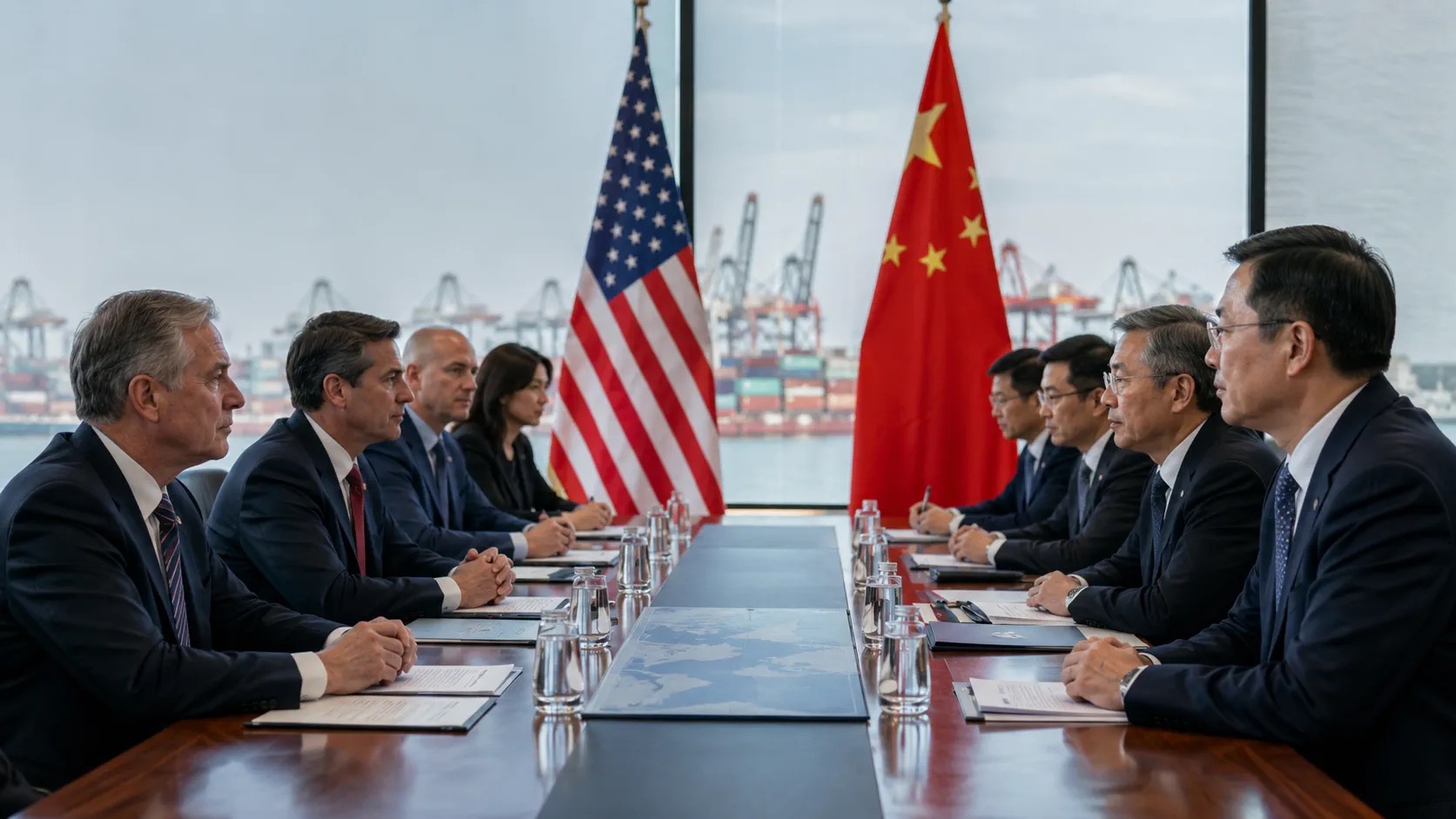
Trade councils are now at the center of the latest U.S.-China economic thaw after both Washington and Beijing confirmed that the world’s two largest economies will set up new forums for trade and investment issues following last week’s Beijing summit.
The White House said on May 17 that President Donald Trump and President Xi Jinping had chartered a U.S.-China Board of Trade and a U.S.-China Board of Investment. China’s commerce ministry, in a statement carried by Xinhua on May 18, said the two sides would establish trade and investment councils and had agreed in principle to lower tariffs on products of respective concern on an equivalent scale.
The development matters because it turns summit language into a more permanent framework for handling tariff reductions, market-access complaints, and investment frictions. For businesses, that is more important than symbolism alone, because a standing mechanism can influence how quickly disputes are escalated, resolved, or ring-fenced before they spread across supply chains.
At the same time, the architecture is still early and incomplete. Neither side has published operating rules, a negotiating calendar, or product-level tariff details, which means the commercial significance will depend on implementation rather than the announcement itself.
Why Trade Councils Matter Now
The timing of the councils is significant because Washington and Beijing are trying to show that selective economic cooperation can continue even while broader strategic competition remains intense. That balancing act has become more urgent as tariff conflict, export restrictions, and geopolitical shocks have all raised costs for companies exposed to both markets.
Unlike a one-off purchase announcement, the councils suggest both governments want a recurring venue for economic management. That raises the chances that future disputes over tariffs, investment approvals, or sector-specific access could be channeled through a formal process instead of being handled only through public threats or sudden retaliation.
From summit language to a standing forum
The White House described the new boards as the cornerstone of the latest package reached during Trump’s visit to China. In its formulation, the Board of Trade will let the two governments manage bilateral trade across non-sensitive goods, while the Board of Investment will serve as a government-to-government forum for investment-related issues.
Beijing used slightly different wording, but the direction was similar. China’s commerce ministry said the trade and investment councils would address each side’s concerns in trade and investment cooperation, and added that details related to the broader outcomes were still being finalized.
That combination of public confirmation from both capitals is what makes the story more substantive than earlier preview reporting. Before the summit ended, Treasury Secretary Scott Bessent had discussed the idea in media interviews, but the post-summit statements suggest the concept has moved beyond exploratory remarks into an agreed diplomatic structure.
Trade councils put tariff bargaining on a formal track
The trade side of the new mechanism could matter most in the near term. China’s commerce ministry said the two countries would use the trade council to discuss tariff reductions on specific products and had agreed in principle to lower tariffs on products of respective concern on an equivalent scale.
That does not amount to a sweeping tariff reset. However, it does imply a more targeted and negotiable process than the broad punitive rounds that have defined recent U.S.-China trade fights. For manufacturers, importers, and commodity traders, even limited product-by-product relief can reshape margins, sourcing choices, and contract planning.
The existence of a formal council also matters politically. It gives both sides a way to claim they are defending national interests while still creating room for narrowly tailored commercial concessions, which is often how large trade relationships begin to stabilize after a period of escalation.
What Trade Councils Mean for Business and Investors
For executives and investors, the headline is less about diplomacy and more about process. Markets can absorb tough policy if the rules are visible, but they struggle when commercial access changes without warning. A standing mechanism does not remove that risk, yet it may reduce the frequency of abrupt surprises.
The most immediate commercial value could come from dispute management. If the councils become active, they may give companies a clearer sense of which issues are politically negotiable, which sectors remain strategically off limits, and where market openings might actually materialize over the coming quarters.
Investment disputes gain a clearer official lane
The investment side is especially notable because it addresses one of the murkiest areas in the bilateral relationship. Cross-border capital flows between the United States and China have been constrained not only by formal restrictions but also by uncertainty over what counts as strategic, sensitive, or politically acceptable.
A government forum will not erase those constraints, and neither side has suggested that national security screens are going away. Still, a standing venue for discussing non-sensitive investment issues could help companies, financiers, and advisers distinguish between transactions that are likely to move forward and those that are likely to stall.
That is why the new board could matter well beyond headline investment numbers. If it reduces ambiguity around lower-risk sectors, it may help companies make decisions on joint ventures, local expansions, sourcing partnerships, and financing structures with a little more confidence than they have had recently.
Boeing, farm trade, and supply chains become early tests
The early test of the framework will come from whether it helps deliver on the commercial commitments already announced around the summit. The White House said China approved an initial purchase of 200 Boeing aircraft, committed to buy at least $17 billion a year in U.S. agricultural products from 2026 through 2028, and restored market access for U.S. beef while resuming some poultry imports.
Those are tangible markers because they connect the new institutional framework to real industries. Aviation, agriculture, and critical-minerals supply chains all sit at the intersection of politics and commerce, which makes them useful indicators of whether the councils can translate diplomatic language into repeatable business outcomes.
There is also a broader supply-chain angle. The White House said China would address U.S. concerns about shortages of rare earths and related processing equipment, while Beijing said both sides would work on non-tariff barriers and market-access issues involving agricultural products. If the councils help manage those bottlenecks, the effect could extend well beyond the companies directly named in the summit package.
Why Caution Still Surrounds Trade Councils
Even so, the councils should not be mistaken for a full reset in U.S.-China economic relations. The two governments remain divided over technology controls, industrial policy, security priorities, and the political limits of dependence on one another. A forum can manage friction, but it cannot remove the underlying rivalry.
That is why the most realistic reading is neither triumph nor dismissal. The councils are meaningful because they create a tool the two sides have recently lacked, but they are unproven because the commercial terms remain incomplete and the strategic distrust is still very much alive.
China says the outcomes are still preliminary
The strongest note of caution has come from China itself. Reuters reported on May 16 that China’s commerce ministry had described the tariff, agricultural, and aircraft deals reached during Trump’s visit as preliminary, even as it confirmed the plan to establish the new trade and investment bodies.
That distinction matters. It suggests Beijing wants to preserve room to negotiate details rather than lock itself publicly into every commercial outcome claimed by Washington. In practical terms, that could affect timelines, product coverage, and the pace at which businesses actually see relief.
AP, meanwhile, framed the agricultural commitments as a source of hope for U.S. farmers hurt by the trade war, underscoring that the deal’s credibility will be judged by whether promised demand turns into actual shipments. The same logic applies to aircraft, investment discussions, and tariff adjustments.
Implementation will matter more than symbolism
The next phase will be measured by mechanics: whether officials announce meeting schedules, whether tariff lists are specified, whether market-access irritants are resolved, and whether the investment channel handles concrete cases rather than vague principles. Without that follow-through, the councils risk becoming another diplomatic headline with limited commercial value.
Investors will also watch for signs that the structure can survive political stress. If a new security flare-up, campaign demand, or enforcement dispute quickly overwhelms the councils, then markets will treat them as temporary theater. If they continue functioning through tension, they could become an important stabilizer in the bilateral economic relationship.
For now, the creation of trade councils is best understood as a serious attempt to build process into a volatile relationship. It does not settle the biggest U.S.-China arguments, but it may give both governments a more disciplined way to handle the business and policy fights that still matter to global companies every day.
The new trade councils could become one of the most consequential business outcomes from the Beijing summit if they deliver real tariff clarity, smoother market access, and more predictable investment handling. Readers can continue following related policy, industry, and market coverage at Berrit Media.
Discover more from Berrit Media
Subscribe to get the latest posts sent to your email.