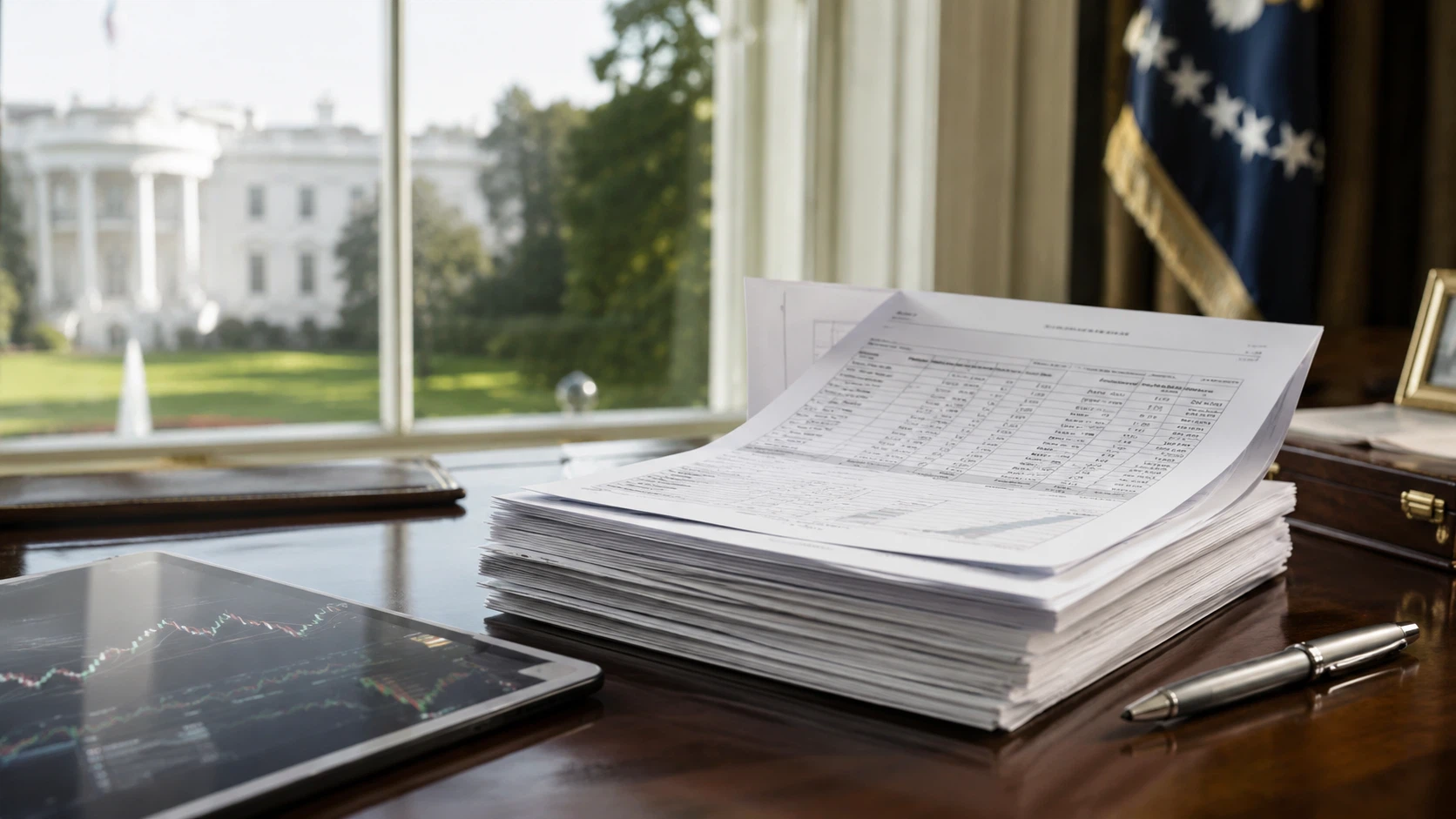
Trump trades disclosed by the U.S. Office of Government Ethics have opened a new window into how large and active President Donald Trump’s investment activity remained during the opening months of 2026, while he was back in office and shaping policy with direct consequences for public markets. The filings do not prove any policy abuse, but they do show a pace and scale of transactions that is unusual enough to revive familiar questions about conflicts, transparency, and market trust.
Reuters reported on May 14 that newly public filings showed at least $220 million of transactions and a cumulative disclosed range that could run to about $750 million because the ethics forms use broad value bands rather than exact amounts. Bloomberg, reviewing the same release, said the records covered more than 3,700 trades in the first quarter across more than 100 pages, underscoring how extensive the activity was even before Trump’s annual disclosure arrives.
What the new filings show
The immediate significance of the disclosures is straightforward. They move the debate away from general assumptions about presidential wealth and into specific reported trades, dates, and company names. That matters because financial-disclosure systems are meant to help the public assess whether a policymaker’s private assets could intersect with official decisions.
In this case, the public record is still incomplete. The Office of Government Ethics said on May 15 that it had granted the president and vice president 45-day extensions for their annual public financial disclosure filings, moving the due date to June 29. That means the newest transaction reports provide a partial picture rather than a full balance-sheet view, but even that partial picture is enough to raise serious policy and governance questions.
The scale of the Trump trades activity
Reuters said the filings included transactions involving major U.S. companies such as Microsoft, Meta, Oracle, Broadcom, Bank of America, and Goldman Sachs. The report also described sizable purchases in an S&P 500 index fund, Nvidia, and Apple, alongside large sales in Microsoft, Amazon, and Meta. Even allowing for the wide disclosure bands used in U.S. ethics forms, that mix suggests a highly active portfolio rather than passive long-term holding alone.
Bloomberg’s count of more than 3,700 trades pushed the story from a routine compliance item into a broader market and ethics development. At that volume, the issue is not just what securities appeared in the forms, but how often positions were turned over while the president was directing trade, technology, tax, regulatory, and foreign-policy decisions that can move valuations across sectors in hours.
The raw totals also matter because ethics disclosures often fail to resonate unless the underlying amounts are large enough to signal real exposure. A reported minimum of $220 million in transactions, and a possible upper range several times higher, clears that threshold. For investors, watchdogs, and policy observers, the question is no longer whether there was meaningful market activity, but how the public should interpret it.
What the Trump trades forms leave unclear
The filings still have important limitations. Reuters noted that the documents did not make clear who made each decision or whether specific transactions were executed directly by Trump, by a family office structure, or by outside managers operating under broad authority. That missing detail is central, because ethics risk depends not only on ownership but also on decision-making control.
Trump Organization executive vice president Eric Trump told Reuters that the accounts were fully discretionary and managed by outside financial professionals, adding that Donald Trump was not involved in the stock trades and did not direct them. That defense is meaningful, and it could reduce the risk of direct trading based on policy knowledge. However, it does not eliminate scrutiny, because a president still benefits economically from portfolio outcomes even when another party presses the buy and sell buttons.
There is also a technical transparency problem. OGE’s periodic transaction reports disclose ranges rather than exact values. That means the public can see broad categories of activity but cannot easily determine precise position sizes, realized gains, or how long a given asset was held. In practice, that leaves significant room for uncertainty in interpreting both the scale of exposure and the possible intersection with policymaking.
Why the disclosure matters in office
Presidential ethics debates are not only about whether a law was broken. They are also about confidence in the neutrality of state power. A president can affect corporate fortunes through tariffs, procurement, sanctions, antitrust tone, energy policy, financial regulation, industrial subsidies, and diplomatic signaling. When large trading activity sits alongside that power, even lawful arrangements can produce a perception problem.
That perception matters for markets because credibility is itself an economic asset. Investors want confidence that public policy is being made for strategic or economic reasons, not because of personal financial incentives. The bigger and more active a portfolio appears, the harder it becomes to separate official action from questions about private benefit, especially in sectors like technology where policy shocks can quickly reshape valuations.
Policy power and Trump trades optics
The optics are especially sharp because many of the reported names sit in sectors that have been central to Washington policy fights. Technology companies have been caught in debates over artificial intelligence, antitrust oversight, cloud computing, export controls, taxation, and cybersecurity. Banks and brokers, meanwhile, are directly affected by rates, capital rules, enforcement posture, and macroeconomic signaling.
That does not mean any single trade was connected to a single policy decision. The filings, at least based on the reporting now public, do not establish that. But ethics systems are designed to confront possibility as well as proof. The concern is that a president’s exposure to market-moving companies can cloud public confidence even when there is no documented evidence of intervention on behalf of any one holding.
Moreover, the reported pace of activity changes the nature of the discussion. A static portfolio can often be handled through traditional disclosure and recusal expectations, however imperfectly. Thousands of reported trades create a more dynamic problem, because exposures may shift faster than outside observers, journalists, or even watchdog groups can track in real time. That makes oversight harder and suspicion easier.
Discretionary accounts and accountability
The argument that third-party managers controlled the accounts is an important part of Trump’s defense, and it fits a common structure used by wealthy clients who want distance from day-to-day portfolio moves. If the arrangement was genuinely discretionary, it may reduce the likelihood that trades were informed by direct presidential instruction.
Still, discretionary management is not the same thing as a blind trust. In a classic blind trust, the officeholder is cut off from knowledge of specific holdings and from influence over management decisions under a tighter framework. Here, based on the public reporting so far, the structure has been described as discretionary, but the public does not yet have enough information to know how insulated the president was from knowledge of allocations, strategy changes, or concentration in politically sensitive sectors.
That distinction will matter in the public debate. Ethics specialists often judge arrangements not only by whether a legal form exists, but by whether it convincingly severs the connection between private wealth and public power. Until fuller disclosures or clearer documentation emerge, Trump’s trades are likely to remain exposed to criticism on precisely that point.
What to watch next
The current filings are unlikely to be the end of the story. They are better understood as a trigger for further scrutiny, because they offer enough detail to establish the scale of activity but not enough precision to settle the harder questions around control, timing, and concentration.
That is why the next disclosure milestones matter. The annual public financial filing due by June 29 could fill in broader asset, income, and liability information, while additional transaction reports may continue to appear under OGE’s regular reporting rules. Each new release could either reinforce the impression of an unusually active presidential portfolio or help clarify that the activity sat within a more insulated management structure than critics assume.
The annual filing could sharpen the picture
The annual disclosure is important because it should provide a wider map of Trump’s holdings than transaction reports alone can offer. Periodic trading forms show movement, but they do not fully show the architecture of wealth behind that movement. The annual report can help observers understand whether the reported trades were spread across a diversified investment base or clustered in areas with more direct policy sensitivity.
It may also clarify how much of the activity was tied to funds versus individual securities, and whether the portfolio leaned toward broad-market exposure or concentrated bets on specific companies. That distinction is crucial. A president with heavy exposure to individual names in sectors under active policy review will naturally face deeper scrutiny than one whose wealth is largely parked in broad diversified vehicles.
Just as important, the annual filing may help show whether the public debate has outpaced the facts. If the fuller disclosure supports the claim that outside managers were acting with meaningful independence inside a broadly diversified framework, that could soften some criticism. If it reveals more concentrated or more actively shifted exposure, pressure for stronger safeguards will probably increase.
Why Trump trades may broaden the ethics debate
Beyond the immediate politics, this episode may revive a broader conversation about whether U.S. financial-disclosure rules are still fit for an era of rapid digital trading and hyper-responsive markets. Rules built around reporting bands and delayed disclosure can struggle when portfolio activity is measured in thousands of transactions and public officials can move markets with a single announcement.
That debate is not limited to one president or one party. It goes to the credibility of institutions that ask the public to trust that private wealth and public power are being kept in proper balance. Markets function best when participants believe the rules are intelligible, enforceable, and applied consistently to the people who write them as well as the people who invest under them.
For now, the filings have done one thing clearly: they have turned presidential finances back into a live policy story rather than a background issue. Whether that becomes a short-lived controversy or a lasting reform push will depend on what the next disclosures show, how watchdogs interpret them, and whether the White House can persuade skeptics that discretion really meant distance.
Trump trades may yet prove to be a contained ethics controversy rather than evidence of a deeper problem, but the disclosures have already raised the bar for transparency around presidential investing. Readers can follow Berrit Media for related coverage on policy, markets, and the business consequences of political power.
Discover more from Berrit Media
Subscribe to get the latest posts sent to your email.