SoftBank IPO activity is widening from software and chip-adjacent bets into the physical systems that make artificial intelligence expansion possible, after Reuters reported that SoftBank Group has lined up banks for U.S. listings of SB Energy and its planned robotics spinout Roze.
The reported move matters because it suggests investors are no longer valuing AI only through model makers, semiconductor designers, and cloud platforms. They are starting to price the businesses that secure electricity, build campuses, and compress the time needed to deliver new data center capacity.
SoftBank IPO Plans Turn AI Infrastructure Into a Broader Capital Markets Trade
For most of the past AI cycle, public-market attention has concentrated on companies closest to computation itself. Chip designers, memory suppliers, cloud platforms, and model developers captured the clearest upside because they sat directly at the center of demand.
That hierarchy is now shifting. If Reuters’ reporting is borne out, SoftBank is preparing to test whether the same enthusiasm can extend deeper into the physical stack, where power infrastructure and automation around construction are increasingly deciding how quickly new capacity can reach customers.
SB Energy Brings a Proven SoftBank IPO Asset to Market
Reuters reported on May 26 that SoftBank has hired JPMorgan, Goldman Sachs, Morgan Stanley, Citi, and Mizuho for an SB Energy listing that could come as early as September, according to people familiar with the matter. The same report said SB Energy could seek a valuation of more than $50 billion, though SoftBank did not respond to Reuters and the banks either declined to comment or did not respond.
Unlike a purely speculative concept, SB Energy already has a public operating story. On May 20, the company said it intended to confidentially submit a draft registration statement to the U.S. Securities and Exchange Commission for a proposed initial public offering, making clear that the offering and timing would depend on market conditions and the SEC review process.
That official filing step gives Reuters’ new report more weight than a rumor standing alone. It does not confirm the final valuation or timing, but it shows that SoftBank already has one leg of this strategy moving through an established IPO process rather than merely exploring options.
Roze Would Extend SoftBank IPO Thinking Into Construction Robotics
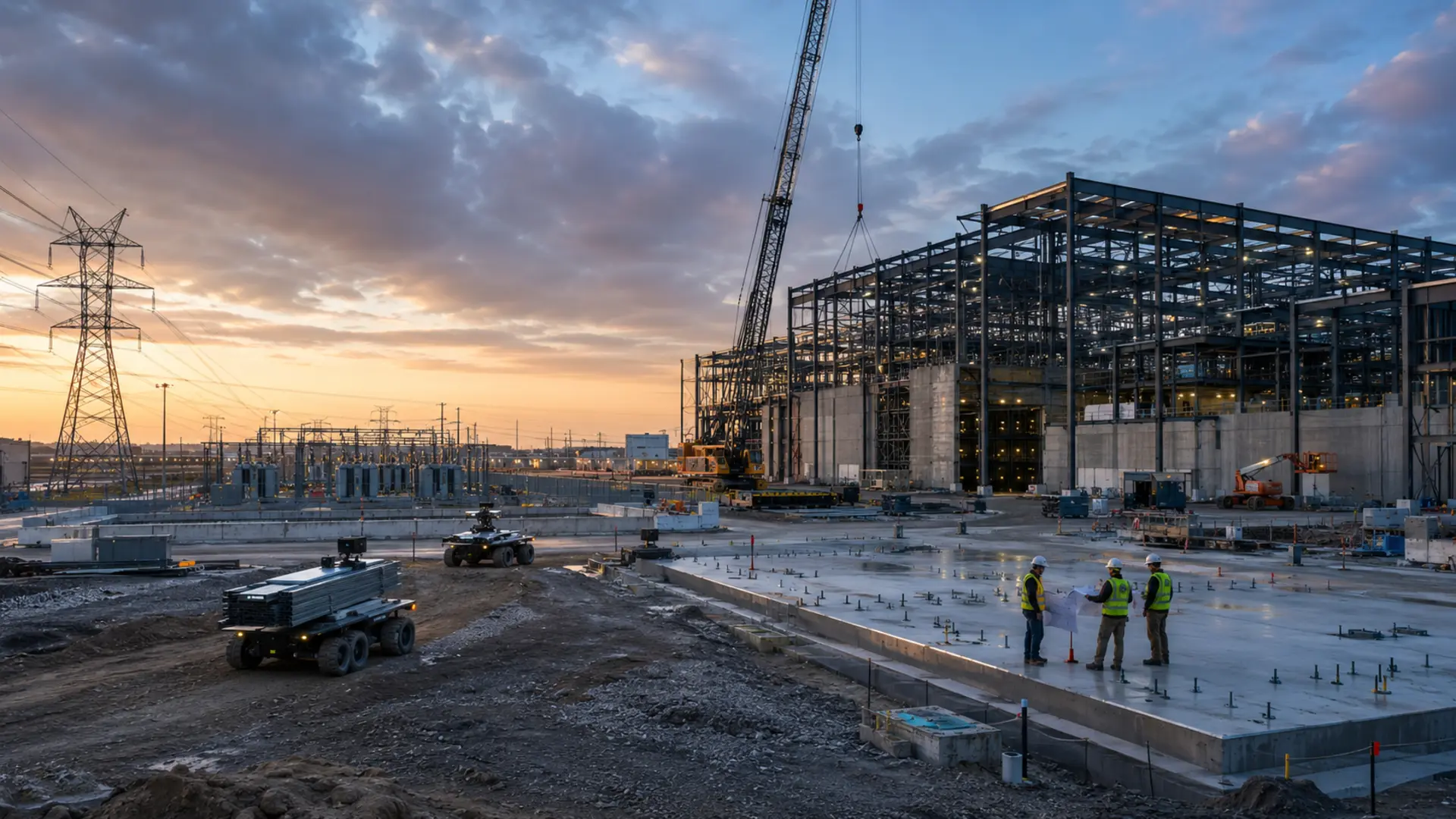
The second part of Reuters’ report is strategically even more revealing. The news agency said SoftBank has also selected Goldman Sachs, JPMorgan, Mizuho, and Morgan Stanley for the planned IPO of Roze, a robotics business focused on building data centers and improving the efficiency of AI infrastructure construction.
That angle fits prior reporting from Bloomberg and the Financial Times in late April that SoftBank was working on a U.S.-listed AI and robotics vehicle called Roze. Those earlier reports framed the project as part of Masayoshi Son’s effort to push beyond software ownership into the industrial systems needed to support the AI buildout.
Roze still looks less mature than SB Energy because there is no public IPO filing or equivalent corporate statement yet. Even so, the fact that Reuters now reports specific banking mandates suggests the idea has moved further inside SoftBank’s execution machinery and is no longer just a conceptual extension of Son’s AI rhetoric.
The AI Buildout Is Shifting From Chips to Power and Physical Delivery
The broader significance of the story is not simply that SoftBank may list two more assets. It is that both businesses sit in the areas where AI’s expansion is meeting real-world constraints: access to power, land, equipment, labor, and project delivery.
Those constraints are becoming investable themes in their own right. The more the market believes that compute demand will keep outrunning available infrastructure, the more value can migrate toward companies that unblock the construction and energy bottlenecks behind the next wave of data center growth.
SB Energy Sits at the Power Bottleneck Behind AI Growth
SB Energy has become one of the clearest examples of that shift. OpenAI said in January that it had partnered with SB Energy as part of Stargate, and that OpenAI and SoftBank would each invest $500 million into the company to help build next-generation AI and energy infrastructure in the United States.
OpenAI also said it selected SB Energy to build and operate its previously announced 1.2 gigawatt data center site in Milam County, Texas. According to that statement, SB Energy is developing several multi-gigawatt data center campuses, with initial facilities already under construction and expected to enter service starting in 2026.
SB Energy’s own website reinforces that operating scale. The company describes itself as a fully integrated U.S. data center and power platform, says it has raised more than $18 billion in project capital, lists roughly 5 gigawatts of operating and under-construction power capacity, and says it has three AI data centers in construction. That is why an SB Energy flotation would be read not as a generic renewable-energy listing, but as a direct market test for AI’s power layer.
SoftBank IPO Momentum Now Reaches the Labor and Build Cycle
Roze addresses a different bottleneck. If model demand keeps compounding and major operators continue announcing multi-gigawatt campus ambitions, the industry will need not only more electricity and equipment, but also faster and more repeatable ways to build the underlying physical plants.
That makes construction efficiency more consequential than it might have seemed in an earlier cloud cycle. Delays in permitting, site preparation, module installation, and labor coordination can now push back revenue recognition for everyone upstream and downstream, especially when demand for compute is arriving faster than traditional infrastructure timelines allow.
By tying Roze to robotics for data center construction, SoftBank appears to be betting that the next infrastructure premium will go not only to chip suppliers and landlords, but also to companies that compress the build schedule. If investors buy into that logic, Roze could help define a new public-market category inside AI infrastructure rather than merely ride an existing one.
What Investors and Rivals Will Watch Next
Even with the strategic logic in place, the story is still at an early stage. The most important unknowns now are whether SoftBank can turn ambitious internal plans into offerings that withstand public scrutiny on timing, financial disclosure, and execution credibility.
Those questions matter because the market has become more willing to reward infrastructure stories, but it is also demanding clearer proof that AI-linked capital spending can translate into durable returns instead of headline-heavy asset inflation.
Timing, Valuation, and Disclosure Will Shape the SoftBank IPO Test
For SB Energy, investors will want to see how much contracted or visible demand supports its development pipeline, how project financing is structured, and how exposed the business is to construction costs, interconnection delays, and wholesale power volatility. The confidential filing means those details are not public yet, but they will become central if the listing proceeds.
For Roze, the disclosure bar may be even higher. The company will need to prove that robotics applied to data center construction can become a repeatable, scalable business rather than an ambitious internal experiment wrapped in an AI narrative. That is especially true if the valuation expectations reported by earlier media coverage remain anywhere close to SoftBank’s internal aspirations.
SoftBank’s own willingness to keep leaning into OpenAI, Stargate, and U.S. infrastructure gives the plan a coherent strategic backdrop. But coherence alone will not settle the capital-markets question. Investors will still ask whether these entities are being listed because they have independently compelling economics, or because AI enthusiasm currently offers unusually rich terms for raising capital.
A Successful SoftBank IPO Cycle Could Reprice the Infrastructure Stack
If SB Energy and Roze both move ahead, the impact could reach beyond SoftBank’s balance sheet. Their reception would offer a live signal about whether public investors are prepared to fund the second-order beneficiaries of the AI boom at large scale, not just the companies selling compute directly.
That would matter for rivals across energy development, modular infrastructure, cooling, engineering services, specialized construction, and industrial automation. A strong reception could encourage more private operators to accelerate capital raises or listings around the same thesis, broadening the investable AI landscape well beyond chips and software.
It would also sharpen the competitive pressure on incumbents. If capital starts flowing more freely toward companies that can secure power and deliver campuses faster, the winners in AI may increasingly be those that control bottlenecks in the physical world, not only those with the best models or most advanced silicon.
SoftBank’s reported dual-IPO push is still partly source-based and far from complete, but the direction is clear: the market is beginning to treat AI infrastructure as an ecosystem of physical assets and industrial capabilities, not just a software-and-semiconductor story. Readers can continue following related coverage on investment, data centers, and technology strategy at Berrit Media.
Discover more from Berrit Media
Subscribe to get the latest posts sent to your email.