AI Infrastructure has become the latest arena for SoftBank Group’s global capital push after the Japanese investment company announced plans to develop and operate up to 5 gigawatts of artificial-intelligence data center capacity in France, representing investment of as much as €75 billion.
The commitment, announced by SoftBank on May 31 and tied to France’s 2026 Choose France summit, would begin with a €45 billion first phase aimed at delivering 3.1 gigawatts of capacity in the Hauts-de-France region by 2031. The company said the initial sites are planned for Dunkirk, Bosquel and Bouchain, positioning northern France as a major European compute corridor for AI companies, cloud providers, enterprises, public institutions and research organizations.
The announcement gives France one of Europe’s most visible bids to capture AI infrastructure spending at a moment when data centers, grid access, power equipment and high-performance computing capacity are becoming strategic industrial assets. It also extends SoftBank founder Masayoshi Son’s aggressive AI investment cycle beyond the United States, where the group is already associated with OpenAI and large-scale AI buildout ambitions.
SoftBank’s AI Infrastructure Bet Moves Into Europe
SoftBank framed the French plan as part of a broader race to build the physical systems needed for advanced artificial intelligence. The company said its commitment is designed to expand access to high-performance compute capacity in France and strengthen European technological sovereignty.
The scale matters because AI investment is no longer measured only by software products or model releases. The industry’s next stage depends on where companies can secure power, land, cooling systems, specialized components, skilled workers and enough financing to build data centers at industrial scale.
Why AI Infrastructure Is Becoming A National Strategy
SoftBank said the projects will support customers ranging from AI companies and cloud providers to public institutions and research organizations. That customer mix shows how AI infrastructure is becoming a shared foundation for business, government and scientific workloads rather than a narrow technology-sector asset.
France has been trying to position itself as a European AI hub, supported by nuclear-heavy electricity generation, industrial land, engineering talent and a national policy push around digital sovereignty. For policymakers, the ability to host large AI data centers can influence where startups scale, where cloud capacity is sold, and where strategic data workloads are processed.
The SoftBank announcement also reflects a larger global pattern. Major AI developers and their financial backers are moving closer to power markets, chip supply chains and construction partners because compute scarcity can limit product growth as much as talent or capital.
Why France Matters To SoftBank
SoftBank said the first phase would deliver 3.1 gigawatts of AI data center capacity in Hauts-de-France by 2031. The region’s proximity to Paris, Brussels, Amsterdam, London and Frankfurt gives it a geographic argument as a low-latency base for European workloads.
Reuters-syndicated reporting said Son described France’s role as an energy producer and exporter as decisive for AI infrastructure investment. That point goes to the center of the data center debate: AI compute requires reliable power at very large scale, and governments able to offer grid access may attract disproportionate investment.
The company’s official materials also emphasized France’s industrial capabilities and national ambition. That language signals that SoftBank is treating the project not only as a real-estate or cloud-capacity decision, but as a strategic partnership with a country trying to turn energy and manufacturing depth into AI-era leverage.
France AI Infrastructure Plan Links Data Centers And Manufacturing
The French buildout is not limited to server halls. SoftBank said it will work with Schneider Electric on a large-scale industrial production cluster at the Port of Dunkirk to support the data center program.
That manufacturing component is important because the AI infrastructure boom is putting pressure on equipment supply chains, from power modules and enclosures to cooling, grid interconnection and prefabricated systems. Faster deployment depends on whether developers can standardize and localize the components that turn available power into operating compute capacity.
Schneider Electric Brings The Power Layer
SoftBank said the Dunkirk cluster will include one facility operated by SoftBank to manufacture enclosures and another operated by Schneider Electric to integrate data center power modules. The companies aim to combine SoftBank’s robotics and automation capabilities with Schneider Electric’s energy technology and supply-chain expertise.
Schneider Electric chief executive Olivier Blum said in SoftBank’s release that the AI challenge is delivering speed and energy efficiency at scale. That comment reflects a practical constraint facing the industry: data centers must be built quickly, but they also need electrical systems that can handle dense AI workloads without overwhelming local grids or operating budgets.
For investors, this makes the supply chain around AI infrastructure as relevant as the operators themselves. Companies that provide electrical equipment, cooling, automation and modular systems may become beneficiaries of the AI capital cycle even when they do not train models or sell cloud services directly.
EDF And Local Sites Shape The Buildout
SoftBank said the first phase includes data centers in Dunkirk, Bosquel and Bouchain. Data Center Dynamics reported that state-owned EDF is partnering on the Bouchain development, with the site of a former power plant forming part of the plan.
Using former industrial or power-generation sites can help data center developers address some of the hardest questions around land use, power access and local acceptance. These sites may already have infrastructure advantages, though each project still faces permitting, environmental and community scrutiny.
SoftBank also announced a separate joint venture majority-owned by the company and formed with Sesterce to develop and operate a 1 gigawatt AI data center campus in Bosquel. The company said that project is expected to create 400 long-term skilled roles once operational, adding a local employment angle to a project that will otherwise be judged heavily on power use and compute capacity.
Investment Questions Surround The SoftBank Buildout
The AI infrastructure commitment gives SoftBank a larger European footprint, but it also raises familiar questions about funding, execution and timing. A plan of up to €75 billion is a strategic signal, not a completed data center network.
Large AI projects typically unfold across years and depend on permitting, grid connection, equipment availability, customer demand and financing conditions. For SoftBank, the France plan sits alongside other AI commitments that have already made the group one of the most closely watched investors in the sector.
SoftBank’s AI Infrastructure Financing Burden
Data Center Dynamics noted that SoftBank carries more than $130 billion in debt and had secured a $40 billion bridge loan in March to fund its latest OpenAI investment. That context matters because the French commitment arrives as the company is already tied to several large AI-related bets.
SoftBank has invested heavily in OpenAI and is linked to broader AI data center programs, including Stargate-related ambitions in the United States. The group has also been pursuing robotics, chip and infrastructure strategies that fit Son’s view that artificial intelligence will reshape industrial systems.
The question for markets is whether SoftBank can turn that conviction into operating assets with clear returns. AI infrastructure can produce durable cash flows when demand is strong, but it requires enormous upfront spending and exposes investors to construction delays, power pricing, hardware cycles and customer concentration.
Europe’s Compute Race Gets A Larger Benchmark
TechCrunch noted that SoftBank described the France plan as its largest AI infrastructure investment in Europe. If delivered, the project would give Europe a larger regional benchmark for what sovereign compute ambitions may require in capital and power terms.
The European debate over AI often focuses on regulation, model development and startup financing. SoftBank’s plan shifts attention to the less glamorous but decisive layer: electricity, transmission, industrial equipment, engineering capacity and data center operations.
That shift may pressure other governments to clarify how they intend to attract or manage AI data center investment. Countries with low-carbon power, faster permitting and stronger industrial suppliers may gain an edge, while regions with constrained grids could struggle to host the next wave of AI workloads.
AI Infrastructure Now Sits Between Growth And Constraint
The French announcement captures the central tension in the AI economy. Investors are willing to commit extraordinary sums to compute capacity, yet the infrastructure required to support that growth is increasingly visible to communities, utilities and governments.
For SoftBank, the France plan offers a chance to anchor a European AI platform around data centers, local manufacturing and sovereign technology policy. For France, it is a high-profile test of whether national energy and industrial strengths can translate into a durable position in global AI infrastructure.
Power And Sustainability Will Define The Debate
SoftBank said the French campuses will use advanced technologies to minimize environmental impact and water usage. That assurance is likely to remain under scrutiny because AI data centers are power-intensive and can become politically sensitive when local utilities, land and water resources are involved.
The company and its French partners are leaning on the argument that France’s grid and industrial base make the country well suited for large-scale AI compute. That argument may resonate with investors, but it will still need to be tested through permitting, construction milestones and public engagement.
The sustainability question is not separate from the investment case. Data centers that can secure reliable, lower-carbon power and efficient cooling may be better positioned with customers that face their own climate, cost and resilience targets.
What Comes Next For The French AI Infrastructure Push
The next milestones will be practical rather than rhetorical. Investors, customers and policymakers will watch for site-specific approvals, grid agreements, equipment orders, financing structures, construction schedules and tenant commitments.
The 2031 target for the first 3.1 gigawatts gives the project a long runway, but AI demand is moving quickly. SoftBank will need to show that the French program can move at a pace that matches customer needs while preserving the environmental and local-economic benefits highlighted in its announcement.
If the project advances, it could make northern France one of Europe’s most important AI compute regions. If delays or financing limits emerge, it would underscore how difficult it is to convert AI investment pledges into operating infrastructure at the scale now being promised.
SoftBank’s France plan shows that AI Infrastructure has moved from a technology-sector cost line into a strategic investment race involving governments, power companies, manufacturers and global capital. Readers can continue following related coverage on data centers, AI investment and digital sovereignty at Berrit Media.
Sources: SoftBank Group announcements on its France AI data center capacity plan and Bosquel joint venture; Reuters-syndicated reporting on SoftBank’s France investment plans; TechCrunch; Data Center Dynamics.
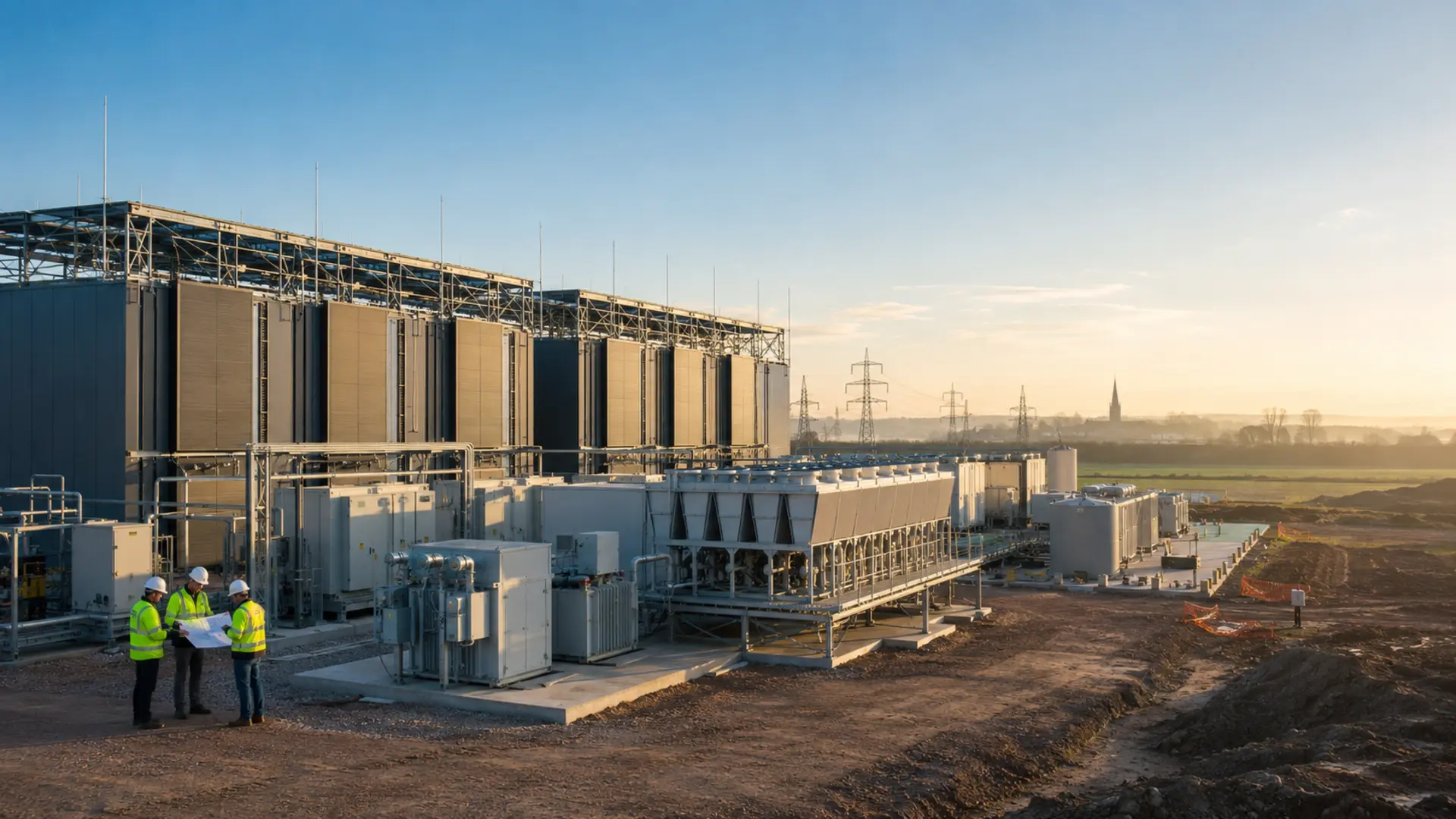
Featured Image Alt Text: AI Infrastructure data center construction site in France with power systems and server equipment.
Discover more from Berrit Media
Subscribe to get the latest posts sent to your email.