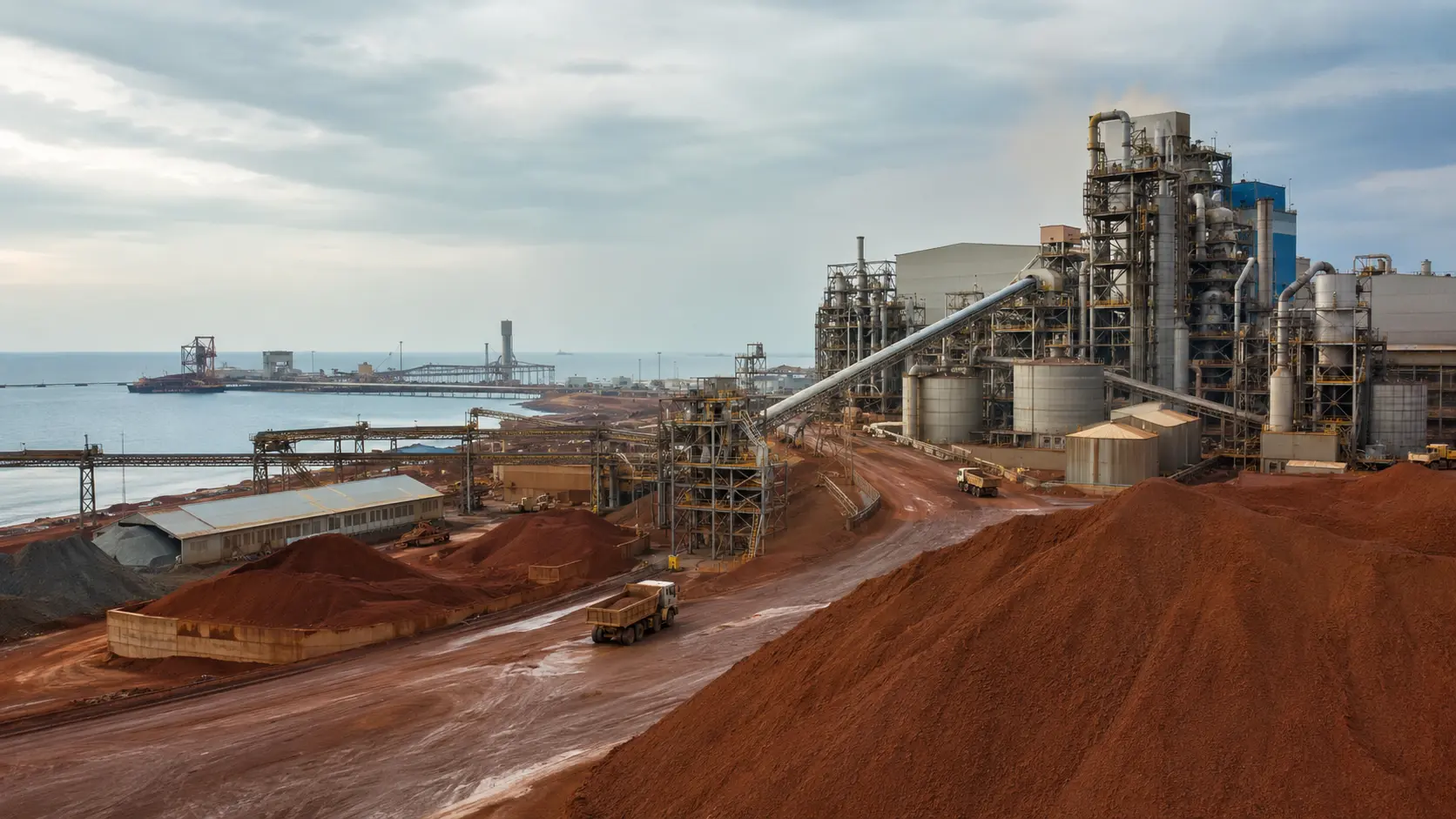
Guinea alumina is moving to the center of China’s metals strategy after Aluminum Corporation of China, or Chalco, approved a roughly $1 billion project to build a 1.2 million-ton-per-year alumina refinery in Guinea. The decision turns Chalco’s long-running bauxite presence in West Africa into a more ambitious refining push at a time when Beijing is trying to lock in more control over the industrial inputs that feed its aluminum system.
Chalco said the project will be developed through a Hong Kong subsidiary and that three of its subsidiaries signed an amended and restated mining agreement with the government of Guinea on May 21. The agreement still requires shareholder review and approvals from relevant agencies in Guinea, but the move signals a deeper commitment to local processing rather than relying only on ore extraction and shipment.
The timing matters beyond one company. Reuters reported in April that Guinea’s bauxite output jumped 25% in the first quarter of 2026, driven largely by Chinese demand, and that more than 70% of the country’s bauxite is shipped to China. Guinea’s government has also been pushing miners toward more domestic processing, making Chalco’s refinery plan a strategic fit for both Beijing’s supply-chain goals and Conakry’s industrial policy.
Why Guinea Alumina Matters to Chalco
Chalco’s plan is not simply a capacity addition. It represents a shift in where value is captured in the aluminum chain, moving part of the refining step closer to the ore source instead of leaving Guinea mainly as a raw-material exporter.
That distinction is important because alumina sits between mined bauxite and finished aluminum. A company that controls both the mine and the refinery gains more influence over cost, logistics, and resilience, especially when governments are becoming more assertive about resource ownership and local beneficiation.
Guinea alumina turns ore into processing control
For years, Guinea’s importance to the global aluminum market has rested on its vast bauxite reserves and export flows to China. What Chalco is now proposing is a more integrated industrial model: mine the ore, refine more of it locally, and reduce dependence on separate processing chains farther downstream.
That matters because alumina refining is where mining strategy becomes industrial strategy. The more upstream steps a producer can internalize, the less exposed it may be to freight swings, policy shocks, or bottlenecks that emerge when ore, refining, and smelting are spread across too many jurisdictions.
In practical terms, the project gives Chalco a way to tie its Guinea mining rights more directly to a long-term processing asset. Instead of treating Guinea mainly as a source of feedstock, the company would be turning the country into a more important node in its international production footprint.
Chalco is moving beyond raw bauxite exports
Chalco’s disclosure shows that the company’s subsidiaries had already secured bauxite mining rights in the Boffa north and south deposits under a 2018 agreement with Guinea. The new agreement expands that relationship into refining, suggesting the company believes the economics and policy direction now support a bigger local build-out.
The company also said the board had approved the planned investment as early as June 26, 2025, but delayed public disclosure because an earlier announcement could have hurt the project’s progress. That detail suggests the refinery was not a sudden reaction to a market headline, but a transaction that required extended negotiation and execution work before being ready for public scrutiny.
If completed, the Guinea facility would be Chalco’s first alumina project abroad, according to market reporting on the filing. That gives the decision extra weight because it moves the group from overseas resource extraction into overseas midstream processing, a step with broader implications for how Chinese industrial champions manage supply security.
What the Guinea Agreement Changes
The immediate development is the amended and restated mining agreement signed on May 21 between Chalco-linked entities and the Guinean government. That updated framework appears to provide the legal and commercial basis for moving from a mining-centered presence into an integrated refinery plan.
Even so, the project is not yet fully cleared. Chalco said the agreement still needs shareholder review and approval from the relevant Guinean authorities, meaning the company has advanced the project materially but still faces execution gates before construction and commissioning can become certain.
The Guinea alumina project revives a delayed disclosure
One of the more unusual features of Chalco’s filing is that the board approval dates back to mid-2025. In effect, investors are only now seeing a deal path that the company believed had become sensitive enough to keep confidential while negotiations and project conditions were still developing.
That delayed disclosure changes the story from a routine Friday announcement into a sign of how long strategic resource deals can take to mature. Cross-border mining projects often depend on permitting, host-government negotiations, transport planning, and clarity over fiscal or ownership terms, all of which can stretch timelines well beyond the initial board decision.
For Berrit Media readers, that is the real signal: Chalco is willing to carry a long development cycle to secure a more durable position in Guinea. That patience tends to characterize projects aimed at reshaping supply chains rather than chasing a short commodity-price move.
Guinea gets a larger stake in local processing
The project also fits Guinea’s own policy direction. Reuters reported earlier this year that the government was considering export curbs and accelerating plans for domestic alumina refineries to reduce its dependence on shipping raw ore abroad.
Seen through that lens, Chalco’s plan looks like a commercial response to host-country pressure as much as a Chinese supply move. Guinea wants more industrial value created at home, while miners want to protect access to reserves in a market where resource nationalism and local-processing demands are rising.
That alignment does not eliminate risk, but it does help explain why this project could progress where a pure extraction expansion might face more friction. When the host government can point to refining capacity, jobs, and industrial upgrading, a mining agreement becomes easier to defend politically.
What It Means for China’s Aluminum Chain
At a broader level, the project speaks to how China is managing exposure across critical industrial inputs. Aluminum is not framed as dramatically as semiconductors or rare earths, but it remains essential to transport, packaging, construction, power infrastructure, and parts of the energy transition.
That makes upstream control more valuable than a narrow commodity story might suggest. A refinery in Guinea would not transform the market overnight, but it would deepen Chinese influence over a part of the aluminum chain that starts at the mine and runs through refining into broader industrial production.
Guinea alumina could hedge policy risk
China’s heavy reliance on Guinean bauxite has created scale, but it also creates concentration risk. When one country becomes central to feedstock supply, any export restriction, permitting dispute, or transport disruption can reverberate across downstream producers.
Adding refining capacity inside Guinea is one way to adapt to that reality. If Guinea is determined to capture more value from its mineral wealth, Chinese groups that invest in local processing may be better positioned than those trying to preserve a simple dig-and-ship model.
From that perspective, Chalco’s refinery plan looks like a hedge against future policy tightening. It is a way of staying aligned with Guinea’s development agenda while preserving long-term access to a resource base that matters deeply to China’s aluminum ecosystem.
Chalco faces execution and approvals before returns
None of that means the project is risk free. The filing makes clear that approvals are still required, and large refining investments in frontier mining jurisdictions can face delays tied to infrastructure, permitting, power supply, and cost inflation.
There is also the challenge of turning a strategically sound asset into an economically disciplined one. Alumina refineries are capital-intensive, sensitive to energy and logistics costs, and exposed to shifts in commodity prices, so execution will matter as much as headline scale.
Still, the strategic logic is easy to see. Chalco, which describes itself as one of the world’s largest aluminum groups, is using Guinea not just as an ore source but as a platform for deeper industrial presence abroad, and that makes this deal more significant than a standard mining expansion announcement.
Chalco’s Guinea alumina project is therefore best read as a supply-chain upgrade with geopolitical and industrial overtones, not merely as another metals investment. Readers can continue following related business, commodity, and industrial-policy coverage at Berrit Media.
Discover more from Berrit Media
Subscribe to get the latest posts sent to your email.