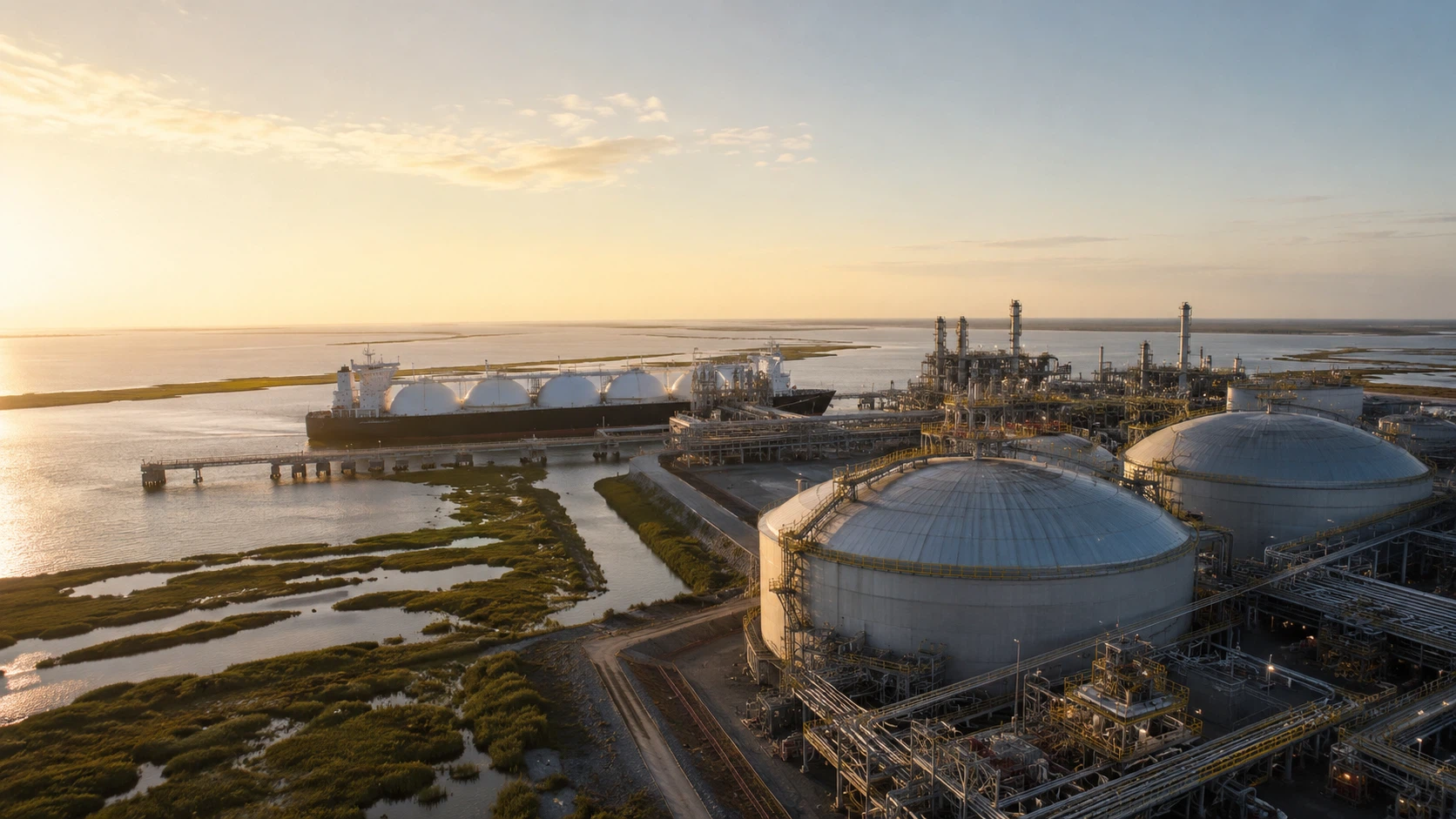
Commonwealth LNG moved from planning to full construction on May 15 after Caturus said it had closed $9.75 billion in project financing for the 9.5 million-tonnes-per-annum export terminal in Cameron Parish, Louisiana. The decision gives one of the largest remaining US liquefied natural gas developments a final green light as buyers search for long-term supply outside politically disrupted regions.
Reuters reported that the financing package allows the company to start building the plant, while Caturus and Mubadala Energy said the final investment decision marks the start of full construction and brings total equity and debt commitments tied to the project to $21.25 billion. Operations are expected to begin in 2030, according to the company and its investors.
Why Commonwealth LNG Reached Final Investment Decision
Caturus has spent months trying to turn Commonwealth LNG from a permitted Gulf Coast export idea into a fully financed project with committed buyers, equipment orders and strategic backers. Friday’s announcement showed that the company believes those pieces are now sufficiently locked in to move beyond pre-construction work.
The timing also matters. LNG developers have been trying to prove that new US export capacity can still win financing even after years of cost inflation, regulatory scrutiny and shifting demand assumptions. In that sense, Commonwealth LNG is more than a single project milestone. It is also a test of whether capital markets still support large-scale US gas export infrastructure with a credible commercial structure.
Commonwealth LNG financing pulls in blue-chip backers
The financing package itself was broad. Caturus said Kimmeridge, Mubadala Energy and CPP Investments all participated, while other financial partners included EOC Partners, funds and accounts managed by BlackRock, and an Ares Infrastructure Opportunities fund. That matters because large LNG projects typically need a mix of sponsor capital and outside financing before lenders are willing to support full construction.
Mubadala Energy said it already held a 24.1% stake in the wider Caturus platform and remained an equity participant in the project financing. CPP Investments said it would contribute $1.2 billion, lifting its total stake in Caturus to 31% including previous investments. Those figures suggest the project is being backed not only by debt providers but also by shareholders willing to deepen their exposure as construction begins.
Caturus and Mubadala both said investor demand was strong enough to produce total commitments of $21.25 billion. The company did not frame that only as a financing event. It presented the close as confirmation that its integrated model, which combines upstream gas production with LNG export capacity, has become investable at scale.
Commonwealth LNG contracts helped reduce development risk
Commercial contracts were another important part of the story. Caturus said long-term offtake agreements had already been secured with EQT, Glencore, Mercuria, PETRONAS and Aramco Trading. For LNG developers, those contracts are often the difference between a project that remains theoretical and one that can convince financiers it has a durable revenue base.
Reuters, citing Mubadala Energy, reported the same customer lineup and said the project is expected to start operations in 2030. That alignment between the company announcement and outside reporting strengthens the core timeline and customer picture. It also shows that Commonwealth LNG is not moving ahead on hope alone. It is moving ahead with buyers already attached.
The company has also been advancing procurement. Caturus said Technip Energies had already been authorized to order major long-lead equipment, while Baker Hughes, Honeywell and Solar Turbines equipment is slated for the facility. Those details help explain why the final investment decision arrived now rather than later: key engineering and commercial elements were already being lined up for a full construction launch.
What Commonwealth LNG Means for Louisiana and US Export Capacity
Commonwealth LNG is not the biggest US LNG project under development, but it is large enough to matter for the next wave of Gulf Coast export capacity. A 9.5 mtpa terminal can materially expand shipping volumes, reshape local contractor activity and deepen the concentration of export infrastructure along the Louisiana coast.
The project also arrives as the United States retains its position as the world’s largest LNG exporter. Reuters said elevated global LNG prices and supply disruption linked to the Iran war have kept attention on non-Middle East supply, giving new US capacity a more urgent commercial backdrop than developers faced in calmer markets.
Commonwealth LNG strengthens the next Gulf Coast build cycle
For the US industry, the final investment decision is a signal that the Gulf Coast buildout is continuing rather than pausing. Many proposed terminals struggle to pass the same threshold because they fail to secure enough financing, contracts or political support. Commonwealth LNG cleared those hurdles this week, making it part of the group of projects that now looks real rather than aspirational.
Caturus said phase one of the project should generate more than $3 billion in annual export revenue once the terminal is online. That figure is the company’s projection, not a guaranteed outcome, but it illustrates the scale of the facility it is trying to build. The terminal will also be capable of loading LNG carriers of up to 216,000 cubic meters, underscoring its intended role as a full-scale export asset rather than a niche facility.
The company is framing the terminal as the downstream pillar of a broader integrated gas platform. In the weeks before the financing close, Caturus said it expanded upstream holdings through the acquisition of Galvan Ranch assets from SM Energy. It added that the platform is now producing more than 1 billion cubic feet equivalent per day on a net basis and ranks among the top 10 private US natural gas pure-play producers. That claim comes from the company, but it helps explain how management wants investors to view Commonwealth LNG: not as a standalone terminal, but as part of a larger supply chain business.
Louisiana is using Commonwealth LNG to reinforce its energy pitch
State officials quickly tied the project to a broader economic narrative. Louisiana Economic Development said the final investment decision pushed the state past $100 billion in announced capital investment projects since Governor Jeff Landry took office in January 2024. The agency also said Commonwealth LNG would strengthen Louisiana’s position as a global energy hub while generating more than $3 billion in annual export revenue once operations begin in 2030.
That official framing is naturally promotional, but it reflects something real about the competition for energy infrastructure. States want these projects because they bring construction work, supplier demand, tax revenue and long-duration industrial activity. LNG projects are especially valuable in that contest because they combine energy, logistics, port access and export earnings in one development package.
Louisiana’s advantage has long rested on geography, existing energy infrastructure and a workforce used to heavy industrial projects. Commonwealth LNG adds another data point to that argument. If construction stays on schedule, the terminal will further bind Cameron Parish and the wider Gulf Coast to the next chapter of the global gas trade.
Why Global Buyers and Investors Are Watching Commonwealth LNG
The story resonates beyond Louisiana because it sits at the intersection of energy security, project finance and geopolitics. Buyers in Asia and Europe have spent the last several years trying to diversify supply away from concentrated risk, even while keeping an eye on price, shipping economics and contract flexibility.
That is why the project’s offtake roster matters as much as the financing package. The presence of traders and strategic buyers such as Glencore, Mercuria, PETRONAS and Aramco Trading shows that different parts of the market still want long-term access to new US molecules, even after repeated debates about energy transition timelines and future gas demand.
Commonwealth LNG lands as energy security regains urgency
Reuters said the United States has played a key role in supplying Asia during the current Middle East crisis and that global LNG prices have stayed elevated as conflict-related disruption removed part of supply from the market. That context gives extra weight to Friday’s announcement. A project that might once have been judged mainly on economics is now also being judged on supply resilience.
In practical terms, that supports the commercial case for US export capacity. Buyers worried about disruption often accept that diversification carries a cost, especially when alternative supply routes look fragile. Commonwealth LNG does not solve that problem overnight, since operations are still years away, but it adds another future source of Gulf Coast supply to the long-term planning map.
The project’s customer mix also reflects that logic. Trading houses, national energy champions and industrial counterparties all want optionality in volatile markets. Caturus is betting that a fully contracted US export terminal with upstream backing will look more attractive in that environment than a merchant-style project exposed to greater price swings.
Investors are backing integrated LNG strategies again
There is also a capital-markets angle here. LNG projects have always required enormous patience from investors because the cash comes much later than the spending. What Friday’s announcement suggests is that investors are still prepared to fund long-cycle energy infrastructure when the commercial structure is clear and the sponsor group is credible.
Caturus has leaned heavily on its “wellhead-to-water” description to make that case. The idea is that control over upstream gas supply and export infrastructure can reduce risk, improve visibility and create more strategic flexibility over time. Whether the model proves superior will depend on execution, costs and market conditions, but it has clearly been persuasive enough to attract partners willing to write large checks now.
That combination of project finance, equity support and contracted offtake is what makes Commonwealth LNG a story worth watching. It shows that even in a market crowded with proposed terminals, capital is still available for projects that can demonstrate scale, counterparties and a believable route to operation.
Commonwealth LNG now moves from financing headlines to construction risk, execution discipline and a long wait for first cargoes in 2030. For readers tracking how capital, policy and industrial demand are reshaping global energy trade, there will be more to follow on this story and related coverage at Berrit Media.
Discover more from Berrit Media
Subscribe to get the latest posts sent to your email.