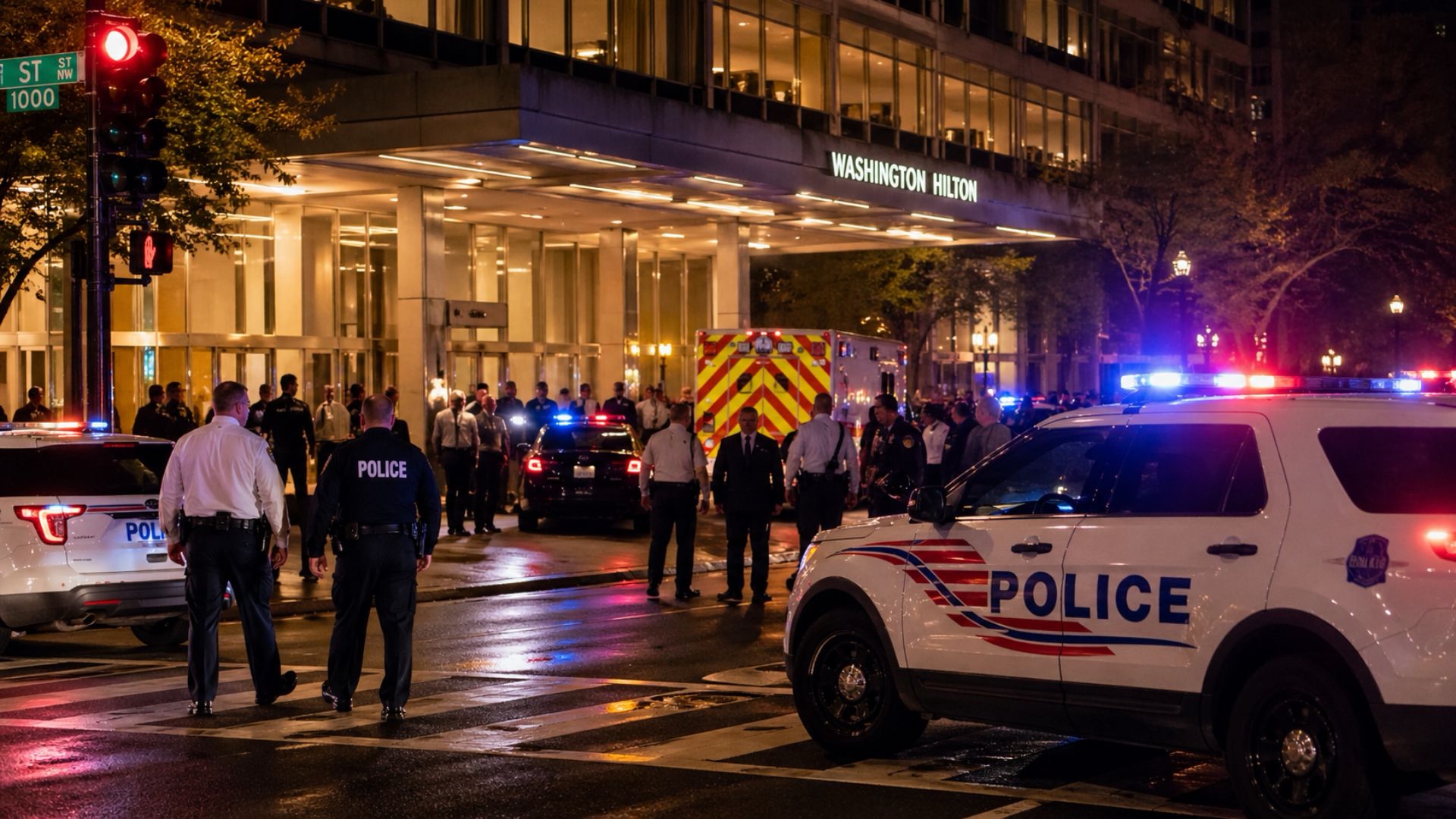
WHCD Shooting forced the rapid evacuation of President Donald Trump from the White House Correspondents’ Dinner in Washington after a suspect reportedly opened fire near the event’s security area. The incident disrupted one of the most visible nights on the American political and media calendar, turning a formal dinner into a major security emergency. Trump was reported safe and uninjured, while other senior officials were also moved away from the venue under Secret Service protection.
The shooting took place at the Washington Hilton, where the annual dinner had gathered political leaders, media executives, journalists, and senior members of the administration. Reports said First Lady Melania Trump, Vice President JD Vance, and Cabinet officials were among those present when the security response began. Authorities later said a suspect was in custody, and one law enforcement officer was struck in protective equipment but was expected to recover.
WHCD Shooting Turns Formal Dinner Into Security Emergency
The incident began as the dinner was underway inside the hotel ballroom. Guests heard loud noises that witnesses described as gunfire, prompting confusion across the venue. Secret Service personnel moved quickly to secure Trump and other protected officials, while attendees inside the ballroom took cover.
The White House Correspondents’ Dinner is usually a ceremonial gathering between Washington’s political class and the press corps. However, the WHCD Shooting immediately shifted attention from media politics to physical security, emergency coordination, and the vulnerability of large political events held outside government-controlled facilities.
WHCD Shooting Triggers Immediate Evacuation
Secret Service agents moved Trump away from the ballroom after the security breach. The response followed standard protective protocols for a potential armed threat near a sitting president. Reports said armed personnel moved through the venue as guests remained uncertain about the origin and scale of the threat.
Trump later appeared at the White House and said the officer who was hit had been protected by a ballistic vest. He also said the officer was doing well after the incident. Two law enforcement officials also confirmed that a vest stopped the bullet, according to reporting from Washington.
The evacuation also included other protected officials. Vice President JD Vance and senior Cabinet members were moved away from the scene as authorities worked to secure the hotel. The incident underlined how quickly a symbolic public event can become a controlled security operation when a weapon is involved.
Suspect Detained After Security Breach
Authorities said the suspect was armed with a shotgun, a handgun, and multiple knives as he moved through a Secret Service checkpoint. Officials also said he was running in the direction of the ballroom before personnel stopped him. The suspect was not shot, but he was taken to a hospital for evaluation.
The Associated Press reported that the suspect was identified as Cole Tomas Allen, 31, of Torrance, California, citing law enforcement officials. Washington Mayor Muriel Bowser said there was no immediate indication that anyone else was involved, while police described the suspect as a likely lone actor.
The suspect’s reported status as a hotel guest raised immediate questions about event access, screening placement, and the distance between public hotel areas and the ballroom. Axios reported that the gunman was apprehended before reaching the magnetometers and that the security equipment was positioned near the ballroom rather than at the hotel entrance.
Security Questions Grow Around Washington Hilton
The Washington Hilton has long been associated with major political events in Washington. Its role as a private hotel, however, creates a different risk profile from the White House or other federal buildings. That distinction became central after the shooting, as officials and attendees assessed how an armed suspect reached the event’s security perimeter.
The WHCD Shooting also revived concerns about the safety of high visibility political gatherings. In a polarized environment, political leaders face threats not only at campaign rallies but also at private venues, dinners, conferences, and media events.
WHCD Shooting Raises Screening Concerns
The placement of magnetometers became a key point after the attack. If screening is located close to a ballroom entrance, an armed person may enter the hotel before encountering the most secure checkpoint. That creates a wider area of exposure for guests, staff, and security teams.
Officials will likely review whether the screening perimeter should have started earlier inside the hotel or outside the building. For events involving a sitting president, the controlled area usually matters as much as the screening device itself. A weapon intercepted near the ballroom can still trigger panic and expose officers to danger.
Moreover, private venues often involve multiple entrances, hotel guests, staff corridors, elevators, and service areas. Each access point adds operational complexity. Therefore, the investigation may focus not only on the suspect’s actions but also on how the event perimeter was designed.
Political Events Face A Harder Threat Landscape
The WHCD Shooting comes at a time when political security has become more demanding. Large public events now require coordination between federal protection teams, local police, hotel security, emergency medical responders, and venue managers.
This incident showed that threats can emerge inside spaces that appear controlled. A formal dinner with assigned seating, press credentials, and official guests still depends on layered security. If one layer is tested, the entire event can change within seconds.
Meanwhile, the public nature of such gatherings adds pressure. Attendees often record incidents on phones, partial details spread quickly, and early reports can change as investigators gather evidence. That makes disciplined communication essential during the first hours after a security breach.
Federal Charges And Investigation Move Forward
Federal prosecutors are expected to move the case into court quickly. U.S. Attorney Jeanine Pirro said the suspect would face two counts of using a firearm during a crime of violence and one count of assault on a federal officer with a dangerous weapon. She said the suspect was expected to appear in court on Monday.
The investigation remains active. Officials must determine motive, planning, weapon access, the suspect’s movements inside the hotel, and whether any security gaps allowed the incident to escalate. Authorities have said there was no reason to believe others were involved, but that conclusion may be reviewed as evidence develops.
WHCD Shooting Puts Federal Protection Under Review
The Secret Service will face scrutiny over how the suspect reached the checkpoint area. However, the rapid evacuation and detention also show that the protective response worked once the threat emerged. Trump and other officials were moved away, and the suspect was stopped before reaching the ballroom.
The officer’s injury also places attention on protective equipment. The ballistic vest appears to have prevented a far more serious outcome. In that sense, the incident may reinforce the importance of tactical readiness at events where threats are statistically rare but potentially severe.
In addition, federal and local agencies will likely review communications during the incident. Clear command structure matters during a fast-moving attack. The coordination between Secret Service, Metropolitan Police, venue staff, and federal prosecutors will become part of the broader assessment.
Legal Process Begins As Motive Remains Unclear
The announced charges indicate that prosecutors view the incident as a serious violent offense involving a firearm and a federal officer. Those charges could carry significant penalties if proven in court. However, the suspect remains legally presumed innocent unless convicted.
Motive remains one of the biggest unanswered questions. Officials described the suspect as a lone actor, but investigators still need to examine his background, communications, weapons, travel, hotel access, and possible planning. That work may take days or weeks.
The court process will also shape the public record. Initial charging documents may reveal more details about the alleged weapon use, the officer’s injury, the suspect’s route through the hotel, and the timeline before detention.
The WHCD Shooting turned a ceremonial Washington event into a national security story within minutes. Trump’s safety prevented a deeper crisis, but the incident exposed difficult questions about venue security, political threats, and protection planning. Continue reading related coverage on Berrit Media for further analysis of political risk, public security, and institutional response.
Discover more from Berrit Media
Subscribe to get the latest posts sent to your email.