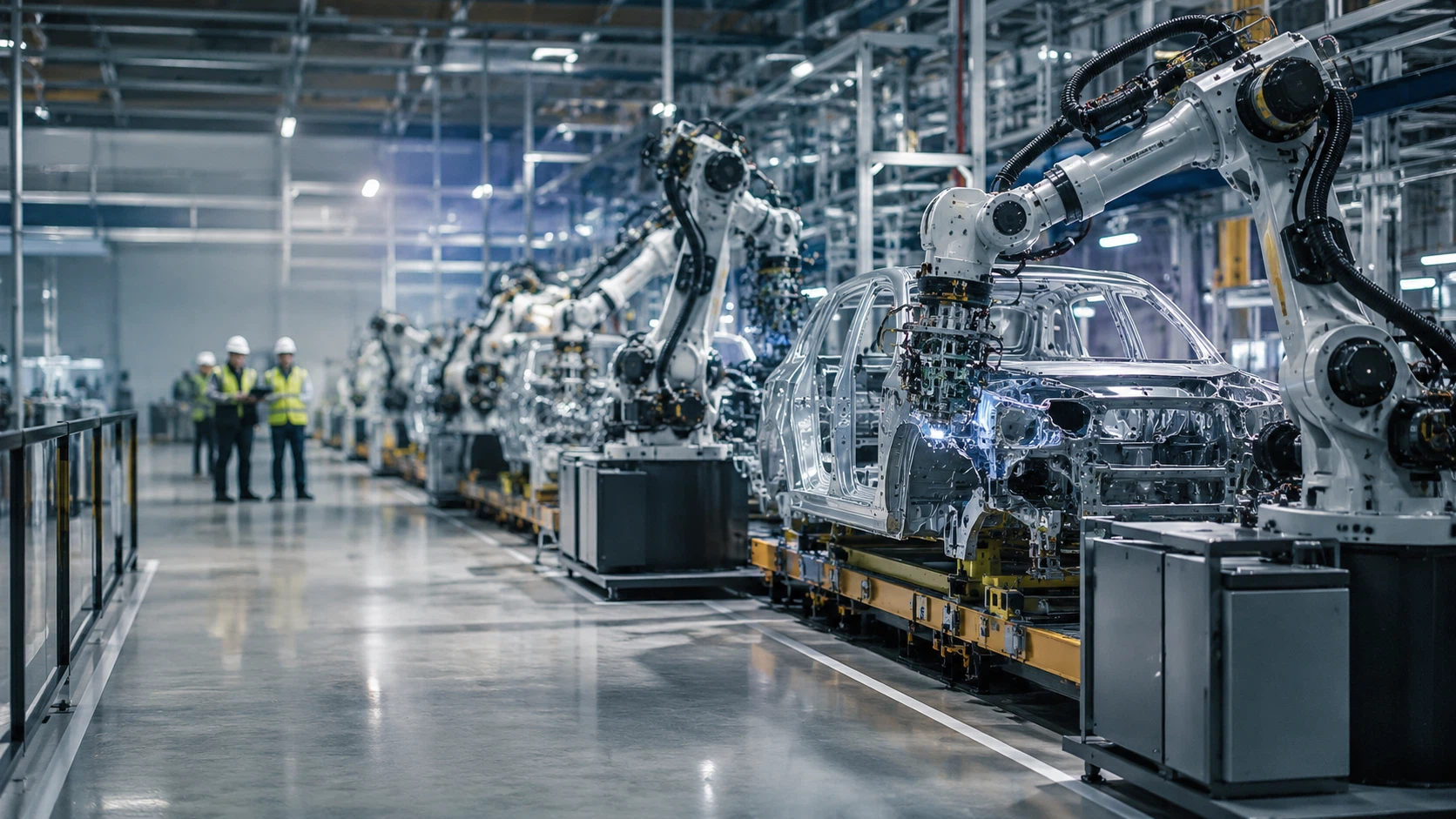
Mind Robotics is moving deeper into the industrial mainstream after the startup announced a new $400 million funding round, a deal Reuters reported values the company at about $3.4 billion. The raise matters because it shows investors are willing to fund not only AI software and data centers, but also the hard operational work of putting AI-driven robots into live factory environments.
According to Mind Robotics, the round was led by Kleiner Perkins and pushes the company’s total funding above $1 billion in less than a year. Reuters said the valuation has climbed sharply from roughly $2 billion in the company’s March Series A round, underscoring how quickly capital is moving toward startups that promise to connect artificial intelligence with real-world manufacturing output.
Mind Robotics Funding Signals a New Phase for Factory AI
The latest round lands at a time when the AI market is broadening beyond chatbots, code assistants, and cloud infrastructure. Investors are increasingly asking where machine learning can create durable value in sectors that still depend on physical processes, labor coordination, and costly production downtime.
That is where Mind Robotics is trying to position itself. In its funding announcement, the company said it is building an AI-native robotics platform that combines foundation models, purpose-built robots, and deployment infrastructure for industrial settings. Kleiner Perkins, which led the round, described the company as an attempt to bring software-style learning loops into factory automation.
Why Mind Robotics is attracting new capital
The company’s pitch is broader than a single robot or a narrow automation tool. Mind Robotics says it is building a full stack that includes models, hardware, and the operational systems needed to deploy robotics in manufacturing plants. That integrated approach gives investors a larger market story than a pure component supplier or a research-only AI startup.
Reuters reported that the new financing follows a rapid sequence of earlier fundraising, including a $125 million seed round and a $250 million Series A in March. That pace suggests backers see an opening to build scale before traditional industrial players or larger technology groups lock up the most valuable customers, talent, and deployment data.
The investor roster also supports the argument that this is more than a niche robotics bet. Alongside Kleiner Perkins, the company said the round included Meritech, Redpoint, SV Angel, Incharge, A-Star, and Garuda. Such a syndicate signals confidence that factory automation could become a major commercial layer of the wider AI economy rather than a side category.
How the company plans to use the Mind Robotics funding
Mind Robotics said the fresh capital will be used to scale deployments, expand its customer base, and keep building its technology platform. The company has framed the opportunity as much larger than one factory or one industry, arguing that robotics systems improve most when they are trained and refined in real production environments.
Kleiner Perkins said the platform is being designed for high-volume manufacturing, where reliability and feedback loops matter more than flashy demos. That emphasis matters because industrial buyers usually care less about novelty than about whether a system can reduce bottlenecks, operate safely, and improve throughput over time.
The use of funds also reflects the economics of robotics. Unlike many software startups, companies in this space need capital not only for engineering talent but also for hardware development, testing, field operations, and deployment support. The new round gives Mind Robotics more room to absorb those costs while trying to expand beyond its initial footprint.
Rivian Gives Mind Robotics an Early Industrial Edge
A major reason the startup has drawn attention is its tie to electric-vehicle maker Rivian. Mind Robotics and its investors say Rivian’s facilities provide a live, high-volume manufacturing setting where the company can train, test, and refine its systems under real operational pressure rather than in controlled lab conditions.
That relationship gives the startup a credibility advantage in a market filled with ambitious robotics claims. Many AI companies can show prototypes. Fewer can point to a demanding industrial partner where performance can be evaluated against production targets, downtime risk, and the daily realities of running a modern factory.
Why live production data matters for Mind Robotics
For robotics companies, real-world data can be as important as capital. Factory floors generate a constant stream of signals about movement, timing, quality control, safety constraints, and process variation. Access to those signals can help a company improve how its systems perceive environments, respond to exceptions, and adapt to changing production conditions.
Kleiner Perkins said Rivian’s manufacturing environment gives Mind Robotics the kind of feedback loop that is difficult to recreate synthetically. That is a meaningful point because many robotics systems still struggle when they move from clean demos into noisy industrial settings with changing layouts, supply disruptions, and imperfect materials.
The value of live production data also helps explain the speed of the fundraising. Investors often reward AI companies that control scarce inputs, whether that means proprietary data, distribution, or compute access. In this case, Mind Robotics appears to have a direct route into manufacturing conditions that competitors may find hard to replicate quickly.
What the Rivian link means for commercial credibility
Reuters reported that Rivian is both a key partner and a shareholder, giving the relationship financial as well as operational significance. That does not guarantee commercial success, but it does provide a stronger validation signal than a simple pilot announcement or research collaboration.
For potential customers, an early tie to a known manufacturer can lower perceived risk. Industrial buyers tend to adopt new automation systems cautiously because mistakes can disrupt output, affect worker safety, or create quality problems. A startup that can point to an active relationship inside a complex production setting starts that sales conversation from a stronger position.
At the same time, the Rivian connection may shape how the market judges Mind Robotics over the next year. Buyers and investors will want to know whether the company can translate one close partnership into a broader customer pipeline across other automotive or industrial manufacturing environments. That expansion test will matter as much as the funding headline itself.
Factory Automation Is Becoming a Bigger AI Investment Theme
The broader significance of the deal is that AI capital keeps moving outward from the digital layer into the physical economy. Over the past year, investors have poured money into chips, cloud services, model developers, and power infrastructure. Mind Robotics suggests they are now looking more seriously at factories as another place where AI may produce measurable economic returns.
That shift makes strategic sense. Manufacturers face persistent pressure around labor availability, quality control, cycle time, and the cost of downtime. If AI systems can make robots more flexible, easier to train, and more effective in changing environments, factory automation could become one of the more durable commercial use cases in the next stage of the market.
How Mind Robotics fits the wider AI funding cycle
The round fits a pattern that has defined much of 2026: investors are still chasing AI, but the categories are widening. Capital is no longer going only to foundation model companies or cloud platforms. It is also moving into infrastructure, industrial tools, and sector-specific systems that can turn AI capability into revenue inside established industries.
Mind Robotics is well placed in that narrative because it sits at the intersection of software, hardware, and operations. That mix can be harder to scale than pure software, but it may also prove harder to displace if deployments work. For investors, that can justify larger bets even when commercialization takes longer and execution is more demanding.
Moreover, the company offers exposure to a part of AI that business customers can evaluate in practical terms. Factory managers do not need an abstract promise about intelligence. They need better throughput, lower error rates, safer processes, and more resilient production lines. Startups that can link AI directly to those outcomes may keep attracting capital even if broader market sentiment becomes more selective.
Risks remain as Mind Robotics scales
The funding round does not remove the usual risks around private-company valuations, deployment complexity, and customer concentration. Reuters attributed the $3.4 billion valuation to a person familiar with the matter, which means outside investors still have limited public visibility into revenue, margins, or the pace of commercial adoption.
Execution will also be demanding. Scaling robotics across factories requires more than good models. It involves integration with existing equipment, worker training, maintenance support, safety procedures, and proof that systems perform reliably across different production environments. Those are long sales cycles and operationally heavy deployments.
Even so, the size and speed of the new round send a clear signal about where investors think the next AI battleground may be. Mind Robotics is becoming a test case for whether factory automation can absorb venture-scale capital and convert it into repeatable industrial value. Continue reading related coverage at Berrit Media for more on the companies, capital flows, and technologies shaping the next phase of the global economy.
Discover more from Berrit Media
Subscribe to get the latest posts sent to your email.