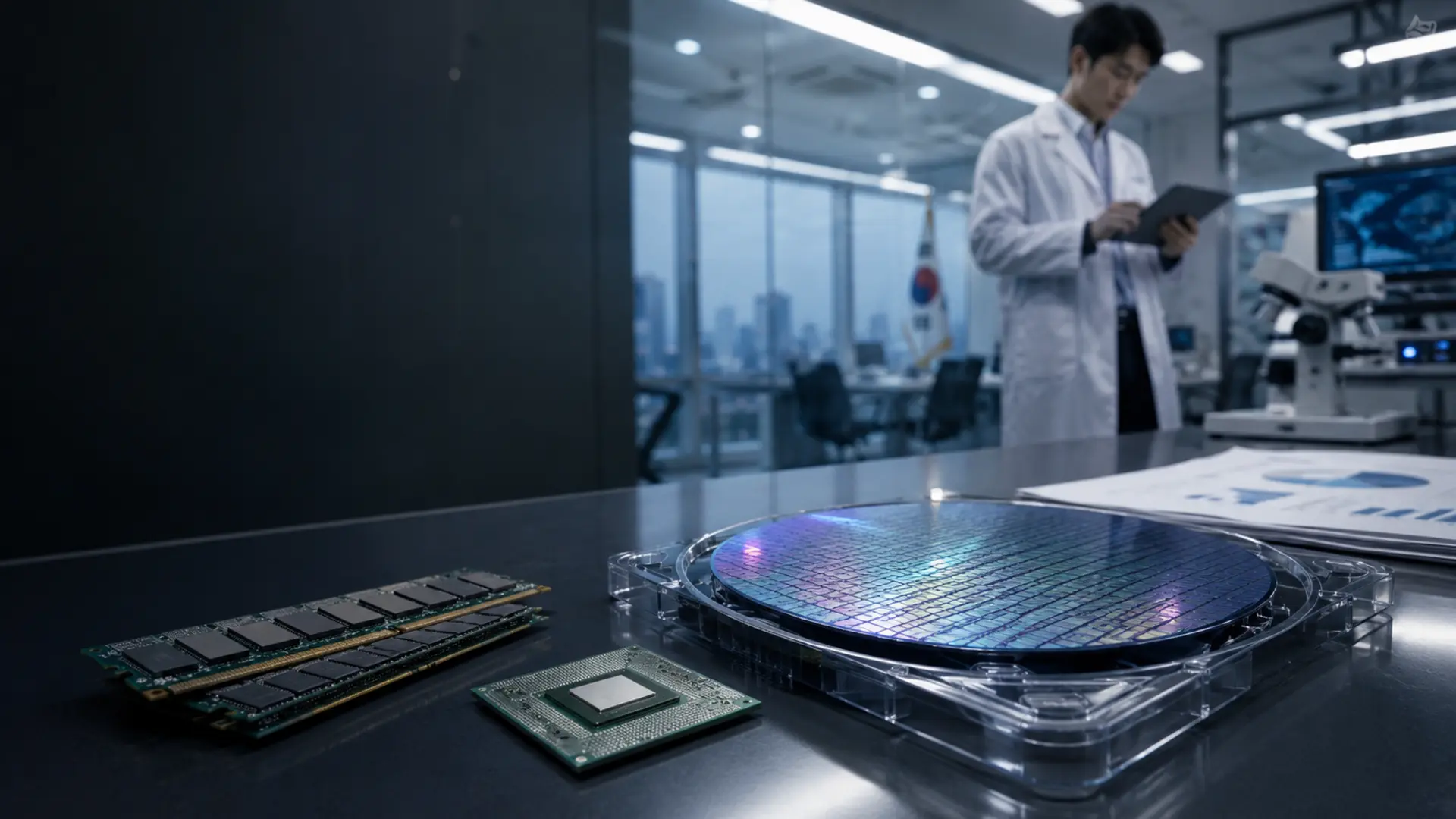
FuriosaAI funding has become South Korea’s latest strategic move in the global race to build artificial intelligence hardware beyond the dominant GPU supply chain.
The country’s government-led National Growth Fund has approved about 800 billion won, or roughly $533 million, of investment for FuriosaAI, according to reporting that cited South Korea’s financial authorities and Reuters. The decision gives the Seoul-based AI chip startup a rare state-backed capital base at a moment when governments, cloud providers, and model developers are all trying to secure more efficient computing capacity.
The investment is part of a wider 4.14 trillion won package approved by the fund’s deliberation committee for five advanced-industry projects. South Korean outlet Newsis reported that the FuriosaAI support includes 370 billion won from an advanced strategic industry fund and is intended to help the company scale its second-generation neural processing unit while developing a third-generation chip using HBM4 or HBM4E memory.
The development matters because AI computing is no longer only a company procurement issue. It has become an industrial policy test, a capital-markets signal, and a question of whether countries outside the United States and China can build credible semiconductor ecosystems around inference, data centers, memory, packaging, and software tools.
Why FuriosaAI Funding Matters Now
FuriosaAI funding arrives as AI hardware demand remains intense, but the strategic debate is shifting from simply buying more Nvidia chips toward building national and regional alternatives that can support inference workloads at scale.
South Korea already has global strength in memory chips through Samsung Electronics and SK Hynix. A larger commitment to an AI accelerator designer suggests Seoul wants to connect that memory advantage with domestic processor design, data-center buildouts, and long-term sovereign AI capacity.
FuriosaAI Funding Supports a Fabless Challenger
FuriosaAI is a fabless semiconductor company, meaning it designs chips while relying on manufacturing partners for fabrication. That model allows a smaller company to focus capital on architecture, software compatibility, customer validation, and product deployment rather than building plants of its own.
The company’s positioning is especially relevant because AI inference chips are becoming a separate competitive arena from training chips. Inference workloads involve running trained models for real users, often under cost, latency, and energy constraints that can make specialized processors attractive to enterprises and cloud operators.
Newsis reported that FuriosaAI began mass production of its second-generation Renegade NPU in January and plans a third-generation product tied to advanced high-bandwidth memory. Those details place the company inside the same broader supply chain conversation that has made HBM capacity, advanced packaging, and power efficiency central to AI infrastructure planning.
The funding also follows earlier international attention on FuriosaAI after reports last year that Meta had explored an acquisition. FuriosaAI’s decision to remain independent, combined with a larger state-backed financing path, gives the company a clearer route to scale without selling into a larger platform owner.
State Capital Targets the AI Hardware Gap
Government-led capital can be especially important in semiconductor startups because hardware cycles are slower and more expensive than software. A chip company must fund design, tape-out, validation, software tooling, manufacturing commitments, and customer trials before revenue reaches the level investors usually expect from fast-growing technology companies.
That financing burden is one reason the FuriosaAI decision has policy weight. South Korean media reports described the investment as support for a company with independent design competitiveness and a way to prevent a funding gap before commercial scale is achieved.
The National Growth Fund’s structure also shows how Seoul is using public and private money to steer capital toward industries it sees as strategically important. AI chips, data centers, vaccines, battery materials, and power equipment all appeared in the latest approval package, making FuriosaAI part of a wider industrial-capacity agenda rather than a standalone startup story.
For investors, that raises a familiar question: whether state-backed financing can create durable technology champions or merely subsidize costly competition. FuriosaAI’s ability to convert funding into customer adoption, software support, and reliable production will determine which side of that debate becomes more convincing.
South Korea’s AI Chip Strategy Expands
South Korea’s FuriosaAI funding decision fits a broader effort to defend the country’s semiconductor relevance as AI reshapes demand across memory, logic, networking, data centers, and industrial software.
The country has long been central to the memory market, but AI has made the value chain more demanding. National competitiveness now depends not only on producing memory components but also on capturing more design, infrastructure, and system-level value.
FuriosaAI Funding Links Chips and Memory
The reported focus on HBM4 and HBM4E is significant because high-bandwidth memory has become one of the most important constraints in advanced AI systems. HBM sits close to processors and feeds data quickly enough to support large model workloads, making it a strategic component in both training and inference systems.
South Korea’s memory giants already benefit from AI demand, but a domestic AI chip designer could help the country capture more of the architecture layer as well. If FuriosaAI can design accelerators that pair effectively with next-generation memory, South Korea’s ecosystem could become less dependent on foreign processor roadmaps.
That is a difficult goal. AI chip markets reward performance, developer support, supply reliability, and customer confidence, not national ambition alone. Startups competing against Nvidia, AMD, Google, Amazon, and other custom-silicon programs must prove that their products reduce real deployment costs without adding integration friction.
Still, a credible domestic accelerator company gives South Korea an option it would otherwise lack. It can support local data-center projects, attract enterprise pilots, and strengthen bargaining power in a market where compute supply has become a strategic asset.
Data Centers Broaden the Policy Package
The FuriosaAI package was not the only AI infrastructure item approved by the fund. Newsis reported that Smilegate Group’s AI data-center project in Goyang, Gyeonggi Province, received support through 250 billion won of equity investment and 250 billion won of subordinated loans.
That pairing of chip funding and data-center finance is important. AI processors need deployment environments, and domestic data centers need access to hardware, power equipment, cooling systems, and software stacks that can serve enterprise customers at commercial scale.
The same approval package also included financing for a data-center power-equipment producer in North Chungcheong Province. That detail may look smaller beside FuriosaAI, but power distribution has become a serious constraint as AI facilities require more electricity, redundancy, and grid coordination.
Taken together, the projects show a policy design that treats AI as an industrial system. Chips, memory, power equipment, and data centers are being financed as connected bottlenecks rather than isolated sectors.
Investment Signals Behind FuriosaAI Funding
FuriosaAI funding also sends a capital-markets signal about how investors and governments are valuing AI hardware companies after a period dominated by foundation-model fundraising.
A company spokesperson told Reuters, according to ETStartup, that FuriosaAI is nearing the close of a pre-IPO fundraising round expected to exceed $500 million and that its latest round valued the company at about 3 trillion won, or around $2 billion.
FuriosaAI Funding Tests Pre-IPO Demand
A pre-IPO round of that size would put FuriosaAI among the more closely watched AI hardware startups in Asia. It would also reflect investor appetite for companies that can serve demand for specialized inference infrastructure, especially as model use spreads from research labs into customer service, enterprise software, manufacturing, media, and commerce.
The valuation signal is not only about one startup. It suggests that investors are still willing to fund capital-intensive AI infrastructure if they believe the company owns a strategic position in the supply chain. Hardware companies face longer timelines, but they also sit close to a spending category that cloud providers and governments consider essential.
For FuriosaAI, the path from financing to a public listing would likely require more than successful product announcements. Public-market investors will want evidence of customers, margins, production capacity, software maturity, and a defendable role in a market where large platforms can design their own chips.
The government-backed component may help reduce financing risk, but it does not remove execution risk. The company still has to prove that its processors can win workloads on performance, efficiency, availability, and integration support.
Competition Extends Beyond Nvidia Alternatives
Much of the AI chip conversation is framed around alternatives to Nvidia, but FuriosaAI’s challenge is broader. It must compete in an ecosystem where Nvidia’s advantage includes not only chips but also software, developer familiarity, networking, customer relationships, and a deep installed base.
That does not make competition impossible. Inference workloads can be more fragmented than training workloads, and some customers may prioritize power efficiency, cost predictability, or local supply over maximum benchmark performance. Those segments could create openings for specialized accelerators.
South Korea’s support may also make FuriosaAI more relevant to enterprises and public-sector buyers that want domestic or regionally controlled AI infrastructure. As AI systems move into regulated industries, procurement choices may increasingly consider data sovereignty, supply security, and policy alignment.
The strategic question is whether FuriosaAI can turn those advantages into repeatable commercial deployments. If it can, the investment may become a case study in how smaller economies build AI hardware capability around targeted capital and existing semiconductor strengths.
Policy Risks and Market Implications
The FuriosaAI funding decision strengthens South Korea’s AI hardware ambitions, but it also exposes the country to the practical risks of industrial policy in a fast-moving technology cycle.
Governments can supply patient capital and coordinate ecosystems, yet they cannot guarantee technical adoption. AI hardware markets change quickly, and winners are shaped by software compatibility, manufacturing access, model architecture trends, and customer economics.
Public Money Raises Performance Expectations
Large state-backed investments invite scrutiny because public resources are being used to support companies that must still compete commercially. FuriosaAI’s funding will likely be judged by production progress, ecosystem growth, and whether the company can help South Korea reduce dependence on imported AI compute.
The National Growth Fund’s wider package gives policymakers a way to argue that the investment is not a narrow corporate subsidy. By also supporting data centers, vaccines, battery materials, and power equipment, the fund is positioning itself as a vehicle for strategic industrial development.
That broader framing may help politically, but it also raises expectations. If several supported projects stumble, critics may question whether public-private funds are allocating capital effectively or chasing sectors that already attract heavy global investment.
For now, FuriosaAI appears to offer a relatively strong strategic case because it sits at the intersection of AI demand, semiconductor design, memory supply, and national infrastructure. That is why the story is larger than a conventional funding round.
FuriosaAI Funding Could Shape Asian AI Infrastructure
Asia’s AI infrastructure market is becoming more competitive as governments and companies seek capacity outside a small group of global chip suppliers. Japan, South Korea, Taiwan, Singapore, and other markets are all trying to position themselves around data centers, chips, cloud services, and enterprise AI adoption.
FuriosaAI funding gives South Korea a sharper narrative in that race. The country can argue that it is not only producing memory for foreign AI systems but also financing a domestic processor company and the infrastructure around it.
If FuriosaAI succeeds, it could encourage more state-backed investment in fabless chip firms across the region. If it struggles, the outcome may reinforce how difficult it is to challenge entrenched AI hardware ecosystems even with government support.
Either way, the decision adds a concrete financing milestone to the global AI infrastructure story. For more coverage of technology investment, industrial policy, and market strategy, readers can continue following related analysis at Berrit Media.
Discover more from Berrit Media
Subscribe to get the latest posts sent to your email.