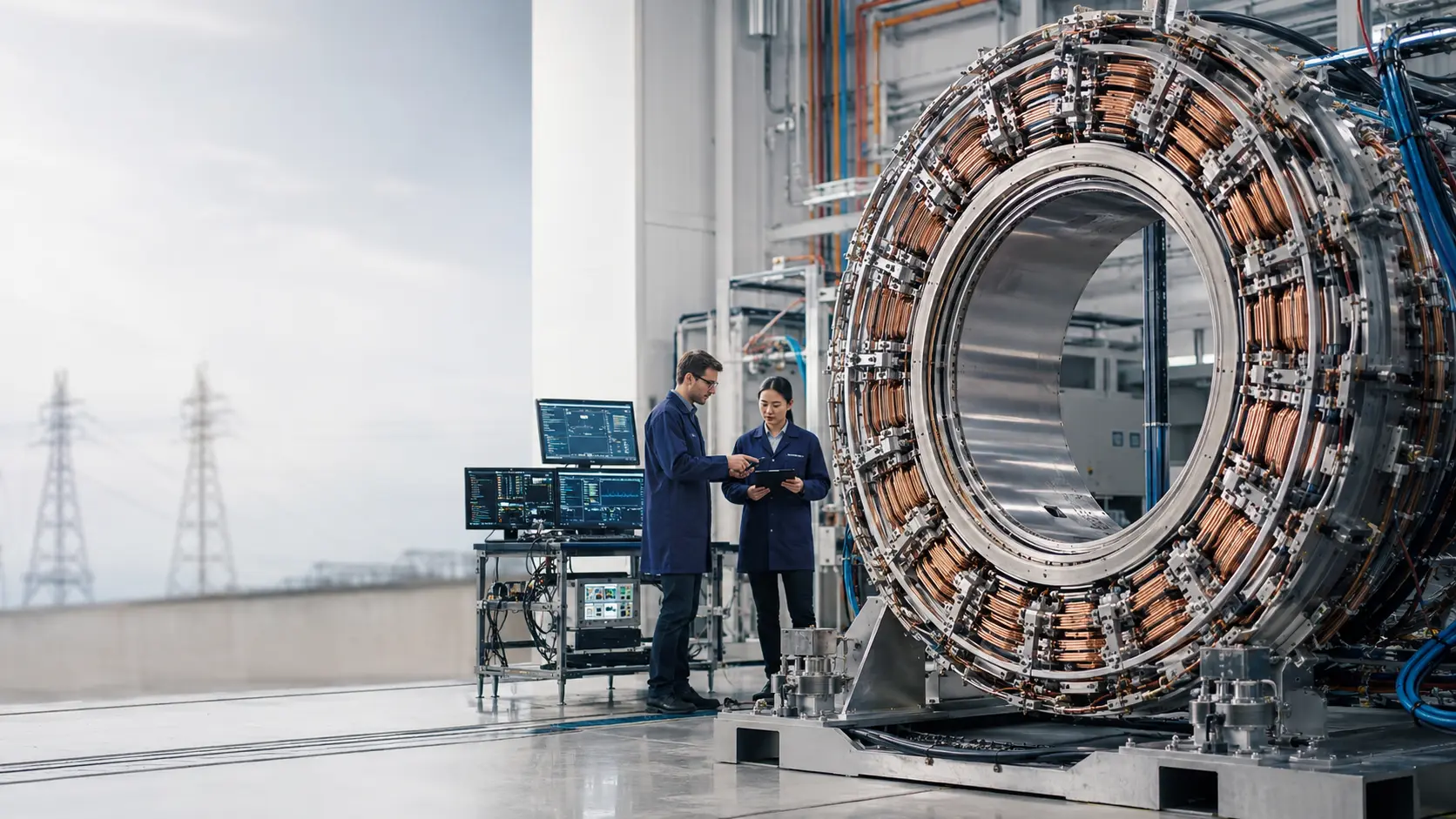
Thea Energy raised $100 million in a Series B round on May 27, giving the New Jersey fusion startup fresh capital to expand magnet manufacturing, advance site work, and begin building its large-scale Eos demonstration system as investors look for long-duration power technologies that could eventually support more electricity-hungry economies.
The financing stands out not only because of its size, but because it comes after a string of technical and policy milestones that make Thea one of the more closely watched names in the fusion field. The company said the oversubscribed round was led by Thomas Tull’s US Innovative Technology Fund, with participation from General Innovation Capital Partners, Linse Capital, Climate Capital, Idemitsu Kosan, and other investors. TechCrunch reported that the raise brings Thea’s total private funding to $130 million.
Why Thea Energy Matters Beyond Another Fusion Round
Fusion funding announcements are no longer rare, but not every company can point to recent engineering progress alongside new capital. That combination is what gives this round more editorial weight than a routine startup financing brief.
Thea has been trying to position itself as a more buildable version of the stellarator, a fusion design long admired for steady-state potential but often criticized for its engineering complexity. Its pitch is that simpler, software-controlled magnet arrays can reduce some of the cost and manufacturing pain that have historically slowed commercial fusion programs.
Thea Energy turns a lab concept into a build program
According to the company’s May 27 announcement, the new funds will expand magnet manufacturing capacity and support the siting and construction of Eos, the large-scale integrated stellarator it wants to use as its next major proving ground. That matters because the real commercial test for fusion companies is not a laboratory headline on its own, but whether they can convert physics claims into repeatable industrial systems.
Bloomberg Law reported that the round is aimed at developing a demonstration project at a time when rising electricity demand is lifting interest in technologies that could eventually supply firm power. That wider context helps explain why fusion, despite its long timelines, continues to attract serious capital from investors looking beyond conventional software and semiconductor bets.
What makes Thea more notable than a generic clean-energy startup is that its roadmap is tied to a concrete hardware buildout. Search results and company materials indicate that Eos is intended to be a power-plant-relevant integrated system, not just a component experiment, and that the company aims to select a site later this year while continuing to add staff.
Thea Energy funding arrives with technical proof points
The financing also follows a set of milestones that give investors a clearer checklist than they had even a few months ago. On May 13, Thea said its first full-scale Eos-spec planar shaping coil reached the magnetic fields and electrical currents required for what it described as power-plant-relevant, steady-state fusion in the upcoming Eos system.
Earlier, on January 13, the company said the U.S. Department of Energy had certified its preconceptual Helios pilot plant design. Thea said it was the first awardee in the DOE’s Milestone-Based Fusion Development Program to complete that final major design-review milestone, a useful credibility marker in a sector where technical claims are often hard for generalist investors to compare.
Those milestones do not remove the long-standing execution risks around fusion, but they do create a more legible sequence: design review, magnet validation, then a larger integrated system. In venture-backed deep tech, that kind of sequencing often determines whether a company remains an interesting science project or starts to look like a capital formation story with industrial relevance.
How Thea Energy Fits the New Power Investment Cycle
The financing lands in a market that is thinking differently about electricity. Investors, utilities, hyperscalers, and industrial policy planners are all confronting the same problem: how to secure enough reliable power for data centers, electrification, and manufacturing without depending entirely on traditional baseload assets.
That shift does not mean fusion is close to becoming a mainstream power source. It does mean the bar for getting funded has changed. Capital is increasingly flowing to technologies that can credibly claim a path to high-output, around-the-clock generation, particularly when those claims are attached to measurable engineering milestones instead of vague future scenarios.
AI-era electricity demand is reshaping venture appetite
Bloomberg Law framed Thea’s raise against surging electricity demand, and that backdrop is central to understanding why fusion stories now resonate beyond climate-tech circles. The artificial intelligence buildout has widened the conversation from carbon reduction alone to infrastructure resilience, speed of deployment, and the future cost of dependable power.
For investors, that creates a broader thesis. A company like Thea is no longer judged only against other experimental energy startups. It is also being evaluated within a wider race to secure the next generation of grid capacity that could support data centers, industrial campuses, and national competitiveness goals over the next decade.
The same dynamic helps explain why fusion rounds are increasingly discussed in business and market terms, not just scientific ones. If future demand growth keeps pressuring existing grids, even long-horizon technologies can gain strategic relevance earlier than their commercial revenue would normally suggest.
Fusion remains risky, but Thea Energy has a clearer checklist
None of that changes the basic risk profile. Fusion remains one of the hardest industrial challenges in modern technology, and startups in the field still have to prove not only plasma performance, but also manufacturing repeatability, cost control, regulatory readiness, and financing durability over many years.
Still, Thea’s position appears somewhat clearer than a story built on aspiration alone. The company has tied this round to specific uses of capital, identified Eos as the next major system, and arrived at the raise after publicizing both a DOE design-review certification and a recent magnet milestone. That combination gives outsiders a more grounded way to track progress.
For Berrit Media readers, the important business point is that markets are starting to sort fusion startups less by abstract promise and more by operational evidence. In that environment, Thea Energy is trying to sell itself not simply as a breakthrough concept, but as an emerging infrastructure company moving step by step toward a commercial test.
What Comes Next for Thea Energy and the Fusion Field
The next phase is where this financing will either gain strategic importance or fade into the crowded backlog of deep-tech fundraising announcements. A strong round can extend runway and attract attention, but it only changes the market narrative if the company turns capital into visibly faster execution.
That means the coming milestones around siting, construction, hiring, and integrated system progress matter more than the headline amount alone. Investors will want to see whether Thea can compress the distance between validated components and a credible demonstration path without losing control of cost and schedule.
Eos is the next commercial test for Thea Energy
Eos now sits at the center of the story. The company has described it as a large-scale integrated stellarator meant to deliver power-plant-relevant, steady-state fusion conditions using its simpler magnet architecture, which is supposed to be easier to build than older stellarator designs.
If Thea can move Eos from concept to site selection and into a visible construction program, it will give the market a clearer basis for comparing the company with other fusion ventures that are racing toward pilot systems. That would also help shift the conversation from theoretical design advantages to execution discipline, which is where major capital decisions are usually made.
Just as important, Eos offers a narrative investors can understand. It translates fusion from a distant end-state into a nearer operating milestone, which is often necessary for keeping financial backers engaged through long development cycles and uneven technical progress.
Thea Energy now has to prove speed, cost and siting
The biggest open questions are practical ones. Can Thea manufacture its magnets at the scale and consistency it is promising? Can it site and build Eos on a timeline that keeps confidence intact? And can it do so at a capital intensity that still leaves room for future financing without excessive dilution or strategic drift?
Those questions matter because fusion finance can tighten quickly when milestones slip. Investors may accept long timelines, but they generally become less tolerant when a company cannot show that each round is removing a specific engineering or deployment bottleneck.
For now, Thea has bought itself a stronger position in that race. The new capital, the DOE-linked design milestone, and the recent magnet result together make the company one of the more credible fusion stories in the current funding cycle, even if commercial power remains years away.
Thea Energy has not solved fusion, and the path from demonstration hardware to bankable power infrastructure remains uncertain. But this round gives the startup a meaningful chance to prove whether its architecture can move from promising engineering to industrial execution, and readers can continue following related business and technology coverage at Berrit Media.
Discover more from Berrit Media
Subscribe to get the latest posts sent to your email.