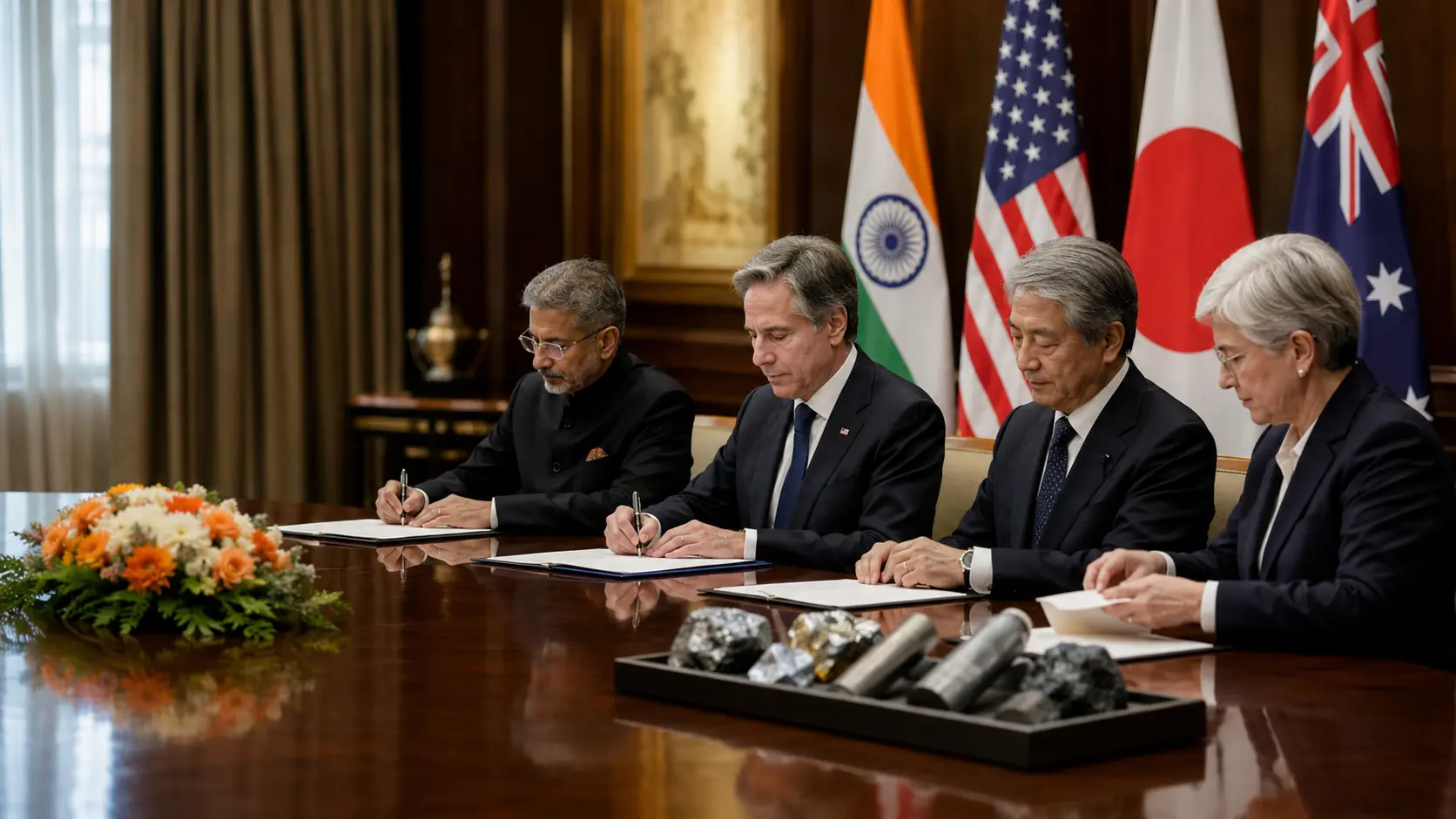
Critical minerals moved to the center of Indo-Pacific economic strategy on May 26, 2026, when the Quad launched a new framework to mobilize up to $20 billion for supply-chain projects and India and the United States signed a parallel bilateral pact on mining and rare earths cooperation.
The announcements matter because they push a long-running strategic conversation into a more operational phase. Instead of only warning about concentrated supply, the United States, India, Japan, and Australia are now laying out financing tools, project criteria, regulatory coordination, and recycling plans that could shape where future capacity is built.
Critical Minerals Move From Diplomacy to Project Finance
The most important shift in New Delhi was practical rather than rhetorical. The Quad Critical Minerals Initiative Framework says the four countries intend to mobilize up to $20 billion in government and private-sector support through new and existing efforts tied to mining, processing, and recycling.
That language gives the grouping a clearer commercial edge. For executives, lenders, and industrial buyers, the significance is that the Quad is no longer talking only about vulnerability. It is beginning to describe how capital could be organized around specific projects with strategic value.
Critical Minerals Funding Gets a $20 Billion Target
According to the framework released by the Quad governments, support can include guarantees, loans, equity participation, insurance, subsidies, offtake arrangements, and export-credit or development-finance backing where appropriate. That range matters because critical-minerals projects often fail not for lack of geology, but because financing structures are hard to assemble across extraction, refining, and downstream demand.
The framework also says the partners intend to identify projects with a “Quad nexus,” including assets located in member countries, run by companies based there, or supplying Quad markets. That creates a flexible definition broad enough to cover domestic mines, allied processing assets, and cross-border industrial chains feeding semiconductors, defense systems, batteries, and advanced manufacturing.
In effect, the Quad is trying to turn strategic concern into investable criteria. If that works, the initiative could help reduce one of the sector’s biggest constraints: the gap between political urgency and bankable project pipelines.
A Fiji Port Shows the Initiative Is Broader Than Mining
Reuters reported that the foreign ministers also agreed to jointly build a port in Fiji, the first joint infrastructure project announced by the group. On its face, that is a separate development from the minerals framework, but the timing is revealing.
Critical-minerals policy is not only about digging ore out of the ground. It also depends on shipping routes, regional logistics, energy access, and the ability to move equipment and finished materials through trusted infrastructure. A port announcement alongside minerals and energy statements suggests the Quad wants its supply-chain agenda to be read as a wider economic-security architecture.
That matters in the Pacific, where infrastructure influence carries both commercial and geopolitical value. A minerals strategy without transport resilience can still leave the supply chain exposed, especially when processing and end markets are spread across multiple countries.
Critical Minerals Strategy Is Also a Response to Supply Pressure
The New Delhi outcomes did not appear in a vacuum. Japanese government materials from the meeting said the four ministers shared grave concerns about export restrictions, including on critical minerals, underscoring that the issue is no longer treated as a niche commodity matter.
The backdrop is a year in which supply concentration has again become a live policy risk. Governments across the United States, Europe, India, Japan, and Australia have been looking for ways to respond to market concentration, licensing pressure, and the use of mineral access as strategic leverage.
China Export Restrictions Sharpened the Critical Minerals Case
That urgency has grown in recent weeks. Reuters reported on May 22 that China had cut Japan off from several heavy rare earths and other materials for at least four months, in a dispute that echoed the 2010 showdown between the two countries. Those materials feed applications tied to magnets, aerospace, defense systems, and chipmaking.
Earlier in May, Reuters also reported that Beijing said its rare-earth export controls were lawful and that it would cooperate with the United States on “reasonable” concerns. That combination of selective flexibility and retained state control is exactly why allied governments still see diversification as unfinished work rather than a solved problem.
For the Quad, the lesson is straightforward. Even when formal bans are not universal, case-by-case approval systems and concentrated processing capacity can still create uncertainty for manufacturers that need predictable access to specialist materials.
The Framework Goes Beyond Mines Into Rules and Trade Tools
The Quad document is notable for addressing the policy environment around minerals, not only project finance. It says the partners aim to share good practices on permitting and licensing, strengthen tools to review transactions that could threaten national security, and cooperate on geological mapping and resource assessment.
Those details show that the grouping understands the bottleneck is institutional as well as industrial. Investors care about how quickly permits move, whether foreign-investment rules are clear, and whether governments can coordinate on security screening without freezing the private capital they want to attract.
The framework also says the countries will consider coordinated measures to address non-market policies and unfair trade practices, including possible price mechanisms or other measures. That is a meaningful signal because it suggests the Quad is open to shaping market conditions, not simply asking private industry to solve strategic dependence on its own.
Critical Minerals Deals Now Need Execution
The strength of the New Delhi package is that it links multilateral ambition to a specific bilateral agreement. India’s Ministry of External Affairs said New Delhi and Washington signed a framework on securing supply in the mining and processing of critical minerals and rare earths on the sidelines of the Quad meeting.
That gives the broader initiative a more immediate anchor. While four-country frameworks can take time to operationalize, bilateral arrangements can often move faster on project identification, investment channels, and official coordination between ministries and agencies.
The India-US Critical Minerals Pact Gives the Quad a Bilateral Anchor
Indian government materials say the India-U.S. framework covers cooperation across mining, processing, recycling, and related investments. Business Standard reported that the agreement was signed in New Delhi by External Affairs Minister S. Jaishankar and U.S. Secretary of State Marco Rubio.
That is commercially important because India is trying to expand its role in strategic supply chains while the United States is looking for more resilient sourcing and processing relationships outside China. A bilateral structure can help connect Indian resource, industrial, and refining ambitions with U.S. policy support and corporate demand.
It also gives the Quad a layered structure. The four-country framework can define the strategic direction, while bilateral tracks such as the India-U.S. pact may become the first places where projects, financing packages, or offtake relationships actually begin to take shape.
Investors Will Look for Projects, Approvals and Offtake
The next test is whether the political language turns into visible commercial momentum. Markets will want to see named projects, clearer timelines, development-finance participation, and evidence that large industrial buyers are willing to support supply through long-term procurement commitments.
Execution will matter because the critical-minerals business is capital intensive and operationally slow. New mines can take years to permit and build, while processing plants, recycling systems, and logistics assets require patient funding and confidence that governments will keep strategic priorities stable across political cycles.
If the Quad can use this framework to reduce financing friction and give companies better policy visibility, it could become more than a diplomatic label. If not, the announcements risk joining a long list of strategic mineral initiatives that sounded urgent but struggled to change the economics on the ground.
Critical minerals are now being treated less like a specialist commodity story and more like a test of how the Indo-Pacific will organize industrial security, trade leverage, and future technology supply chains. Readers can continue following related coverage at Berrit Media for more on policy, markets, and global industry shifts.
Discover more from Berrit Media
Subscribe to get the latest posts sent to your email.