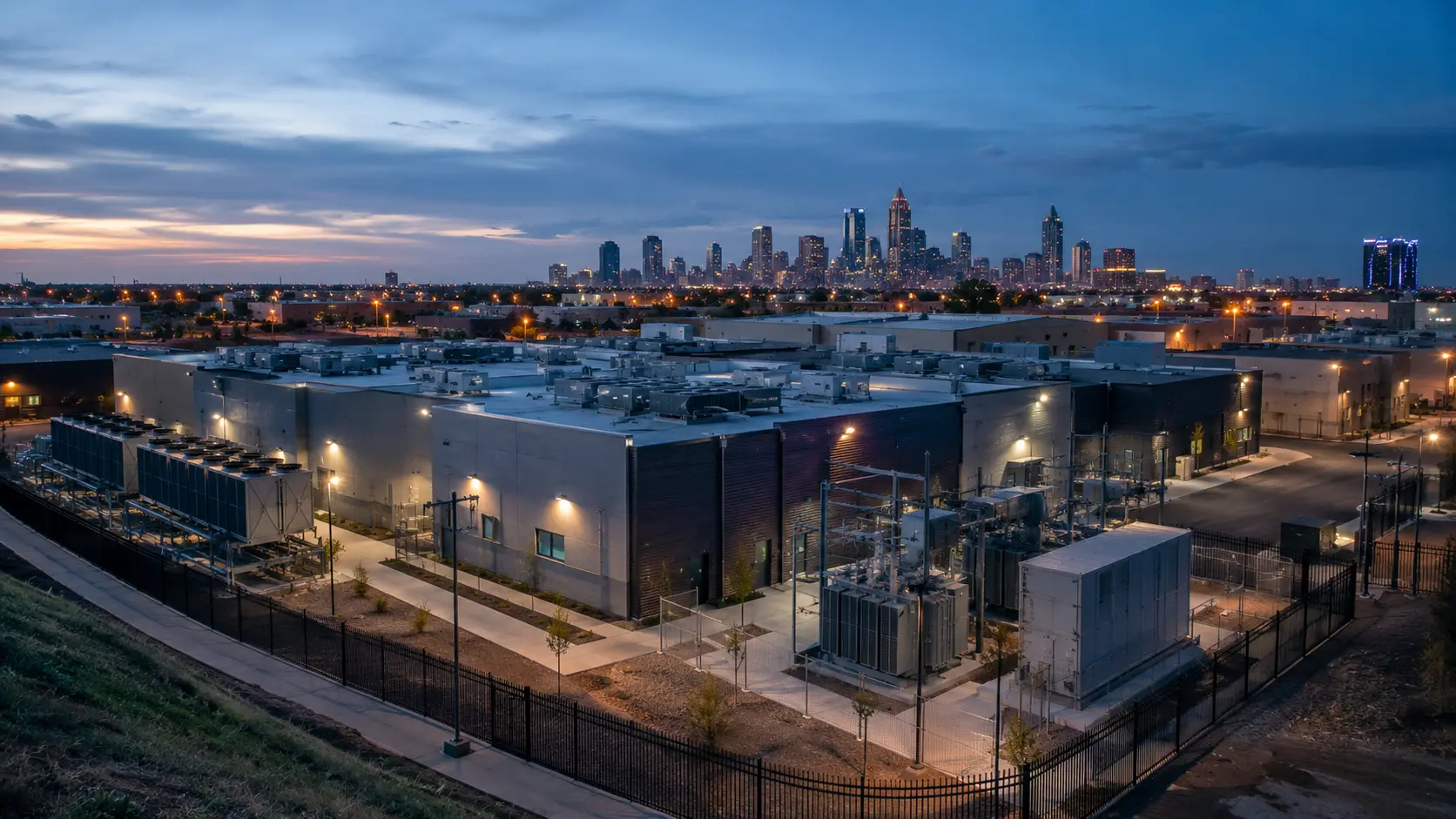
AI inference is reshaping how investors value data center assets, and I Squared Capital’s agreement to buy 10 facilities from Cogent for $225 million shows why the market is moving beyond headline-grabbing training clusters. The deal gives I Squared a ready-made footprint in several tightly supplied U.S. metro areas and pairs it with a fresh $1 billion commitment for upgrades, expansion, and additional acquisitions.
Cogent said on May 26 that its subsidiary Cogent Fiber agreed to sell the sites in cash to a newly formed entity sponsored by I Squared. Reuters, citing I Squared, reported the assets include about 53 megawatts of power capacity and roughly 259,000 square feet of colocation space, a scale that is modest compared with hyperscale campuses but significant in markets where proximity, interconnection, and available power have become decisive.
That combination makes the transaction more than a routine portfolio sale. It offers a clear window into the next phase of AI infrastructure spending, where investors are starting to back assets closer to end users, enterprise workloads, and latency-sensitive applications instead of focusing only on giant training environments.
AI Inference Changes the Economics of Data Center Assets
The strongest signal in this transaction is not simply the purchase price. It is I Squared’s framing of the assets as the base of a dedicated U.S. platform built around inference and edge-oriented colocation demand.
That matters because the commercial logic of AI inference is different from the economics that drove the first wave of generative-AI data center enthusiasm. Training tends to favor very large campuses, concentrated compute, and deep pools of capital, while inference expands the field toward distributed infrastructure that can support daily use at lower latency and with more flexible deployment patterns.
Why AI Inference Favors Distributed Capacity
In its announcement, I Squared said the facilities sit near local internet exchanges and have dense fiber connectivity, characteristics that suit retail and wholesale colocation, content delivery, and latency-sensitive AI inference workloads. That language points to a broader market view: the next growth layer in AI may come from where applications are delivered, not only where models are first built.
Reuters described the transaction as part of a shift from large centralized training centers to facilities deployed closer to end users. For investors, that shift expands the opportunity set beyond the small number of massive campuses now associated with frontier-model buildouts and into older or overlooked assets that already have power, connectivity, and usable shells in metropolitan markets.
The practical implication is that smaller facilities can become strategically more valuable when they offer scarce combinations of interconnection, owned real estate, and upgradeable power. Inference demand does not eliminate the need for hyperscale training capacity, but it does create a second market where location and network adjacency may matter as much as raw size.
What the Portfolio Offers on Day One
Cogent identified the facilities as being in Phoenix, Anaheim, Burbank, Stockton, Atlanta, Chicago, Elkridge, Kansas City, Nashville, and Houston. Those are not fringe locations. They are metro areas with established enterprise traffic, regional cloud demand, or infrastructure significance that can support a range of digital workloads.
I Squared said the assets come with existing high-density-enabled power infrastructure and multi-carrier interconnection. That reduces the amount of greenfield risk usually tied to a new platform launch, because the buyer is not starting with raw land and a long entitlement timeline.
The portfolio also gives I Squared immediate geographic spread. Instead of betting on a single campus, the firm can test where demand emerges fastest, prioritize upgrades market by market, and use the initial platform as a base for bolt-on acquisitions in places where new supply is constrained.
Cogent Uses the Sale to Sharpen Its Own Position
The deal also says a great deal about Cogent’s own priorities. For the seller, monetizing a slice of its data center estate can provide liquidity and reduce exposure to an asset class that requires sustained capital to remain competitive.
That is especially relevant for a company better known for bandwidth-intensive internet access and private network services than for running a large standalone colocation strategy. A selective sale can help management focus on core network operations while still extracting value from infrastructure accumulated over time.
From Inherited Footprint to Selective Monetization
Cogent’s 2024 annual report said the company had expanded its data center footprint substantially after the Sprint network acquisition, growing to 159 buildings including major Sprint data centers and smaller edge sites. That inventory gave the company a broad physical presence, but not every building necessarily fits the same strategic purpose.
By selling 10 facilities in one package, Cogent appears to be separating assets that may be more valuable in the hands of a specialist platform investor than inside a broader connectivity business. In other words, the buyer sees expansion optionality, while the seller sees a chance to simplify and free up capital.
That is a familiar pattern in infrastructure markets. Telecom and network operators often discover that investors focused on a narrower operating model are willing to pay for assets whose embedded value is not fully reflected inside a larger corporate portfolio.
Timing, Conditions, and What Investors Should Notice
Cogent said the transaction is expected to close on the later of June 12, 2026 and the expiration or termination of the applicable Hart-Scott-Rodino waiting period. I Squared, in its own announcement, described the expected closing window more broadly as the third quarter of 2026, subject to customary regulatory approvals.
Those timelines are not necessarily inconsistent, but they do show the ordinary uncertainty that still surrounds even relatively straightforward infrastructure deals. Closing timing will depend on regulatory process and execution details, not only on strategic intent.
Investors should also pay attention to what happens after closing rather than treating the sale as a one-off transfer. The more meaningful test is whether I Squared can turn a purchased portfolio into a scaled operating business with pricing power, tenant demand, and expansion capacity.
The Deal Reflects a Broader AI Infrastructure Reset
What makes this story worth watching is the way it connects private capital, legacy telecom real estate, and the evolving architecture of AI deployment. The market narrative around AI infrastructure has often centered on the largest chip orders and the biggest training clusters, but this transaction highlights a quieter layer of the buildout.
That quieter layer may prove commercially important. If enterprises and developers increasingly need low-latency inference close to customers, then regional facilities with available power and strong connectivity could become a critical part of the stack rather than a secondary afterthought.
Why Private Capital Likes the AI Inference Trade
Private infrastructure investors are often drawn to assets where operational improvement and capital spending can unlock a sharper long-term cash flow profile. This portfolio fits that pattern because the initial acquisition price is only the opening move; the larger value thesis sits in the follow-on investment plan.
Reuters reported that I Squared is committing another $1 billion for upgrades, expansions, and additional acquisitions. That scale suggests the firm is not just buying stabilized facilities for yield, but trying to assemble a platform that can capture a broader wave of AI-related colocation demand.
The attraction is clear. If AI inference becomes a recurring enterprise and consumer workload rather than a specialized niche, then data centers serving that traffic can benefit from durable utilization, pricing support, and strategic scarcity in well-connected metropolitan areas.
What the Next Phase Could Look Like
The next chapter will hinge on execution. I Squared said it plans to stand up a new operating platform with a seasoned management team from day one, which implies a deliberate effort to build a recognizable business rather than hold the assets passively.
That operating approach matters because AI infrastructure is no longer just about owning space with racks and power. Operators increasingly need to package interconnection, service quality, expansion readiness, and customer mix in ways that match evolving cloud, content, and AI deployment needs.
If I Squared can use these 10 facilities as the foundation for a larger inference-oriented network, the deal may look less like a $225 million property transaction and more like an early marker for how the next round of AI infrastructure consolidation will unfold in the United States.
For now, the transaction offers a disciplined example of where capital is moving next: toward assets that sit between the internet’s physical backbone and AI’s everyday commercial use. Readers can follow more business and technology coverage like this across Berrit Media.
Discover more from Berrit Media
Subscribe to get the latest posts sent to your email.