INNIO IPO is moving into the market at a moment when investors are looking well beyond chips and cloud software to the physical systems needed to keep artificial intelligence infrastructure running. The Munich-based distributed energy company said on May 26 that it had launched its U.S. roadshow with 75,000,000 common shares offered by a selling shareholder at an indicated price of $24 to $27 each.
Those terms imply a deal size of roughly $1.8 billion to $2.0 billion before any over-allotment, and Reuters reported that the offering would value INNIO at as much as $20.25 billion. The company has applied to list on Nasdaq under the ticker INIO, turning a specialized power-equipment provider into one of the more closely watched public-market tests of the AI infrastructure trade.
Why the INNIO IPO Matters Now
The timing matters because INNIO is not selling a consumer AI story or a speculative software multiple. It is pitching investors on a more industrial thesis: that growth in data centers, grid congestion, and the need for flexible on-site power are creating a durable market for gas-engine systems, services, and related lifecycle support.
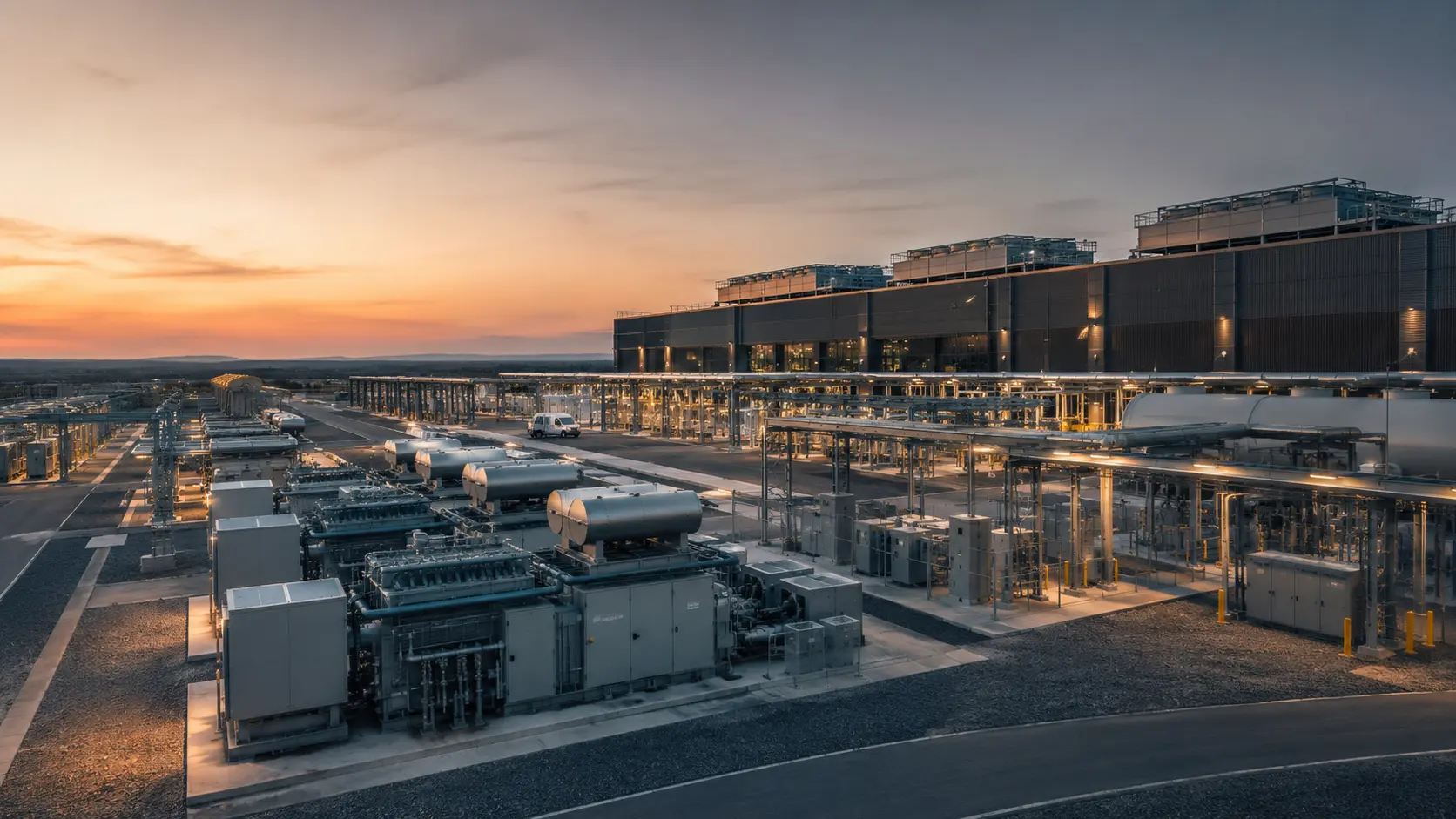
INNIO’s own roadshow materials frame the business around that need for reliable, modular, behind-the-meter power. The company says it serves customers in about 100 countries, employs more than 5,000 people, and sells systems under the Jenbacher and Waukesha brands for data centers, microgrids, grid stabilization, industrial energy, and gas compression.
INNIO IPO Tests Investor Appetite for Power-Enabling AI
The central question behind this flotation is whether investors are prepared to assign premium public valuations to companies that sit one layer behind the best-known AI names. Over the last year, markets have rewarded businesses tied directly to AI chips, memory, and cloud capacity, but the build-out also depends on electricity supply, backup systems, transient performance, and power equipment that can be deployed faster than full grid upgrades.
That is where INNIO’s pitch becomes more interesting than a conventional industrial listing. Reuters said the company is backed by Advent International and Abu Dhabi Investment Authority, and the IPO arrives as asset managers are increasingly trying to identify which suppliers capture value from data center expansion without taking direct exposure to chip cycles or consumer software demand.
At the same time, the structure of the deal shows that this is also a liquidity and valuation event for existing owners, not simply a capital-raising exercise for corporate expansion. Because the shares in the roadshow announcement are being offered by a selling shareholder, the IPO also serves as a public-market referendum on how durable investors believe this power-demand cycle really is.
INNIO IPO Gives Public Investors a Data Center Power Proxy
INNIO’s appeal rests on being more than a one-product manufacturer. The company describes itself as a distributed energy solutions provider with a high-margin services business that generates recurring revenue across the equipment lifecycle, a point that matters because public investors generally reward industrial businesses that can pair hardware sales with service visibility.
That service angle also helps differentiate INNIO from a simple equipment boom-and-bust story. In its May 26 roadshow release, the company highlighted long-term recurring revenues and a global installed base supported across roughly 100 countries, suggesting that future performance will depend not only on new orders but also on maintenance, optimization, and uptime across existing deployments.
For investors trying to map the broader AI supply chain, that creates a clearer listed proxy for the power side of data center development. Instead of betting on one hyperscaler or one chipmaker, shareholders would be buying into a business positioned around the electricity and resiliency requirements that many AI facilities now treat as mission critical.
Data Center Demand Is Reshaping the Company Narrative
Recent company announcements show why INNIO is leaning so heavily into the data center angle. Over the past several months, the group has disclosed a series of projects and agreements that connect its engines and services more directly to the acceleration of hyperscale and flexible-generation demand.
Those announcements do not prove that every growth target will hold, but they do show a pattern. The company is trying to present itself less as a legacy gas-engine manufacturer and more as an infrastructure supplier for an electricity system strained by AI workloads, permitting delays, resilience needs, and the slow pace of large-grid reinforcement.
INNIO IPO Arrives After Landmark Data Center Wins
The strongest example is the VoltaGrid contract announced in October 2025. INNIO said it had secured the largest order in its history by power delivery, a 2.3 gigawatt project made up of 92 power packs of 25 megawatts each for one of the world’s largest data centers, underscoring how quickly temporary and modular generation has moved from backup role to strategic infrastructure.
That order matters less as a one-off headline than as a sign of buyer behavior. In its announcement, INNIO said the system was designed to support prime, backup, and peak power within one integrated platform, a useful reminder that AI facilities increasingly need power strategies that can manage rapid load swings and uncertain grid timelines rather than depend on a single source of electricity.
The pattern continued in April 2026, when INNIO said it had signed a framework agreement with Rehlko covering 1.25 gigawatts of gas-engine capacity over the next three years. The company said a significant portion of that secured capacity is intended for hyperscale, colocation, and enterprise data center operators, adding a second large signal that the market is rewarding speed-to-power almost as much as raw computing scale.
INNIO IPO Sits Between Reliability and Transition Pressures
There is, however, a reason investors will look closely at how INNIO balances growth with the energy-transition narrative. A business tied to gas engines can benefit from urgent data center power demand, but it also operates in a policy and customer environment that is increasingly sensitive to emissions, fuel flexibility, and the long-term viability of transitional technologies.
INNIO is clearly trying to address that concern. In April, it announced what it described as an industry-first demonstration of 100% hydrogen-fueled backup power for data centers at the 3 megawatt scale with the Net Zero Innovation Hub for Data Centers, presenting its systems as adaptable rather than locked into a single fuel pathway.
That does not erase the policy debate around gas-backed power growth, especially in markets where climate targets, permitting, and local air-quality rules can tighten quickly. But it does help explain why INNIO is emphasizing hydrogen-ready systems, transient performance, and flexible generation: management appears to want public investors to see the company as a bridge technology player with optionality, not merely as a beneficiary of short-term fossil-fuel demand.
What Public Investors Will Need to Watch
The roadshow has opened a compelling narrative, but the public-market case will still depend on execution. Investors will need to decide whether INNIO can convert strong order momentum and favorable AI infrastructure tailwinds into durable profitability, service-led margins, and credible long-range positioning in a power market that is becoming more competitive.
They will also need to separate structural demand from timing distortions. The current data center build-out is real, yet large projects can shift around permitting, customer schedules, grid access, capital costs, and power-market economics, all of which can create uneven quarter-to-quarter results even when the long-term direction remains favorable.
INNIO IPO Comes With Fast Growth and Uneven Profitability
Early financial signals show why that balance matters. Reuters, citing the company’s SEC filing, reported that INNIO posted a net loss of $7.2 million on revenue of $668.6 million in the first quarter of 2026, compared with net income of $35 million on revenue of $494 million in the same period a year earlier.
That combination of sharply higher revenue and weaker bottom-line performance is not unusual for businesses moving through a rapid demand cycle, especially when mix, timing, or execution costs change. Even so, it tells investors that the company is not simply riding a clean straight line from AI enthusiasm to expanding profits, and that margin quality will matter as much as headline growth.
Because the proposed valuation is substantial, markets are likely to examine whether recent demand reflects durable infrastructure spending or a brief period of urgent procurement by customers trying to bring data center capacity online before utility connections catch up. That is a higher standard than the one applied to smaller industrial listings, and it is one reason this IPO could become an important reference point for related energy-infrastructure names.
INNIO IPO Will Be Judged on Services, Execution and Policy
Beyond the first trading days, the most important watchpoints are likely to be service attachment, delivery execution, and customer concentration. INNIO’s argument is strongest when it can show that each equipment installation leads to long-lived service revenue and operational stickiness rather than a one-time burst of order intake.
Execution will matter as well because many of the company’s opportunities sit in project-heavy markets where delays can damage confidence quickly. Data center buyers want dependable timelines, resilient components, and support that extends beyond delivery, while investors will want evidence that large contracts such as the VoltaGrid order and the Rehlko framework can translate into disciplined revenue recognition and acceptable returns.
Policy will be the final layer. If grid constraints persist, if data center developers keep prioritizing speed, and if transitional fuels remain acceptable long enough for flexible-generation systems to scale, INNIO could find itself in a favorable pocket of the AI build-out. If emissions rules harden faster than customers adapt, or if utility build-outs narrow the case for on-site generation, the market may revisit how much of today’s demand is structural and how much is temporary.
For now, the INNIO IPO stands out because it pushes the AI investment conversation deeper into the energy stack, where power reliability, industrial execution, and infrastructure timing matter just as much as compute demand. For more reporting on IPOs, AI infrastructure, and global business strategy, continue reading related coverage at Berrit Media.
Discover more from Berrit Media
Subscribe to get the latest posts sent to your email.