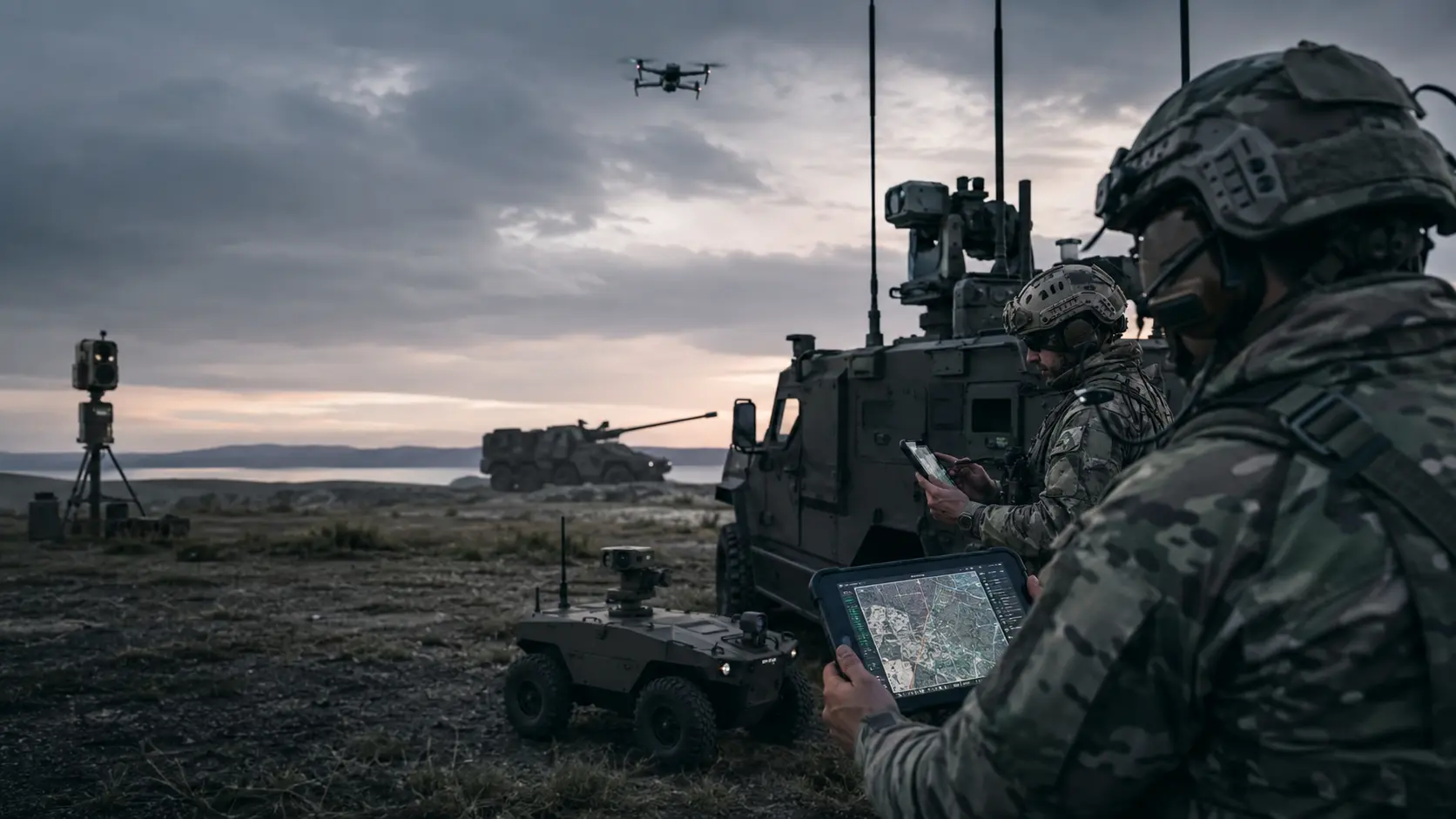
Elbit Systems moved deeper into Europe’s defense overhaul on May 26, 2026, when the company said it had won a contract worth about $1.4 billion for extensive military modernization programs from a European customer. The award matters because it is not a narrow order for one launcher, one sensor, or one ammunition batch. It is a five-year package built around how modern armies now want to fight: networked, faster, more precise, and more survivable across multiple domains.
The announcement arrived alongside Elbit’s first-quarter 2026 results, which gave the market a stronger reason to treat the contract as part of a broader industrial trend rather than an isolated win. The company reported first-quarter revenue of $2.19 billion, up from $1.90 billion a year earlier, while order backlog reached a record $30.2 billion. That combination turns the story from a contract headline into a clearer signal about where European rearmament money is going and which suppliers are positioned to capture it.
## Why Elbit Systems Matters to Europe’s Rearmament
Europe’s military spending boom has created demand for more than traditional hardware replacement. Governments are trying to modernize communications, targeting, reconnaissance, precision strike, and battlefield coordination at the same time, often under pressure to move faster than older procurement cycles allowed. That favors contractors that can supply interoperable systems rather than isolated platforms.
Elbit Systems is increasingly selling into that demand pattern. In its May 26 contract statement, the company said the new package includes uncrewed autonomous systems, networked land electronic warfare, precision-guided artillery and air-to-ground munitions, electro-optical designating and reconnaissance systems, and software-defined radios that connect those capabilities together. In other words, the value of the deal comes from integration as much as from any single product line.
### Elbit Systems Moves Beyond Single-Platform Sales
That matters because defense customers are under pressure to shorten the path from procurement to operational readiness. A country that buys radios from one supplier, sensors from another, electronic warfare tools from a third, and munitions from a fourth can still build a capable force, but integration takes time, money, and political patience. A bundled modernization program can compress that process if the technology stack already works together.
Elbit’s pitch appears to be aligned with that reality. The company framed the contract as a program intended to improve maneuverability and survivability across the entire battle domain, which suggests the customer is buying a more connected force design rather than filling one tactical gap. That fits the wider European shift toward battlefield networks that can link sensing, targeting, communications, and precision effects in real time.
The same pattern has shown up in Elbit’s recent contract flow. On April 6, 2026, the company disclosed a roughly $750 million agreement tied to PULS rocket artillery systems for the Hellenic Armed Forces, including follow-on support. On May 12, its U.S. subsidiary announced a $212 million delivery order for night-vision systems for the U.S. Army. The new European award is larger and broader than either of those, reinforcing the idea that buyers are increasingly looking at Elbit as a systems integrator rather than only a component supplier.
### Elbit Systems Fits Europe’s Demand for Faster Fielding
European defense ministries are also operating under a practical constraint: they need capabilities that can be fielded on meaningful timelines. The war in Ukraine, instability around Europe’s eastern flank, and rising questions about long-term U.S. security guarantees have all pushed governments to focus on near- to medium-term readiness, not only ten-year planning documents.
That urgency helps explain why electronic warfare, reconnaissance, and precision effects have become so central. These are areas where armies can materially improve combat performance without waiting for an entirely new generation of armored vehicles or aircraft to arrive. Software-defined radios, electro-optical systems, and autonomous tools can raise battlefield effectiveness more quickly when they are integrated into existing force structures.
Elbit did not identify the customer, and it did not disclose delivery phasing or country-specific budget mechanics. But the five-year timetable is itself revealing. It is long enough to suggest a significant multi-wave modernization effort, yet short enough to indicate that the customer wants operational results on a comparatively urgent schedule. That makes the award a useful read on how Europe is translating defense budgets into procurement priorities.
## Record Backlog Gives Elbit Systems More Operating Leverage
The contract would already be important on its own, but the same-day earnings release makes it more meaningful. Elbit said backlog reached $30.2 billion as of March 31, 2026, up from $28.1 billion at the end of 2025, with about 71% of that backlog tied to orders outside Israel. Roughly 49% is scheduled to be performed during the rest of 2026 and 2027.
Those figures matter because backlog is one of the clearest indicators of demand durability in the defense business. Investors and industry watchers do not only want to know whether one government placed one order. They want to know whether orders are stacking into a multi-year revenue base that can support capacity expansion, margin improvement, and longer-term product investment.
### The New Award Lands on Top of a Busy Contract Cycle
Elbit’s recent flow of wins suggests that is exactly what is happening. The Greek PULS contract in April, the U.S. Army night-vision order in May, and the newly announced $1.4 billion European modernization package all point to sustained buying across different geographies and capability sets. That reduces dependence on any single customer or one narrow procurement theme.
The first-quarter revenue mix supports the same reading. Elbit said C4I and cyber revenue rose 17% year over year, mainly because of radio systems and command-and-control sales in Europe. ISTAR and electronic warfare revenue also rose 17%, helped by stronger sales of airborne and land high-power laser and electronic warfare systems. Land revenue increased 27%, driven mainly by ammunition and munition sales in Israel and Europe.
That segment pattern is important because it lines up directly with the technologies named in the new contract. The company is not announcing a modernization package in an area where it lacks current demand momentum. It is winning in categories that are already showing revenue acceleration, which makes the contract look like a continuation of operating trends rather than a one-off event.
### Quarterly Results Show the Economics Improving
The earnings release also showed a business getting more profitable as volume scales. Elbit reported GAAP operating income of $205.1 million in the quarter, up from $149.7 million a year earlier, while non-GAAP operating margin rose to 10.1% from 8.7%. GAAP net income attributable to shareholders climbed to $160.8 million from $107.1 million, and operating cash flow rose to $281.0 million from $183.6 million.
That matters because defense manufacturers often face a tension between growth and execution. A company can announce many contracts, but if supply chains tighten, labor costs rise, or program delivery slips, margins can suffer. Elbit acknowledged that recent regional conflicts have created transportation delays, component shortages, higher input costs, and operational disruptions. Even so, the quarter suggests the business is absorbing that pressure while expanding.
Management also said it is increasing production capacity, automation, robotics, AI usage, and research spending to support demand that is running above historical levels. Research and development expense rose to $150.4 million in the quarter from $114.3 million a year earlier. That is worth watching because it shows Elbit trying to turn today’s order cycle into a stronger long-term position rather than simply harvesting short-term wartime demand.
## What the Deal Says About Europe’s Defense Market
The deeper meaning of the story is not only that Elbit won a big order. It is that Europe appears to be buying a more software-linked, sensor-rich, precision-oriented military architecture. The old procurement mindset of counting tanks, aircraft, and artillery tubes is not disappearing, but the spending logic is broadening toward systems that connect those assets and make them more effective.
That shift has industrial consequences. Suppliers that can combine munitions, sensors, radios, autonomy, and electronic warfare into a coherent offering may have an advantage over companies that are strongest in only one layer of the battlefield stack. Europe’s modernization money is not being spent only on scale. It is increasingly being spent on integration.
### Rearmament Spending Is Shifting Toward Integrated Systems
This is one reason the new Elbit award stands out. The package described by the company is built around operational linkages: seeing, communicating, jamming, designating, and striking inside the same architecture. That is much closer to how current combat lessons are being translated into procurement than a legacy model centered on stand-alone platforms.
Secondary coverage of the announcement also emphasized that angle. Calcalist Tech described the contract as part of Europe’s faster military buildup and noted that the customer is buying a modernization package that blends autonomous systems, electronic warfare, reconnaissance, communications, and precision munitions. That framing is consistent with Elbit’s own description and helps confirm that the strategic significance of the deal lies in the mix, not only the dollar amount.
For Berrit Media readers, the business implication is straightforward. When governments spend this way, value shifts toward companies with credible cross-domain product portfolios, strong integration capacity, and enough installed relationships to win long-duration programs. The market opportunity then extends beyond one order into training, sustainment, upgrades, replenishment, and follow-on digital layers.
### Europe Still Faces Supply, Politics, and Execution Risks
That does not make the story risk-free. Elbit did not identify the European customer, so outside analysts still do not know the exact political context, budget source, or how concentrated the program is across product lines. Margin details on the new contract were not disclosed either, which matters because large defense awards can vary widely in profitability depending on content mix, local industrial participation, and performance milestones.
There are also broader geopolitical and supply-chain uncertainties. Elbit’s earnings release said the company has dealt with disruptions tied to shipping attacks in the Red Sea, elevated material prices, component shortages, reserve-duty call-ups, and restrictions by some countries on engagement with Israel. Any of those factors could affect timing, production efficiency, or future deal flow.
Still, the overall direction is clear. A European customer has committed about $1.4 billion to a five-year modernization effort centered on connected battlefield technologies, and Elbit enters that award with record backlog, rising margins, and visible demand across several adjacent categories. That is strong enough evidence to treat the announcement as a real industry development, not a promotional press release.
Elbit Systems therefore offers a sharper view of where Europe’s defense market is heading: toward multi-domain modernization programs that reward integration, speed, and operational relevance as much as hardware scale. For more business, industry, and technology reporting on the forces reshaping global markets, continue reading related coverage at Berrit Media.
Discover more from Berrit Media
Subscribe to get the latest posts sent to your email.