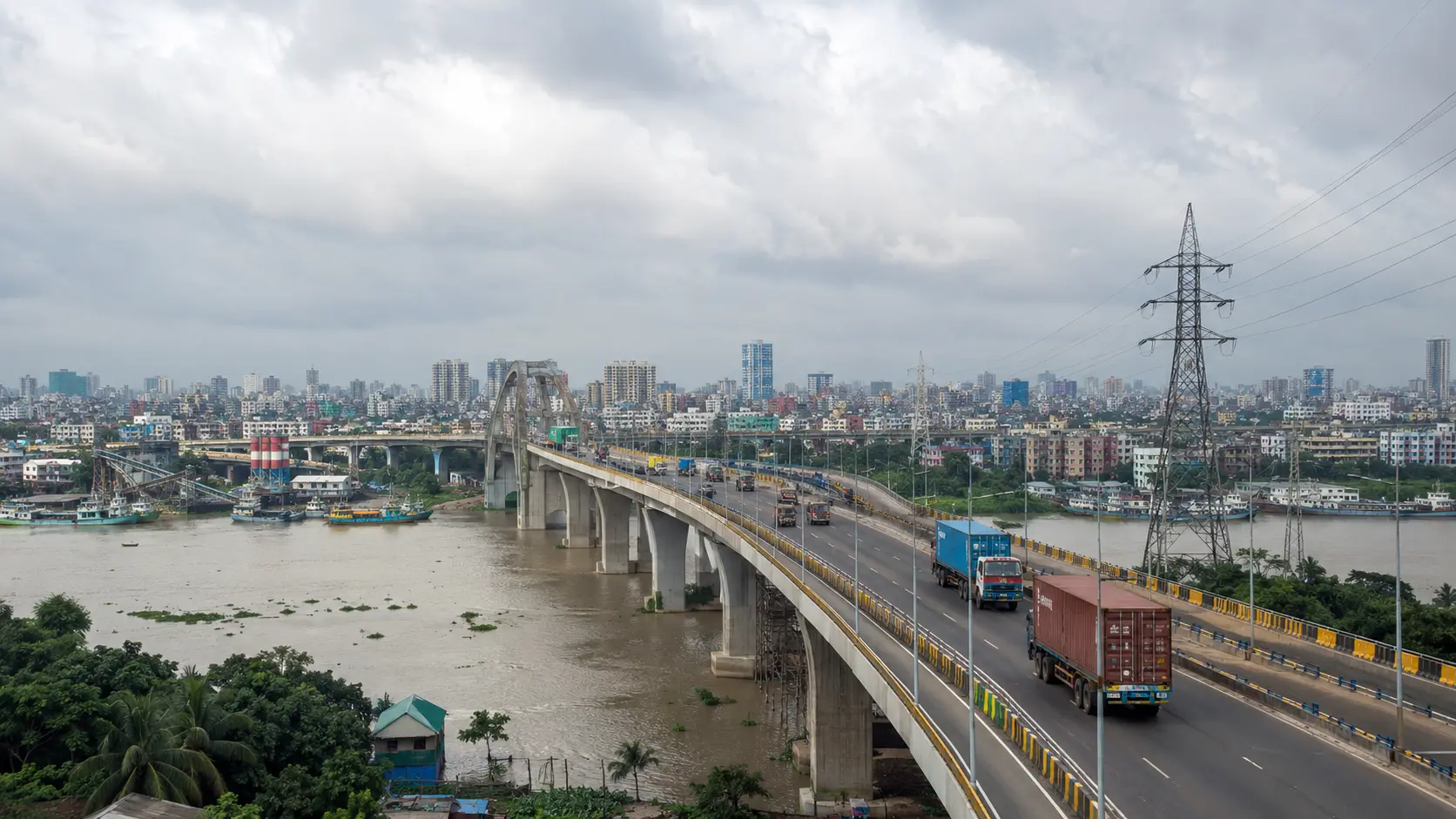
ADB funding moved to the center of Bangladesh’s economic agenda on May 25 after the Asian Development Bank said it would provide $5 billion over the next five years, giving Dhaka a new external backstop as it tries to protect growth, manage pressure on imports, and keep long-term investment plans moving.
The commitment matters beyond headline financing. It links new lending, infrastructure planning, and policy coordination at a moment when Bangladesh is balancing domestic reform needs with a more volatile regional backdrop, including higher energy and shipping costs tied to the U.S.-Israeli war on Iran, according to Reuters.
ADB said the money would support the Integrated Growth Network Development Initiative, a platform meant to improve connectivity, attract investment, and spread development more evenly across the country. During ADB President Masato Kanda’s visit to Dhaka, the bank and Bangladesh also signed about $1.4 billion in loans under the 2026 lending program, according to local reporting and official meeting summaries.
ADB Funding Arrives as Bangladesh Faces a More Demanding External Backdrop
Bangladesh has spent much of the past two years trying to rebuild macroeconomic stability while still financing large infrastructure needs, supporting industry, and containing pressure on its external accounts. That balancing act has become harder as energy costs, freight bills, and imported-input prices remain exposed to geopolitical shocks.
The new ADB commitment does not remove those risks, but it gives policymakers more room to sequence reforms and projects without relying only on short-term fixes. In practical terms, that can help the government preserve momentum in transport, power, and regional connectivity plans even as external conditions stay unsettled.
Energy and Import Costs Are Raising the Stakes
Reuters reported that Bangladesh’s import-dependent economy has been dealing with the fallout from the conflict involving Iran, with higher prices for fuel, liquefied natural gas, fertilizer, and shipping services. Those costs matter because they feed directly into industrial production, food systems, and fiscal planning.
For businesses, the effect is not limited to one sector. More expensive fuel can raise power-generation costs, pricier shipping can squeeze export margins, and fertilizer inflation can ripple through food supply chains and rural demand. That is why an external financing package from a multilateral lender can have wider importance than the value of the signed loans alone.
ADB funding, in that context, acts as both capital and confidence. It tells other lenders, contractors, and investors that Bangladesh still has access to structured development finance even while the wider region faces a harsher risk environment.
ADB Funding Is Also a Reform Signal
ADB said Kanda’s meetings in Dhaka covered development priorities, economic reforms, and Bangladesh’s external financing requirements. That language is important because it suggests the package is being framed not simply as project lending, but as part of a wider conversation about implementation quality, institutional capacity, and medium-term policy direction.
Local reporting said ADB is also providing technical assistance to support Bangladesh’s medium-term development framework and help align future partnership planning. That kind of support rarely generates the biggest headlines, but it often shapes which projects move first, how quickly funds are deployed, and whether reforms are durable enough to attract private capital.
For Bangladesh, the signal is that future financing will likely be judged not only by spending needs, but by the state’s ability to convert that financing into measurable improvements in logistics, energy reliability, and regional economic integration.
Why the Bangladesh Package Matters for Investment and Connectivity
Bangladesh has long had a strong case for infrastructure-led growth, but the next phase is less about building in isolation and more about building networks that lower business costs across regions. That is where the ADB initiative’s emphasis on connectivity becomes strategically significant.
If implemented well, the program could support a broader shift from project-by-project development toward a more integrated investment map. That would matter for manufacturers, logistics companies, port operators, utilities, lenders, and foreign investors looking for clearer visibility on where public capital is likely to flow next.
Transport and Power Links Can Unlock Private Capital
When multilateral development banks commit capital around transport corridors, energy systems, and connectivity upgrades, private investors often treat that as a signal about future demand and lower execution risk. Banks, contractors, equipment suppliers, and industrial tenants can then make decisions with more confidence about where capacity should expand.
That logic helps explain why the ADB package is more than a sovereign-finance story. Bangladesh has ambitions to deepen manufacturing, widen export capabilities, and improve domestic integration between urban centers and secondary regions. Better roads, grid connections, and logistics nodes can reduce frictions that otherwise hold back investment.
ADB funding could therefore have a multiplier effect if the projects are selected well and delivered on time. The clearest gain would not be the headline number itself, but whether that number helps mobilize additional local and foreign capital around a more coherent infrastructure pipeline.
Regional Development Is Becoming a Competitive Issue
ADB said the initiative is designed to support more balanced regional development. That matters because concentrated growth can create congestion, uneven access to jobs, and rising infrastructure strain in a handful of urban hubs while leaving other regions underconnected to national markets.
For Bangladesh, a more regionally distributed growth model could improve labor mobility, broaden industrial land options, and reduce the economic cost of bottlenecks around major cities. It could also help policymakers connect infrastructure spending more directly to social development and climate resilience goals, both of which are increasingly tied to multilateral financing frameworks.
In a global economy where supply chains are being re-evaluated for resilience, countries that can show credible, networked infrastructure plans often stand a better chance of attracting long-term industrial investment. Bangladesh is trying to position itself within that competition rather than simply react to it.
What Markets and Policymakers Will Watch Next in ADB Funding
The announcement gives Bangladesh a stronger development-finance narrative, but the real test starts after the visit ends. Investors, lenders, and policy analysts will now look for signs that the commitment turns into visible execution rather than remaining a promising framework.
That means attention will shift from the size of the package to the structure of delivery. Which sectors receive the earliest support, how quickly loans are approved and disbursed, and whether reforms reduce friction for projects will do more to shape confidence than the $5 billion headline alone.
Execution Speed Will Matter as Much as Financing Size
Large multilateral commitments often succeed or fail on implementation discipline. Bangladesh will need to show that agencies can move projects from planning to procurement and delivery without the delays that commonly erode development returns and weaken investor confidence.
The same issue applies to the newly signed loan agreements. If the $1.4 billion in 2026 program lending moves into energy, transport, climate, and social projects on schedule, the package will start to look like a real accelerator. If bottlenecks build, the market may treat the broader five-year figure more cautiously.
That execution question is especially important now because Bangladesh is trying to manage short-term external pressure while still presenting itself as a credible long-term growth market. ADB funding can help, but only if delivery and reform travel together.
The Broader Financing Signal Could Outlast This Cycle
Kanda has recently emphasized regional connectivity and resilience more broadly across Asia, and Bangladesh fits squarely into that agenda. For ADB, backing a large, system-level initiative in Dhaka is a way to support one of South Asia’s most important growth markets while reinforcing the bank’s role in crowding in future investment.
For Bangladesh, the upside is not only immediate financing. A credible partnership with ADB can improve the country’s standing with other multilaterals, bilateral lenders, export-credit institutions, and private investors that watch for policy consistency and co-financing opportunities.
If that wider signaling effect takes hold, this week’s package may eventually be remembered less as a one-day announcement and more as an attempt to reset how Bangladesh finances connectivity, absorbs shocks, and competes for capital in a more fragmented global economy.
ADB funding gives Bangladesh a timely cushion, but its real value will depend on how well the country converts multilateral commitments into faster execution, stronger connectivity, and broader investor confidence. Keep reading related coverage at Berrit Media for more on policy, markets, and regional business shifts.
Discover more from Berrit Media
Subscribe to get the latest posts sent to your email.