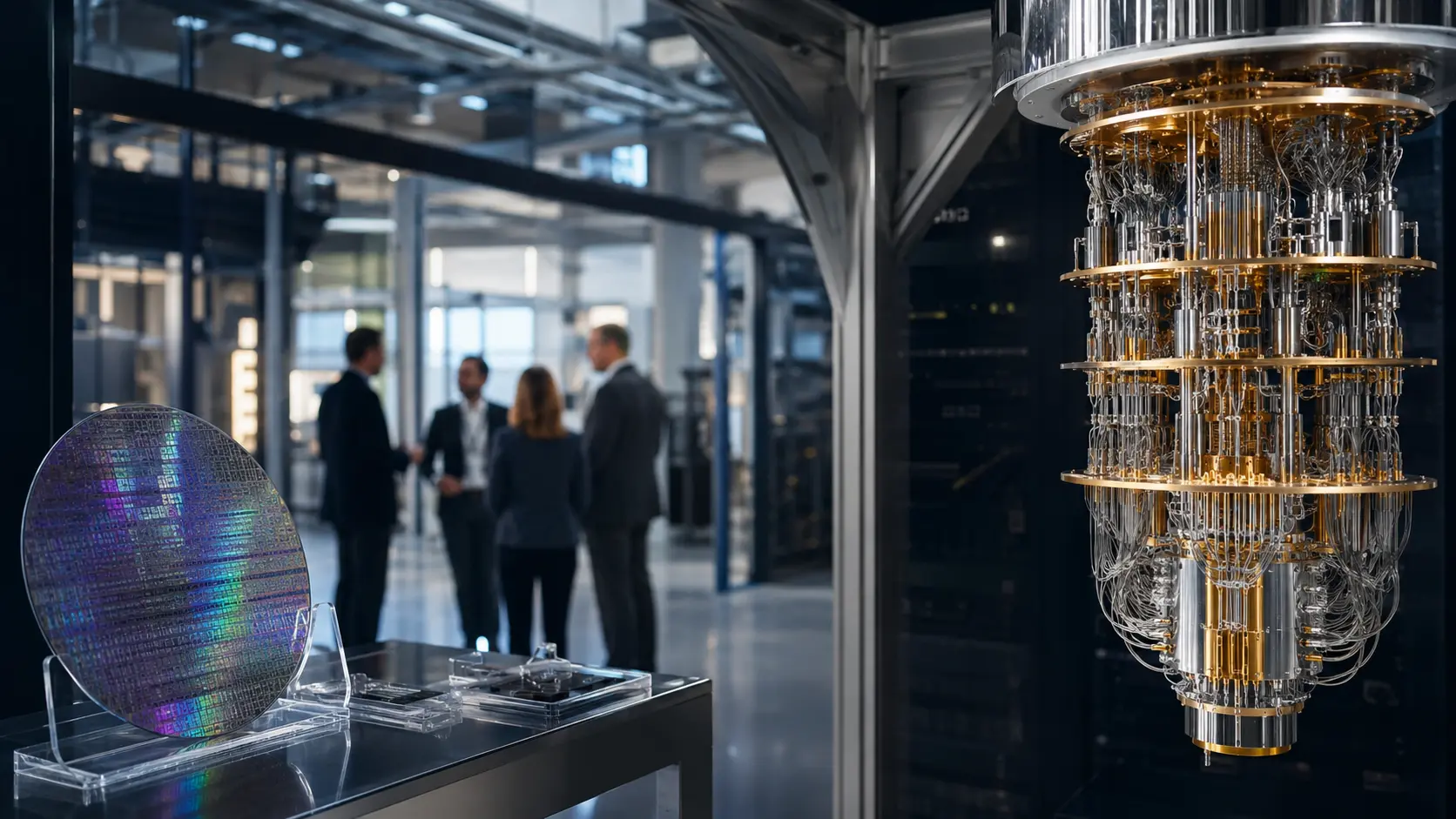
Quantum strategy moved deeper into Europe’s industrial-policy contest on May 22 after France announced an additional €1 billion for its national quantum plan and a separate €550 million semiconductor program, tying frontier computing more tightly to public funding, manufacturing resilience and regional technology sovereignty.
The French government said the new quantum commitment will run through 2030 under France 2030, lifting total public support for the national quantum strategy to €1.7 billion and taking combined public-private engagement to more than €3 billion by the end of the decade. In a parallel announcement, Paris said it will launch a France 2030 call for projects worth €550 million to support advanced semiconductor technologies and industrial projects under a wider European framework.
Taken together, the two measures give France a sharper position in the race to keep key computing capabilities inside Europe. They also turn a familiar policy theme into something more commercially concrete: bigger state support for startups, more emphasis on domestic and European production capacity, and a clearer attempt to reduce dependence on non-European technology supply chains.
Why France Is Expanding Its Quantum Strategy Now
France’s timing reflects a broader shift in how governments are treating advanced computing. Quantum and semiconductor policy are no longer being framed as distant research bets alone. They are now being handled as infrastructure for future competitiveness, security, industrial autonomy and supply-chain leverage.
That matters because the economic case for public intervention has become easier to make. The United States and China have both escalated support for strategically important computing technologies, and European policymakers are increasingly worried that promising companies may scale with foreign capital, foreign manufacturing or foreign policy constraints attached.
Quantum Strategy Becomes a Sovereignty Tool
The French government’s official statement described quantum technologies as a major technological break and a first-rank sovereignty issue, with implications for chemistry, health, energy, defense, telecommunications and cybersecurity. It also warned that future quantum machines could weaken widely used encryption systems, giving the policy an economic and security dimension at the same time.
That framing is important because it shifts quantum strategy out of a narrow laboratory conversation. Paris is effectively arguing that control over computing architecture, talent, supply networks and future deployment pathways will shape national power in the same way previous technology cycles were shaped by chips, cloud infrastructure and telecommunications equipment.
For Berrit Media readers, the key point is that France is not just trying to fund science. It is trying to position itself inside the future commercial stack, from research and hardware to software, procurement and industrial scale-up, before the sector reaches broader practical use.
Why France Thinks Europe Needs More Control
The same French announcement explicitly placed the new push in a European context. Paris said it intends to support a future Quantum Act in 2027, promote large-scale joint public procurement of quantum computers and help build a fully European supply chain that is not constrained by third-country export rules.
That language makes the story more than a domestic funding update. It suggests France sees a window to shape continental policy while the market is still young enough for public money and regulatory design to influence who builds, who owns and who supplies the next generation of strategic computing systems.
It also reveals a familiar European concern: that technological relevance is not only about having research talent, but about whether that talent turns into local champions, local manufacturing and enduring bargaining power when global competition intensifies.
How the Quantum Strategy Is Being Rebuilt
The new package builds on a strategy first launched in 2021. According to the government, that earlier phase helped place France among the sector’s leading countries, and the fresh funding is designed to move from promising momentum toward more durable industrial depth.
What stands out is the structure of the policy. France is not focusing on one narrow bottleneck. Instead, it is spreading support across hardware, software, basic research, applications, talent and European coordination, which suggests officials believe the long-term winners will be the ones that can connect the entire system rather than solve only one isolated technical problem.
Quantum Strategy Spreads Money Across the Full Stack
The government said the new €1 billion investment will support hardware research and development, middleware and quantum software, fundamental and applied computing research, quantum sensing and communications, talent formation and international attractiveness. That multi-track approach reflects the reality that quantum progress depends on more than one breakthrough.
It also gives the funding a stronger business angle than a conventional science package. Software and middleware support can help create tools for future users, while talent and commercialization support matter because even credible hardware roadmaps can stall if firms cannot hire enough engineers, fabrication specialists and system architects to scale operations.
In practical terms, France is trying to reduce the risk of building a fragmented ecosystem. A country may host strong researchers or startups, but still lose strategic advantage if software layers, equipment, manufacturing processes or customer adoption pathways move elsewhere. The new quantum strategy is designed to limit that gap.
Defense Procurement and Public Equity Move Closer to Center
Another notable feature is the emphasis on public leverage beyond grants. The government said public procurement and equity-style support will be mobilized to accelerate the industrialization of a sovereign quantum computer and encourage private investors to follow. That language puts the state in a more active market-shaping role.
Paris also said the PROQCIMA program, which is operated by the defense ministry and already unites several French quantum firms, will receive a major reinforcement. Funding for the next phases through 2030 is set to double, while the technological target rises to 1,024 logical qubits by 2032 from 128 initially planned.
Those details matter because they show France is leaning on defense-related procurement and structured demand, not only venture-style optimism. For startups and industrial partners, that can provide a clearer route from prototype work to larger contracts, especially in a field where commercial timelines remain uncertain and engineering costs are high.
Why Startups and Nvidia’s Backing Matter to the Story
The policy announcement also landed alongside a company-level signal that helps explain why France wants to press its advantage now. Alice & Bob, one of the French quantum startups highlighted by the government, said on the same day that Nvidia’s venture arm NVentures had invested in an extension of its €100 million Series B round.
That does not change the official policy itself, but it strengthens the business logic around it. When a large computing company’s investment arm backs a domestic quantum player while the state expands national funding, the result is a more visible convergence between industrial policy, startup financing and future infrastructure strategy.
Quantum Strategy Gains a Market Signal From Alice & Bob
Alice & Bob said the NVentures investment supports its work toward fault-tolerant quantum computing and builds on an existing technical relationship with Nvidia around hybrid quantum-classical systems. The company said it has been integrating its architecture with Nvidia’s accelerated computing ecosystem, including CUDA-Q, cuQuantum and related tools.
The financial details of NVentures’ investment were not disclosed, so it would be wrong to overstate its immediate balance-sheet effect. Even so, the symbolism is hard to miss. Nvidia is not just selling chips into the AI boom; it is also placing selective bets on the computing architectures that could matter in later cycles.
For France, that kind of validation helps reinforce the case that national support can attract serious strategic capital instead of leaving domestic startups to mature mainly under foreign ownership or outside the European industrial base.
Why Hybrid Systems Strengthen the Commercial Case
The Alice & Bob announcement also underlines an important shift in how the sector is being discussed. Quantum is increasingly presented not as a stand-alone replacement for classical systems, but as part of a hybrid environment where quantum processors, GPUs, software frameworks and high-performance computing centers work together.
That matters for policymakers because hybrid architectures create more immediate industrial linkages. They connect quantum development to existing cloud, semiconductor, accelerator and systems-software ecosystems, making the sector easier to justify as part of mainstream technology policy rather than as a speculative side bet.
It also matters for investors and corporate strategy teams. If quantum adoption arrives through hybrid deployments rather than a sudden breakthrough, countries that already host strong hardware startups, state-backed programs and computing partnerships may be better placed to capture both the early and later phases of commercial value creation.
How the Chip Program Broadens the Policy Bet
The semiconductor package is smaller than the quantum commitment, but it adds an important second leg to the story. France said it will launch a €550 million call for projects in the coming weeks to identify the most strategic technology developments and industrial plans through 2035.
That move places chips and quantum in the same strategic lane. Instead of treating them as separate topics, Paris is pairing long-range computing ambition with nearer-term manufacturing resilience, which is a more complete answer to the way AI, defense electronics and geopolitical risk are all raising pressure on advanced components.
Semiconductors Give the Quantum Strategy an Industrial Base
According to the French government, the semiconductor program will sit inside the Important Project of Common European Interest on advanced semiconductor technologies, coordinated with Germany and the Netherlands. Paris said the initiative should help finance both research and industrial projects and feed into a new national strategy called Semiconductors 2035.
This is where the policy becomes easier to read as a business story rather than a science story. Quantum ambitions may capture attention, but semiconductor capacity, process development and component resilience are what give broader technology strategies a practical operating base. Without that industrial layer, sovereignty claims can remain mostly rhetorical.
France is therefore trying to connect future-looking quantum leadership with a more grounded chips agenda that supports supply, demand and industrial continuity. That pairing can matter to equipment suppliers, component makers, startup founders and investors alike because it widens the addressable policy opportunity beyond a single niche field.
What Europe’s Next Chips Fight Could Look Like
The French statement said the country will push ambitious positions in the coming revision of the European semiconductor rulebook, often described as Chips Act 2, with the aim of stimulating growth and strengthening resilience. It also said public procurement could be used to reinforce demand for European semiconductors.
That is a notable signal because Europe’s next challenge is not only to subsidize capacity, but to ensure enough downstream demand, scaling support and ecosystem coordination for local champions to survive global competition. Public demand can matter here just as much as factory funding if governments want local supply chains to remain viable.
Seen in that light, the quantum strategy and chip package are really part of one message: France wants Europe to move faster from fragmented excellence to coordinated market power. Whether that works will depend on execution, capital discipline and technical progress, but the direction of travel is now much clearer.
France’s quantum strategy is no longer just a research agenda. It is becoming a broader industrial and sovereignty project tied to chips, procurement, startup scale and Europe’s effort to keep more of the next computing wave on its own side of the balance sheet. Readers can continue exploring related business and technology coverage at Berrit Media.
Discover more from Berrit Media
Subscribe to get the latest posts sent to your email.