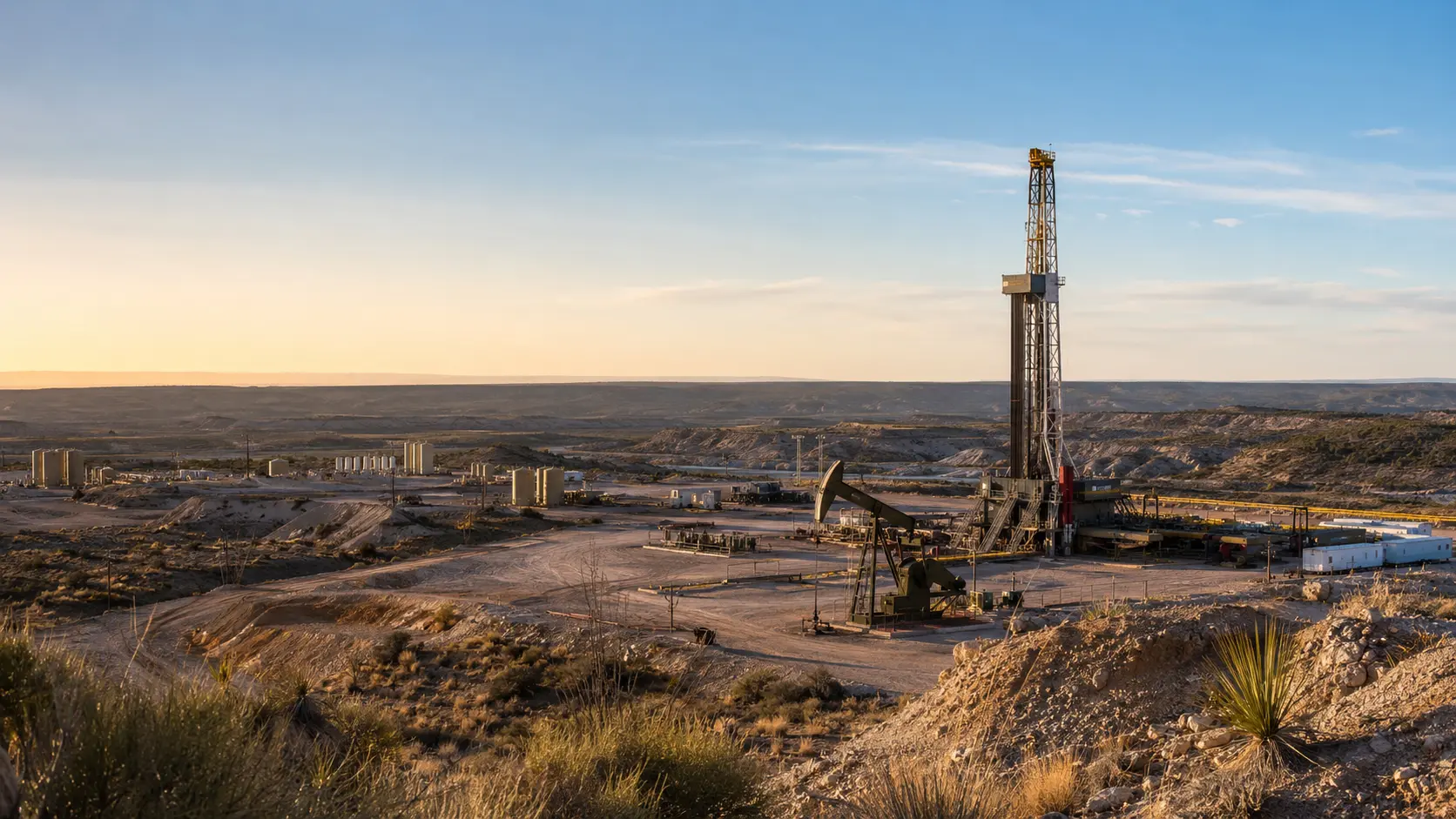
Devon Energy has moved quickly to turn its Coterra merger into a bigger Permian land bet, paying about $2.6 billion for 16,300 net undeveloped acres in New Mexico through a Bureau of Land Management lease sale. The purchase gives the company one of the clearest early signals yet that post-merger shale strategy in 2026 is still centered on scale, contiguous acreage, and the ability to keep drilling inventories deep enough to support shareholder returns for years.
The deal came just two weeks after Devon completed its all-stock merger with Coterra Energy, a combination the companies had said would create a premier shale operator anchored by a stronger Delaware Basin footprint. By moving so quickly after closing, Devon showed that the merger was not simply about synergies and cost savings. It was also about building enough position in the basin to keep capital concentrated where well performance, infrastructure access, and future free cash flow are strongest.
Devon Energy Turns Merger Scale Into a Land Play
Devon framed the acquisition as a rare chance to add high-quality, contiguous federal acreage in the core of the Delaware Basin. In its May 21 announcement, the company said the acreage sits in Lea and Eddy Counties, New Mexico, adjacent to its existing position and capable of supporting longer laterals and multi-well pad development.
That matters because the Delaware Basin remains one of the most competitive oil and gas positions in North America. Companies with scale there are not just buying volume. They are buying flexibility over drilling plans, infrastructure use, operating costs, and the pace at which they can convert inventory into production and cash flow.
Devon Energy Extends Delaware Inventory
According to Devon, the winning bids add around 400 net drilling locations normalized to two-mile laterals. The company said the leases should be accretive to net asset value per share and extend inventory life in a basin already central to the merged company’s future capital program.
That inventory question is a strategic one. When Devon and Coterra announced their merger on February 2, they said the combined company would control more than 10 years of high-quality Delaware inventory and capture $1 billion in annual pre-tax synergies by the end of 2027. Adding more acreage immediately after the merger reinforces the idea that inventory depth is still one of the most valuable currencies in U.S. shale.
It also suggests Devon wants to keep investors focused on duration, not only near-term production growth. In a market that still rewards disciplined capital allocation, having more high-return drilling options can matter as much as headline output because it gives management more room to pace development through commodity cycles.
Federal Lease Terms Change Devon Energy Economics
Devon said the federal leases come with an 87.5% net revenue interest and 10-year terms across all depths, terms it described as more favorable than many comparable state and private leases in the region. The company also highlighted the lower royalty burden and the ability to develop the land with longer laterals using nearby existing facilities.
Those details help explain why federal acreage can still attract aggressive bidding even at a large headline price. Lower royalties, a longer primary term, and adjacency to existing infrastructure can improve project economics in ways that are not obvious from the upfront dollar figure alone. For operators with an established footprint, lease terms and development fit can be as important as the number of acres acquired.
Devon’s chief executive Clay Gaspar said the company’s conviction was strengthened by the basin knowledge it gained through the Coterra merger. That comment is notable because it links the merger directly to the lease decision: scale and technical overlap gave management more confidence to move fast on acreage that smaller or less integrated competitors might have valued differently.
What the Price Says About Post-Merger Shale Competition
The size of the bill immediately became part of the story. Reuters reported that some analysts questioned whether Devon paid too much, noting the implied cost of roughly $6.5 million per net drilling location and calling the total price unusually high compared with past Permian transactions.
That skepticism does not erase the strategic logic, but it does sharpen the market debate. Investors now have to decide whether Devon bought scarce, high-value land that will look smart over time, or whether post-merger urgency pushed management into paying a premium that will be difficult to justify if oil and gas prices soften.
Devon Energy Paid Up for Scarce Acreage
The raw numbers are hard to ignore. Devon said the purchase price works out to about $161,500 per net acre, and Reuters cited analysts who described the total as surprising given historical valuation benchmarks in the Permian. Shares were down in afternoon trading on the day of the announcement, a sign that at least some investors were still digesting the cost.
But price alone does not settle the question. Acreage quality, geological continuity, infrastructure access, royalty terms, and the ability to drill longer laterals all affect what a tract is worth to a specific buyer. Land that looks expensive in a simple per-acre comparison can still be attractive if it unlocks better development sequencing, lowers lifting costs, or supports higher-return wells.
That is especially true in the Delaware Basin, where prime undeveloped acreage has become harder to secure at scale. For a large operator trying to concentrate capital in its best rock, scarcity itself becomes part of the valuation. Devon appears to be betting that control, adjacency, and optionality justify a premium.
The Coterra Merger Changed Devon Energy’s Tolerance for Size
There is also a timing angle that matters. Devon completed the Coterra merger on May 7 after shareholders approved the transaction on May 4, meaning the company entered the federal sale with a larger balance sheet, a broader technical team, and a bigger need to keep its combined drilling queue competitive.
That changed the strategic frame. Before the merger, Devon and Coterra could each pursue basin opportunities within their own capital constraints. After the merger, management had a stronger incentive to prove that the combined company could convert scale into better asset quality, not simply administrative synergies. The lease purchase offered a fast way to demonstrate that ambition.
Devon also said it would fund the acquisition with cash on hand while maintaining its credit profile and its commitment to a disciplined cash-return framework. That funding choice is important because it reduces execution friction in the near term, but it also raises the bar for future operating performance. Investors will want to see this acreage translate into superior economics, not just a stronger map.
Why the Lease Matters Beyond One Company
The transaction says something larger about the current energy market. Even as AI infrastructure, power demand, and industrial policy dominate many headline business stories, upstream oil and gas companies are still competing intensely for top-tier acreage that can support long-cycle cash generation and energy supply security.
It also highlights how public-land policy and corporate strategy intersect. The same federal leasing system that shapes development timelines, royalty burdens, and public revenue can suddenly become a central driver of private-sector portfolio building when attractive parcels come to market in a basin as valuable as the Delaware.
Devon Energy and the New Federal Leasing Backdrop
The Bureau of Land Management said its May 20 oil and gas lease sale in New Mexico and Texas generated more than $4 billion, underscoring how much demand remains for federal energy acreage under the current U.S. policy framework. Devon’s participation was one of the clearest examples of that demand translating into a single, high-stakes corporate move.
That wider sale result matters because it places Devon’s purchase in a broader competitive and political context. Strong bidding supports the Trump administration’s push to present federal leasing as part of an energy-dominance agenda, while also showing that producers still see public-land access as commercially meaningful despite environmental and regulatory debates that continue around onshore development.
For companies, the lesson is practical rather than ideological. When federal parcels are well located and terms are favorable, they can become core strategic assets rather than secondary additions. Devon’s move illustrates how quickly those opportunities can shift from public auction mechanics into long-term capital allocation decisions.
What Investors Will Watch After Devon Energy’s Lease Win
The next test will be operational. Investors will want more detail on when the acreage enters Devon’s development schedule, how management ranks the new locations against its existing inventory, and whether the combined company can use scale and infrastructure adjacency to earn returns that defend the acquisition price.
They will also watch whether the merger’s promised synergies and the new acreage reinforce each other. If Devon can combine lower costs, better development sequencing, and stronger basin focus, the lease could become evidence that the Coterra merger improved strategic agility. If not, the purchase may be remembered as an expensive early signal that scale alone does not guarantee discipline.
For now, the acquisition gives Devon a sharper position in the most closely watched U.S. shale basin and adds a fresh marker for how much operators are willing to pay for future drilling depth. Readers can continue following Berrit Media’s related coverage for more on energy strategy, merger integration, and the business forces reshaping global industry.
Discover more from Berrit Media
Subscribe to get the latest posts sent to your email.