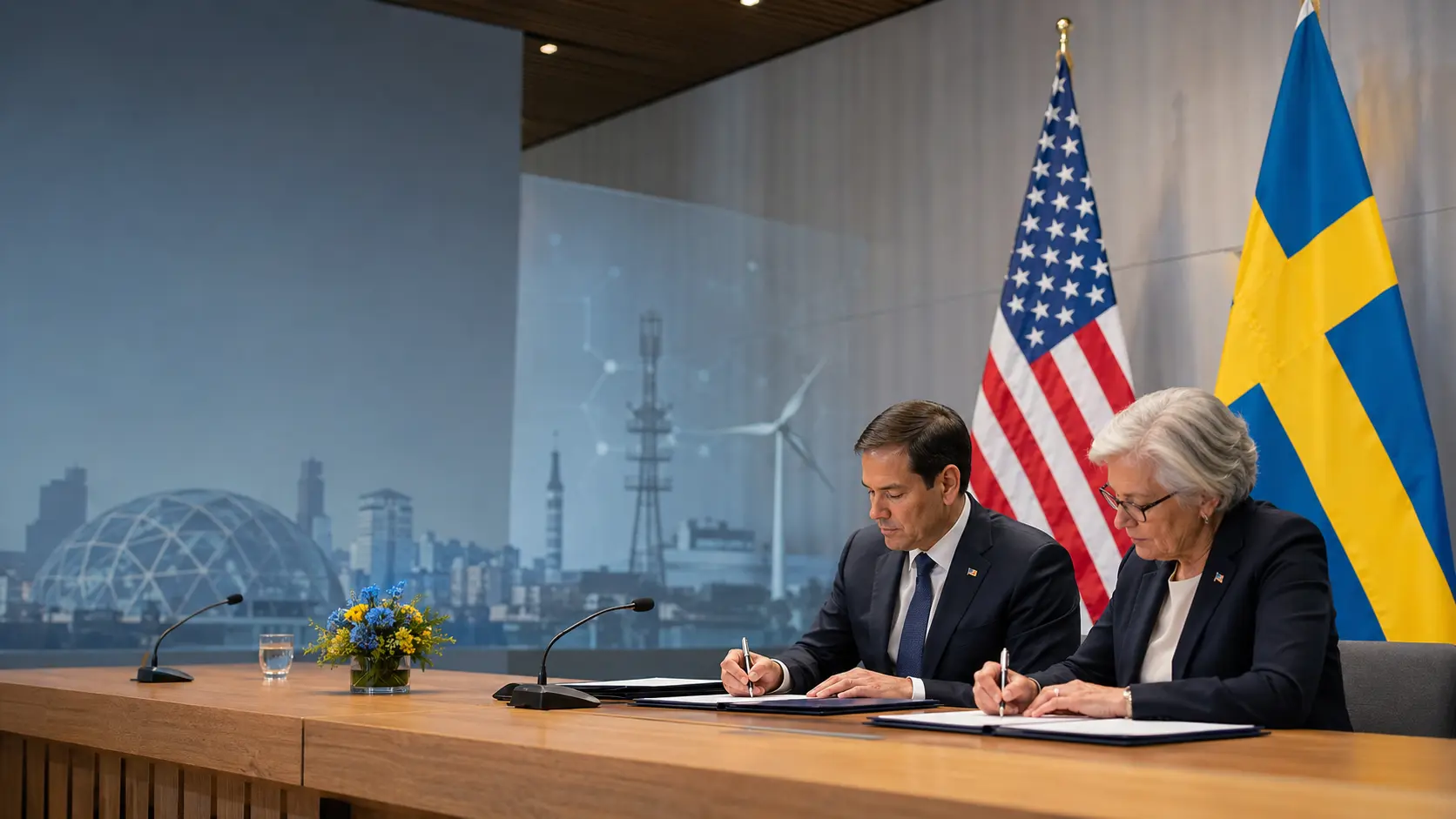
The US-Sweden tech pact signed on May 22, 2026 gives Washington and Stockholm a formal framework to work together on artificial intelligence, advanced connectivity, quantum technology, energy, manufacturing, space, defense innovation and research security. For Berrit Media readers, the significance is not only diplomatic. The agreement turns strategic technology alignment into a more concrete commercial agenda around standards, market access, exports, industrial partnerships and supply-chain resilience.
The memorandum of understanding was signed in Helsingborg by U.S. Secretary of State Marco Rubio and Swedish Foreign Minister Maria Malmer Stenergard. The White House said the non-binding agreement is designed to support the next generation of AI and global connectivity, while Sweden’s government said it should improve access to cutting-edge technology, widen market penetration and deepen cooperation with industry, research and innovation actors.
That combination makes the story more than another broad statement of intent. The text sets out specific workstreams, names strategic technologies and links them to business outcomes that matter to telecom groups, industrial companies, energy developers, defense suppliers, research institutions and policymakers trying to build trusted supply chains outside higher-risk dependencies.
Why the Tech Pact Matters Now
The timing of the agreement matters because it arrives as the United States continues to build a network of technology partnerships with allies around AI, semiconductors, communications and critical infrastructure. Sweden is not just a diplomatic partner in that effort. It is home to globally relevant industrial and telecom capabilities, especially in wireless infrastructure, advanced engineering and research.
The White House text makes clear that this tech pact is meant to strengthen competitiveness as well as security. That framing is important. It suggests Washington is not limiting these arrangements to defensive screening or export controls. It is also trying to shape who builds the next wave of trusted digital and industrial systems, and where those systems are financed, tested and adopted.
How the Tech Pact Widens the AI and Connectivity Agenda
One of the clearest sections of the agreement is the push to deepen cooperation on trusted AI and advanced connectivity. The two governments said they intend to collaborate on research and development, encourage the diffusion of trusted technology stacks and coordinate on international telecommunications standards. In practical terms, that links AI strategy to communications infrastructure, not just to model development.
The agreement goes further than generic AI language by identifying industrial use cases. It highlights joint research on AI for advanced manufacturing, materials and production technologies, as well as industrial automation and other industry-relevant applications. That matters because it points toward deployable business uses of AI in factories and engineering systems, rather than only software-layer competition.
The text also calls for stronger cooperation on 5G and 6G across wireless networks, cloud, electronics and security. For companies operating in telecom equipment, edge computing and industrial networking, the pact could help create a friendlier policy environment for joint pilots, standards work and government-backed advocacy for trusted infrastructure in third countries.
Why Arctic Links and Standards Could Carry the Tech Pact Further
The connectivity provisions are notable for another reason: they connect industrial policy to geography. The memorandum points to stronger links between North America, Northern Europe and the Indo-Pacific, including support for subsea communication cables across the Arctic. That gives the tech pact a physical infrastructure dimension that extends beyond research collaboration.
Standards policy is another overlooked commercial lever. The agreement says the two countries will coordinate in bodies such as the International Telecommunication Union, the Global Coalition on Telecommunications and 3GPP, while aligning ahead of the 2026 ITU Plenipotentiary and the 2027 World Radiocommunication Conference. Standards battles often determine which vendors gain scale, whose patents matter most and how future networks are secured.
Ericsson’s public reaction helps underline that point. The Swedish telecom company welcomed the agreement and said it supports cooperation on 5G, 6G, AI and advanced research. That does not prove immediate commercial gains, but it does show that one of Sweden’s flagship technology groups sees the pact as relevant to competitiveness in the next decade of digital infrastructure.
Where the US-Sweden Tech Pact Could Change Industrial Planning
The most useful way to read the agreement is as a map of sectors where government-to-government coordination may reduce friction for business. The memorandum repeatedly links technology cooperation with market access, exports, commercial partnerships, resilient supply chains and regulatory alignment. Those are signals executives tend to watch more closely than ceremonial language.
It is also meaningful that the pact spans several domains at once. AI, energy, manufacturing, critical minerals, space and defense are often treated as separate policy conversations. Here they are grouped into a single strategic framework. That raises the odds that future projects, funding support or export promotion efforts will be designed across sectors rather than inside narrow bureaucratic silos.
Tech Pact Implications for Manufacturing, Energy and Minerals
The advanced manufacturing section points to digital manufacturing, additive manufacturing, industrial automation, precision engineering and robotics. It also mentions collaboration on advanced materials relevant to defense and semiconductor supply chains, plus technologies for vehicles, high-efficiency motors, advanced batteries and rare-earth-free materials. That range gives the tech pact a direct industrial-policy flavor.
For manufacturers, the value lies less in any single sentence than in the combination of priorities. AI-driven process optimization, advanced materials and supply-chain resilience all sit in the same policy lane here. If the agreement translates into testbeds, pilot programs or easier cross-border industry collaboration, it could help companies shorten the path from research to production-scale adoption.
The energy section is similarly broad but commercially relevant. It covers civil nuclear partnerships, small modular reactors, fusion technologies, nuclear lifecycle innovation and critical minerals technologies across exploration, processing and recovery. Inference from the text: both governments appear to be using the pact to widen the set of technologies treated as essential to future industrial competitiveness, not only to climate or defense policy.
What the Tech Pact Says About Defense and Research Security
The memorandum does not create a defense procurement deal, but it does establish a dialogue on regulatory and policy issues affecting defense technology cooperation and technology transfer. That is a meaningful step for companies working in dual-use systems, sensors, secure networks, aerospace components and advanced industrial electronics, where export controls and cross-border compliance often slow execution.
Research security is another key piece. The White House text says the two sides plan to cooperate on intellectual-property security, investment screening, foreign-funding disclosure, talent safeguards and information-sharing on threats and entities of concern. Sweden’s government framed the pact as a way to protect commercial interests while expanding access to frontier technology.
Those provisions show how much the global technology race has shifted. Trusted collaboration is now being built alongside stronger screening, not instead of it. For executives and investors, that means future growth opportunities may increasingly depend on being inside approved ecosystems that satisfy both innovation goals and security requirements.
What Companies and Policymakers Will Watch Next
The deal is important, but it is not self-executing. The White House states clearly that the memorandum is non-binding, creates no legal obligations and commits neither side to spend funds. Either government can discontinue it with 180 days written notice. That means the real test will be what projects, working groups and business pathways emerge after the signing ceremony.
Even so, the agreement provides a clearer roadmap than many diplomatic technology statements. It defines sectors, names mechanisms and sketches how collaboration could move through standards bodies, research partnerships, commercial facilitation and a joint committee structure. That is enough to make it materially stronger than a generic declaration of shared values.
Why the Tech Pact’s Joint Committee Will Matter
The implementation mechanism will be especially important. The memorandum says the two governments intend to advance the deal through a Joint Committee Meeting mechanism, with the structure and procedures to be defined later by mutual decision. That may sound procedural, but in practice it is where priorities become pipelines.
If the committee develops focused workstreams, industry will have a better sense of where to invest time and lobbying effort. Companies will want to know whether the first visible outputs are standards coordination, export support, research exchanges, pilot manufacturing projects, defense-tech dialogue or energy partnerships. Each path would create a different commercial map.
Investors and policy teams will also watch whether business-facing agencies and corporate stakeholders become more visible in follow-up announcements. Sweden has already said the pact should deepen business-sector cooperation. That raises expectations that the next stage will involve more than ministry-level coordination and could eventually include concrete public-private initiatives.
How the Tech Pact Fits the Wider US Alliance Strategy
Ericsson noted that Sweden is only the fourth country to sign this kind of U.S. Technology Prosperity Deal, following similar arrangements with Japan, South Korea and the United Kingdom. That wider pattern matters because it suggests Washington is assembling a selective architecture for trusted technology collaboration among allies with relevant industrial capabilities.
Seen that way, the US-Sweden tech pact is not a stand-alone Nordic story. It is part of a larger competition over who defines trusted telecom infrastructure, who benefits from AI-enabled industrial modernization, who shapes quantum and research standards, and which supply chains are treated as strategically reliable. That gives the agreement significance well beyond bilateral symbolism.
The US-Sweden tech pact will only prove its value if it produces real commercial openings, stronger standards coordination and durable industrial cooperation. But as of May 22, 2026, it has already moved strategic technology diplomacy closer to business execution. Readers can follow Berrit Media for more coverage of how AI, connectivity, energy and industrial policy continue to reshape the global competitive map.
Discover more from Berrit Media
Subscribe to get the latest posts sent to your email.