Industrial AI is moving from generic automation talk into the core of European engineering strategy after Mistral AI agreed to acquire Austrian startup Emmi AI, giving the French company a stronger position in software used to simulate, design, and optimize physical systems. The deal, announced this week without financial terms, extends Mistral’s ambitions beyond foundation models and into factory, semiconductor, automotive, and industrial workflows where accuracy, downtime, and production yield have direct commercial consequences.
The acquisition matters because it points to a harder, more defensible part of the AI market. Instead of competing only on consumer assistants or general enterprise copilots, Mistral is betting that manufacturers will pay for models that can understand airflow, heat transfer, material stress, and other engineering constraints that shape how real machines behave. That shift gives the story a wider business meaning: industrial customers are emerging as one of the clearest routes for European AI companies to turn technical credibility into durable revenue.
Industrial AI Is Becoming Mistral’s Enterprise Wedge
Mistral said on May 22 that it had entered into a definitive agreement to acquire Emmi AI as part of a push to build leading AI systems for engineering and manufacturing. In its announcement, the company framed the deal as a way to deepen its science roadmap and improve its ability to build agents that can work with existing engineering tools rather than only answer questions in text.
That framing is important because it shows Mistral trying to define a lane that is narrower than the broad chatbot race but potentially more valuable for customers. Industrial buyers typically care less about consumer-style novelty than about yield, defect detection, cycle times, maintenance, and the speed of design iteration. By buying Emmi, Mistral is signaling that it wants to sit closer to those budgets and operating decisions.
Why Industrial AI Fits Europe’s Client Base
Reuters reported on May 19 that Mistral sees engineering and manufacturing as areas the industry has overlooked, even though they fit the company’s European client base. That logic matches the region’s economic structure. Europe still has deep concentrations of advanced manufacturing, industrial suppliers, automotive groups, and engineering-heavy exporters that need specialized software more than another broad workplace chatbot.
The European Commission has also spent the past year making AI adoption in industry a policy priority. In its October 8, 2025 Apply AI strategy, the Commission said Europe should accelerate AI use across key sectors and science, with manufacturing among the strategic domains where local data, engineering expertise, and industrial capacity matter. Mistral’s Emmi deal lines up neatly with that policy direction and gives the company a commercial story that is tied to Europe’s existing strengths.
That does not mean every industrial AI project will scale smoothly. Manufacturers buy carefully, pilots can drag on, and integration into established software stacks is rarely quick. But those same frictions can become an advantage for vendors that prove they understand the customer’s processes. Once a model is embedded in simulation, design, inspection, or maintenance workflows, it may be harder to displace than a generic assistant sitting on top of office software.
Why Industrial AI Needs Physics, Not Just Chatbots
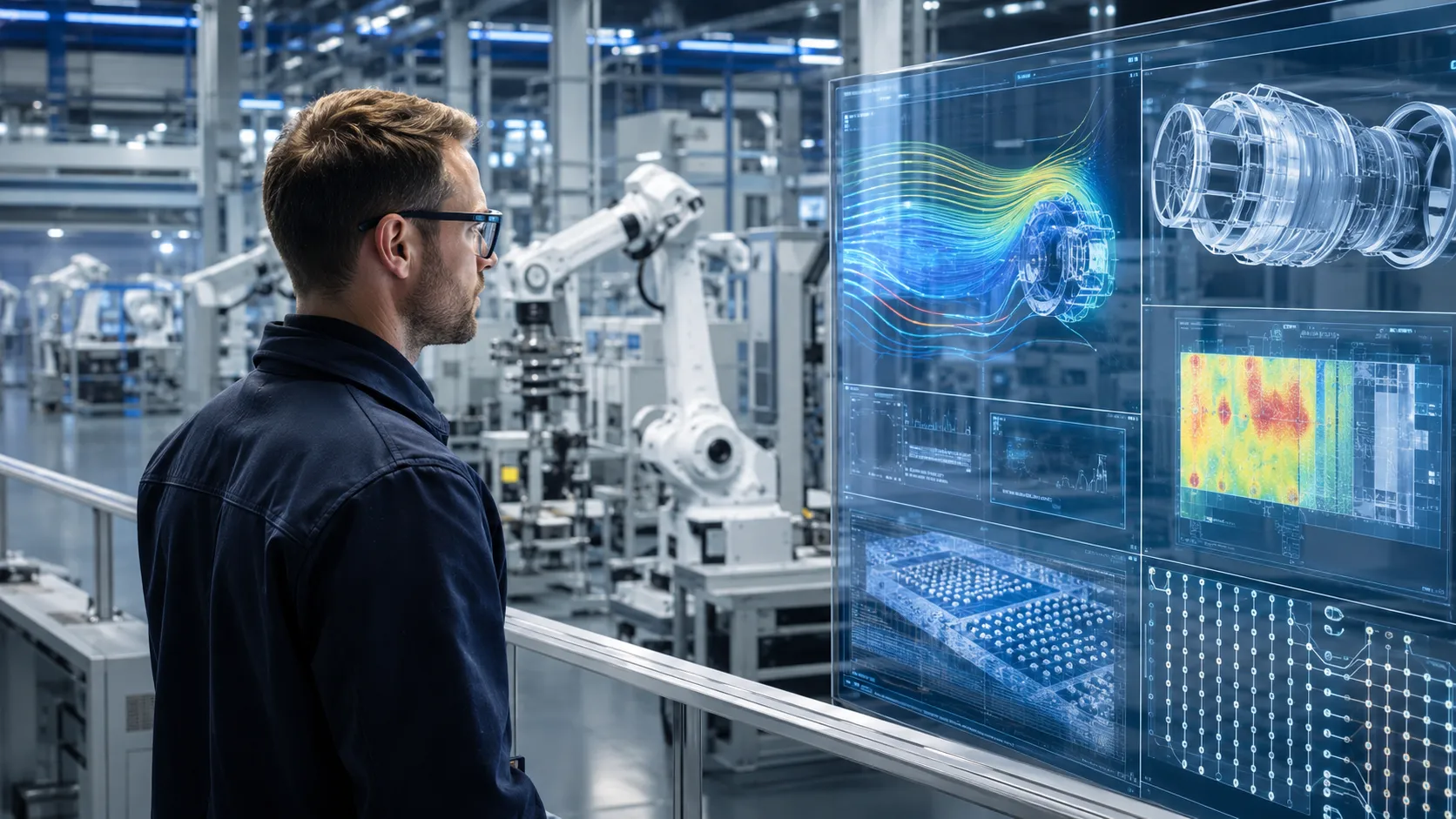
The heart of the transaction is that Emmi AI was built around physics-aware models rather than general-purpose language interfaces. Reuters described Emmi as specializing in models capable of handling airflow, heat transfer, and material stress, while Emmi itself has positioned its technology around real-time simulation and digital-twin style engineering use cases. Those are not side features. They are the difference between software that drafts text and software that helps decide how a machine, component, or production line should perform.
In industrial settings, credibility depends on whether the system reflects physical reality closely enough to save time and money without introducing unacceptable risk. A factory operator, chipmaker, or automotive engineer cannot rely on a fluent answer if the underlying model does not respect the constraints of heat, geometry, material fatigue, or flow. That is why the industrial AI category is developing differently from consumer AI: customers are effectively buying reduced error, lower downtime, and faster iteration, not just convenience.
Emmi’s background helps Mistral address that gap. In an April 2025 funding announcement, Emmi said its AI-enabled simulation technology was designed to solve complex engineering problems at industrial scale and that early customer contracts had already reached seven-digit annual contract values. That suggests there was commercial substance behind the science, which matters because Mistral is not simply buying research talent. It is buying a path into budgets that already exist inside engineering organizations.
What Emmi AI Adds to the Industrial AI Stack
Mistral’s own announcement made clear that this is as much a talent and product integration move as a branding exercise. The company said Emmi’s co-founders and a team of more than 30 researchers and engineers would join Mistral’s Science and Applied AI teams in May. It also said Linz would become an office location, giving Mistral a foothold in one of Europe’s more specialized deep-tech clusters.
That matters because industrial software is rarely won by models alone. Vendors need domain expertise, implementation capacity, customer trust, and an understanding of how enterprise data and design tools fit together. Mistral has spent much of its public profile on sovereign AI and enterprise model deployment, but Emmi gives it a more explicit bridge into the engineering layer where customers care about simulation, tooling, and physical outcomes.
Industrial AI for Simulation and Digital Twins
Emmi said on May 19 that joining Mistral would let it scale its mission of building foundational intelligence for engineering. In its own words, it wants systems that do not just simulate but reason, design, and iterate alongside engineers. That is an ambitious claim, but it captures the broader market direction well. Industrial software is moving toward tools that can compress the time between concept, testing, redesign, and production.
Traditional simulation remains expensive in both compute and human expertise. Complex computational fluid dynamics or multi-physics modeling can take large teams, long runtimes, and difficult data preparation. If AI systems can deliver useful approximations or faster iteration without throwing away engineering rigor, the business case becomes compelling in sectors where every design cycle affects cost, time to market, or production yield. That is the practical promise behind industrial AI, and it is why simulation startups have become strategically interesting rather than academically interesting.
Emmi’s previous materials underline that point. The company said its technology could handle simulations with hundreds of millions of mesh cells in milliseconds without manual pre-processing, a claim aimed squarely at the pain points of engineering teams. Even if customers use those tools selectively rather than universally, the value can be significant. Faster experimentation can change procurement, manufacturing schedules, and product design decisions long before AI ever becomes a fully autonomous engineering system.
Industrial AI and the ASML Template
Reuters also reported that Mistral cited its work with ASML as an example of how these systems can translate into industrial value. According to Reuters, Mistral said EUV lithography machines equipped with its vision models can detect engraving defects and cut diagnostic time from hours to eight minutes. Reuters further cited comments from ASML Chief Financial Officer Roger Dassen at the company’s April annual meeting about the value of reducing downtime on very expensive equipment.
Even with careful attribution, that example helps explain why this market is attractive. In chipmaking and other capital-intensive sectors, minutes matter. A single improvement in diagnostics, maintenance, or defect detection can ripple through capacity planning, waste reduction, and output economics. Vendors that can tie AI directly to those outcomes may find a more rational buying environment than the one surrounding generic workplace assistants, where return on investment is often harder to isolate.
The ASML example also shows why Mistral’s industrial strategy could travel beyond one customer or one sector. Semiconductor tools, automotive systems, energy infrastructure, and advanced manufacturing lines all create high-value operating data. If that data can be turned into specialized models that improve uptime or design accuracy, the commercial opportunity extends well beyond flashy demos. In that sense, Emmi looks less like a small add-on and more like a technical building block for Mistral’s next phase.
Why the Deal Matters Beyond One Startup Exit
On one level, this is a familiar startup story: a fast-rising AI company acquires a smaller specialist team to accelerate product development. But the more interesting angle is what the deal says about how the European AI race is evolving. Mistral is effectively arguing that Europe does not need to win every front of the global model contest to build valuable AI businesses. It can instead combine model capabilities with local industrial depth, engineering data, and sector-specific workflows.
That approach may prove especially relevant as competition intensifies among U.S., Chinese, and European AI companies. Frontier model performance still matters, but it is no longer the only story that enterprises care about. Many customers now want implementation partners that understand compliance, data residency, operations, and domain-specific outcomes. Mistral’s acquisition of Emmi suggests that industrial expertise may become one of the clearest differentiators available to European firms.
Industrial AI and Europe’s Sovereignty Argument
Mistral has often been discussed through the lens of European technological sovereignty, and this deal gives that narrative more concrete business footing. Sovereignty arguments can sound abstract when they focus only on owning a model stack. They become more tangible when the technology is embedded in factories, design systems, industrial equipment, and engineering workflows that are central to regional competitiveness.
The European Commission’s AI strategy explicitly links adoption to competitiveness, research strength, and reduced dependence on foreign technology ecosystems. Mistral’s move into industrial AI fits that logic by targeting customers that already generate high-value proprietary data and may prefer a European partner for legal, operational, or strategic reasons. For executives, that does not automatically outweigh price or performance, but it can matter when procurement decisions touch sensitive production systems.
There is still a gap between policy ambition and enterprise adoption. European companies remain under pressure from larger U.S. platform vendors with deeper capital pools, broader cloud infrastructure, and stronger distribution. Yet that imbalance is precisely why vertical specialization matters. If Mistral can show that a European vendor can outperform broad alternatives inside industrial environments, the sovereignty debate starts to look less ideological and more like ordinary competitive strategy.
What Comes Next for Industrial AI Customers and Rivals
The next test is execution. Mistral now has to prove that Emmi’s science can be integrated into products and sales motions that industrial buyers understand. That means translating research credibility into deployments, reference customers, and measurable performance gains. It also means managing expectations. Engineering organizations tend to be skeptical for good reason, and they usually want evidence at the process level, not only impressive model benchmarks.
Competitors will be watching closely. Large industrial software vendors, engineering platforms, cloud providers, and rival AI startups are all trying to secure a role in the same workflow stack. Some will prefer partnership models, others will build in-house, and more acquisitions are likely if customers keep rewarding specialized tools with domain depth. Mistral’s move may therefore say as much about where the market is going as about the company itself.
For investors and operators, the clearest takeaway is that industrial AI is becoming a more concrete category. It now has policy support, identifiable customer pain points, specialist talent, and a growing list of use cases tied to revenue or cost savings. Mistral did not disclose the price it paid for Emmi, but the strategic logic is visible enough: own more of the engineering layer, get closer to operational budgets, and build a position in the parts of AI that interact with the physical economy.
Mistral’s acquisition of Emmi will not settle the wider AI race, but it does sharpen one important argument about where durable value may emerge. Readers can follow more reporting on technology, investment, and industry shifts through Berrit Media’s related coverage.
Discover more from Berrit Media
Subscribe to get the latest posts sent to your email.