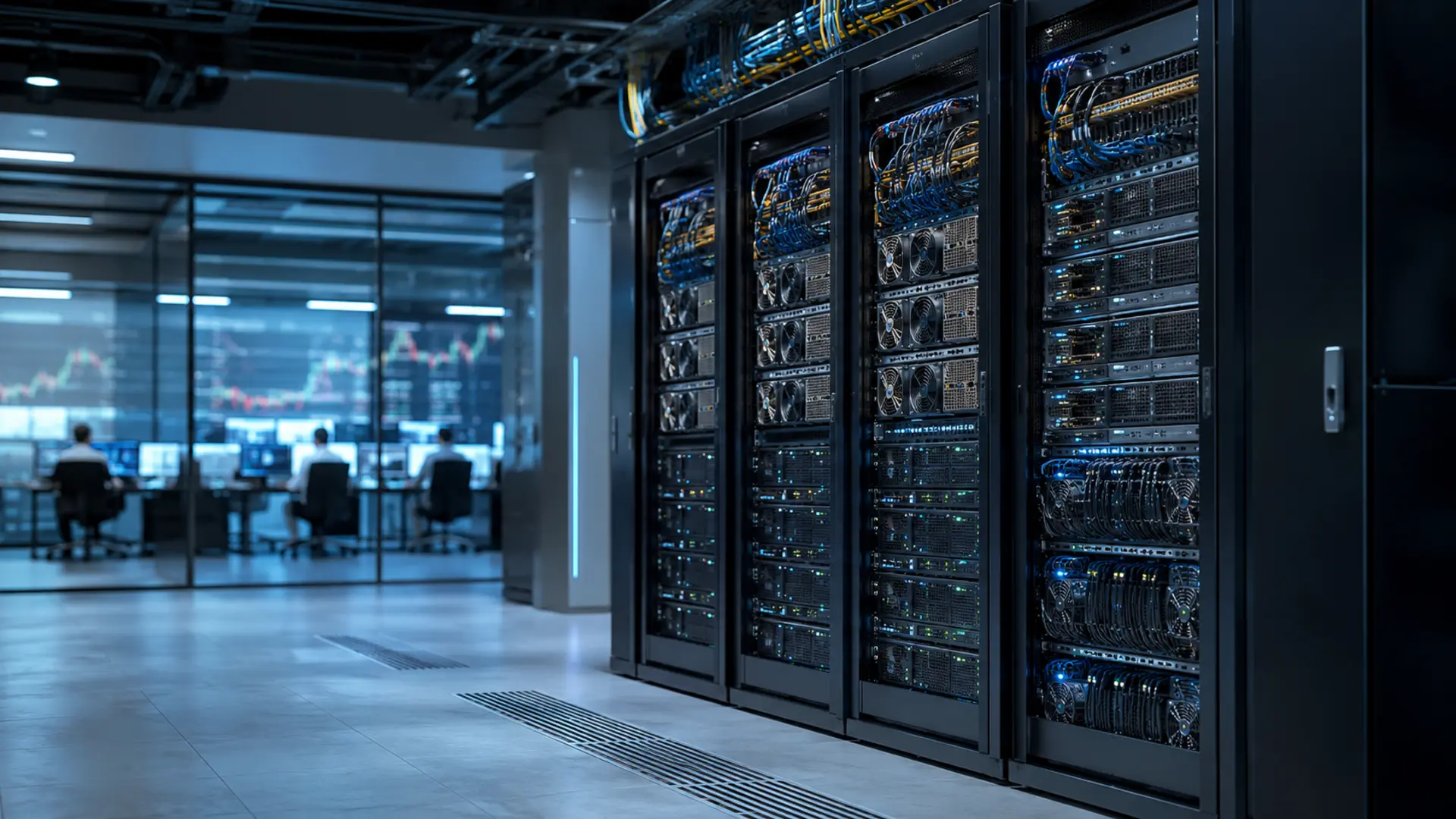
AI trading is moving beyond captive in-house hardware as Lambda signs Hudson River Trading for a new cloud-compute deal built around Nvidia systems, giving Wall Street another sign that advanced research infrastructure is becoming a rentable strategic input rather than a purely proprietary asset.
Reuters reported on May 20 that the agreement will give Hudson River Trading access to more than 1,000 of Nvidia’s latest Blackwell systems through Lambda’s cloud, with financial terms undisclosed. Lambda said the hardware is already installed in a data center, which means the contract is about monetizing deployed capacity rather than waiting for a new equipment buildout.
The development matters because it connects two markets that are both defined by speed, capital intensity, and relentless competition. Lambda has been racing to establish itself as an independent supplier of AI infrastructure, while Hudson River Trading is one of the most compute-heavy firms in modern electronic markets. Their partnership shows how the AI buildout is no longer limited to model developers and hyperscalers; it is also reshaping how large financial firms buy and scale research power.
AI Trading Moves Further Into Rented Compute
The immediate headline is simple: a major quantitative trading firm is adding external AI capacity instead of relying only on its own systems. That is notable in a sector where infrastructure has long been treated as a core internal advantage rather than something to source flexibly from a third party.
Lambda’s own announcement framed the deal as support for Hudson River Trading’s quantitative research and development work. The company said it is providing Nvidia HGX B200 systems along with networking, storage, and orchestration, positioning the arrangement as a full-stack cloud service rather than a narrow hardware rental.
Why AI Trading Needs More Capacity
According to Lambda, Hudson River Trading’s researchers run compute-intensive workloads to train models and simulate trading strategies at scale. That description fits the broader direction of quantitative finance, where more signals, more market venues, and more complex modeling approaches keep increasing the appetite for processing power.
Hudson River Trading’s own website describes the firm as a multi-asset quantitative trading company active across global markets and says it has built an advanced computing environment for research, development, modeling, and risk management. In other words, this is not a newcomer experimenting with AI from scratch. It is a technologically mature trading firm deciding that outside cloud capacity can complement its internal stack.
That shift matters because it suggests the constraint is no longer just model quality or trading logic. Capacity itself is becoming strategic. When firms need to run more simulations, test more scenarios, and iterate faster, compute availability can shape who learns first and who falls behind.
What the Lambda Contract Actually Adds
Reuters said the deal includes access to more than 1,000 Blackwell systems, giving the announcement real industrial scale rather than the feel of a small pilot. Even without disclosed pricing, the size alone signals a serious production-grade commitment for research workloads.
Lambda also said the systems were already purchased and installed. That detail is important because it indicates the contract can start from existing capacity. For customers, that shortens time to use. For Lambda, it improves the business case for building inventory ahead of demand and then filling it with high-value contracts.
The arrangement also appears to broaden Hudson River Trading’s compute options. Reuters noted that Hudson River Trading is a major Google Cloud customer and has publicly discussed using Nvidia chips in Google’s cloud. By adding Lambda, the firm is not necessarily replacing one supplier with another, but it is expanding where and how it can access the Nvidia ecosystem.
Why Nvidia Still Anchors AI Trading Infrastructure
The deal also reinforces something larger than either company: Nvidia’s software and hardware stack remains the default choice when customers need portable, large-scale AI capacity quickly. That matters for cloud competition because many providers are trying to differentiate with custom chips, specialized software, or lower-cost architectures.
In this case, Reuters reported that Lambda’s Stephen Balaban pointed to the broad availability of Nvidia products across major cloud environments as a key attraction for large customers. That portability is commercially powerful. It gives buyers more flexibility while protecting their software and workflow investments.
Nvidia Ubiquity Gives Customers Optionality
For trading firms, optionality has real operational value. Research teams may want to move workloads between providers, combine internal clusters with outside capacity, or keep different pools of compute available for different latency and governance needs. A common Nvidia-based environment makes that easier than a fragmented chip landscape would.
That helps explain why the contract is significant even though Hudson River Trading already has large internal capabilities and existing cloud relationships. The attraction is not just raw hardware access. It is the ability to tap a familiar architecture without rebuilding tools, training pipelines, and supporting systems around a different foundation.
In practical terms, this strengthens Nvidia’s role as the standard layer underneath the AI compute market. Hyperscalers, specialist cloud firms, and enterprise customers may compete intensely on pricing, packaging, and service, but many of them still meet on the same chip platform.
Blackwell Turns Compute Into a Commercial Product
The Blackwell angle matters because it shows how next-generation AI hardware is now being sold not just to train frontier models, but also to serve vertical, high-value workloads in finance. That widens the commercial map for premium accelerators beyond the usual group of large model labs and consumer internet platforms.
It also supports Lambda’s effort to present itself as more than a niche GPU lessor. The company has been assembling capital and operating leadership to expand what it calls its AI factory footprint, and earlier this month it announced a $1 billion senior secured credit facility to support further infrastructure deployment.
When those financing moves are paired with contracts like Hudson River Trading, the strategy becomes easier to read. Lambda is trying to build, finance, and rapidly utilize AI capacity at a scale that lets it compete for demanding enterprise and institutional workloads, not only startup experimentation.
What the Deal Means for Lambda and Wall Street
For Lambda, the contract is another proof point that there is real demand outside the standard hyperscaler customer set. The company already announced a multibillion-dollar Microsoft agreement in late 2025, and the Hudson River Trading win adds a different kind of validation because it comes from a performance-sensitive financial customer with sophisticated internal technology standards.
For Wall Street, the deal suggests that AI infrastructure buying is becoming more modular. Firms that once would have treated additional compute as a purely internal expansion project may now see external capacity as a way to move faster, diversify supply, and avoid overcommitting capital before demand patterns stabilize.
Lambda’s Growth Model Is Getting Clearer
Recent company announcements show Lambda building around three pillars: more capital, more leadership depth, and more flagship customers. On May 5, Lambda said it had expanded its leadership structure, naming Michel Combes as chief executive and shifting co-founder Stephen Balaban to a full-time chief technology role focused on product and technology strategy.
Two days later, Lambda announced the enlarged credit facility, describing it as support for gigawatt-scale AI infrastructure demand. The Hudson River Trading agreement now gives that financing story an operational counterpart. Investors and partners can see not just balance-sheet expansion, but also evidence that the capacity can be matched with real customers.
This is important because the independent AI cloud market is becoming crowded and capital hungry. Winning a customer that depends on scale, uptime, and technical reliability says more about execution than winning a small experimental deployment would.
Wall Street’s AI Trading Buildout Keeps Spreading
The other important signal is that advanced financial firms are treating AI infrastructure as central to research throughput. Hudson River Trading has long positioned itself as a technology-heavy market maker, and its decision to deepen access to Nvidia-based cloud systems suggests that the frontier of competition increasingly includes how fast firms can train, simulate, and refine models.
That does not mean external cloud capacity will replace internal systems across finance. In many cases, firms will likely keep a hybrid approach, using in-house environments for sensitive or tightly integrated workloads while adding rented capacity when they need scale, redundancy, or faster deployment. The Lambda deal fits that logic well.
It also hints at where the next wave of AI infrastructure demand may come from. As more industries conclude that frontier-grade compute is a core competitive resource, specialist cloud providers will have a bigger opening to sell capacity into sectors such as trading, healthcare, industrial research, and advanced engineering.
Lambda’s new agreement with Hudson River Trading does not disclose revenue, margins, or duration, so some of its commercial impact will remain unclear for now. But the structure of the deal is already meaningful: AI trading workloads are moving deeper into rented Nvidia cloud infrastructure, and that shift could become an important part of how both Wall Street firms and AI cloud providers scale. Readers can continue following related technology and infrastructure coverage at Berrit Media.
Discover more from Berrit Media
Subscribe to get the latest posts sent to your email.