AI smuggling is back at the center of the U.S.-China technology fight after prosecutors in Taiwan detained three suspects and searched 12 locations in a case involving Supermicro servers equipped with advanced Nvidia chips. The alleged scheme matters well beyond one shipment route because it touches the fragile enforcement chain around some of the world’s most sought-after artificial intelligence hardware.
Taiwanese prosecutors said the suspects knew the servers were subject to strict U.S. controls and allegedly used false documents to move them toward Hong Kong, with possible onward exposure to mainland China. The case lands only weeks after the U.S. Department of Justice unsealed a much larger criminal case tied to Supermicro-linked server diversions, giving regulators and investors a fresh reason to examine how export-control compliance works in practice across AI supply chains.
Taiwan’s AI Smuggling Case Has Become More Than a Local Investigation
The immediate trigger for the story was the Keelung District Prosecutors Office’s action on May 21 and May 22. Reuters reported that prosecutors were investigating three people suspected of illegally exporting high-end AI servers made by Super Micro and containing Nvidia chips that are covered by U.S. export restrictions.
Focus Taiwan, citing the same prosecutors office, reported that the court approved a motion to detain the three men and hold them incommunicado after investigators argued they posed flight risks and could tamper with evidence. That escalation turned the case from a preliminary allegation into a more consequential enforcement step with real legal weight.
What prosecutors say the AI smuggling plot involved
According to Reuters, prosecutors said the suspects allegedly knew Supermicro AI servers containing advanced Nvidia chips were banned from being sold to mainland China, Hong Kong, and Macau under U.S. controls. They nonetheless sought what prosecutors described as huge illegal profits by buying the servers in Taiwan and declaring them for export with false documents and false information.
Focus Taiwan added that prosecutors believe more than 10 Supermicro AI servers, each valued at about NT$10 million, were shipped to Hong Kong via a third location. Authorities said they are still investigating whether those servers were later transshipped to mainland China, an important distinction because it shows the case is partly about routing methods as much as end customers.
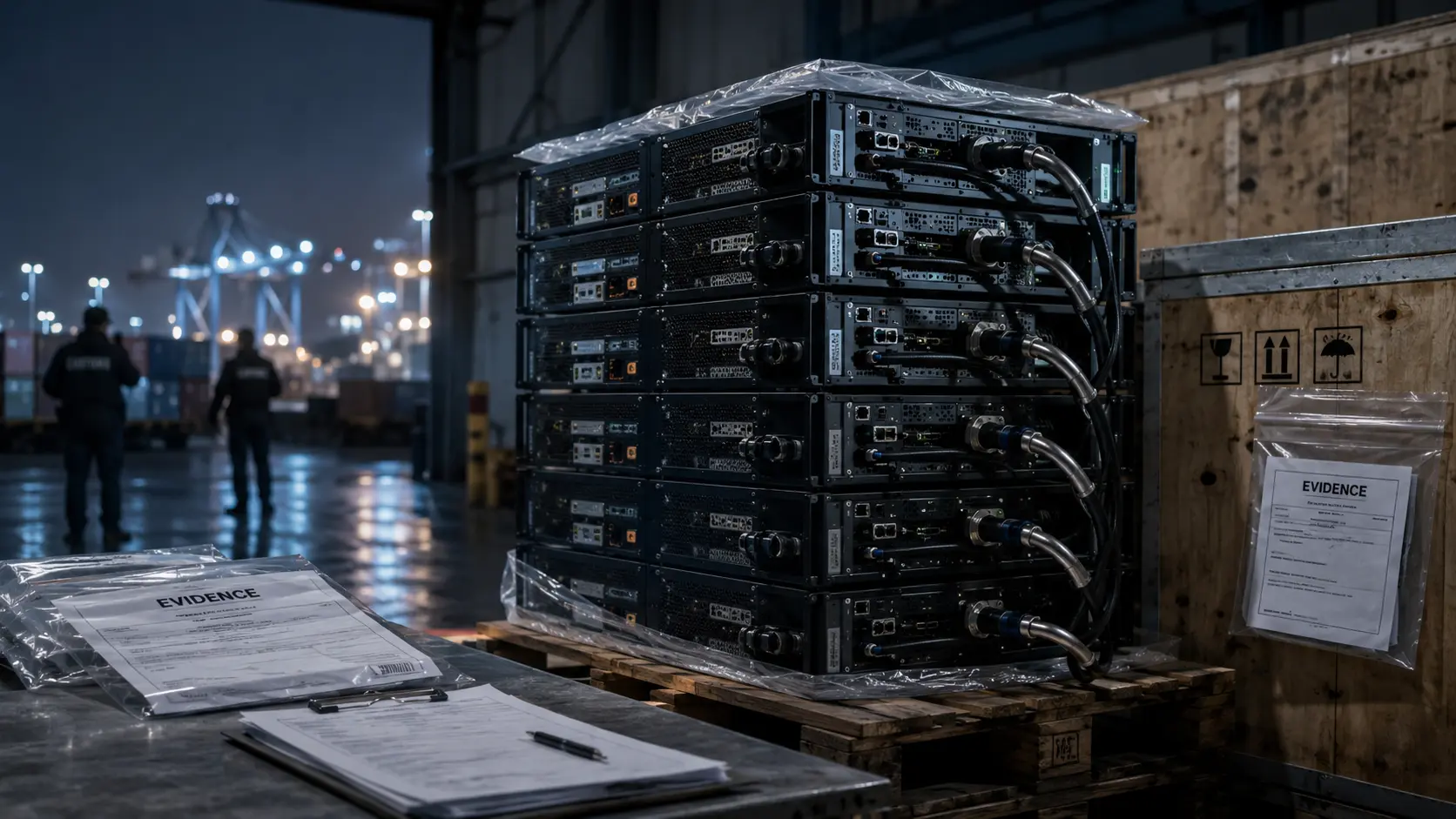
Investigators also seized 50 AI servers equipped with advanced Nvidia chips, along with phones, computers, account books, luxury cars, and NT$9 million, according to Focus Taiwan. Even if the dollar value is modest compared with larger export-control cases, the seizure suggests authorities are treating the matter as part of a broader commercial network rather than a one-off customs violation.
Why Taiwan’s role makes the AI smuggling issue more sensitive
Taiwan is not just another logistics waypoint. It is central to the global semiconductor ecosystem and a key assembly and supply-chain base for advanced computing infrastructure, which means enforcement failures there can ripple into U.S. export policy, Chinese procurement strategy, and investor confidence in AI hardware distribution.
Reuters noted that Taiwan already has strict rules intended to stop high-tech products and know-how from reaching China. That matters because Washington’s restrictions depend heavily on allies and manufacturing partners enforcing documentation, inspections, and shipment controls long after products leave an American boardroom or factory floor.
The commercial stakes are especially high because AI servers are not ordinary electronics. They package scarce GPUs, networking, memory, cooling, and systems integration into complete data-center assets that can immediately support model training and inference, making them more strategically valuable than many standalone components.
The Taiwan Detentions Echo a Much Larger U.S. Export-Control Case
This new Taiwan action did not appear in a vacuum. It follows a March 19 announcement from the U.S. Department of Justice charging three people, including Supermicro co-founder Yih-Shyan “Wally” Liaw, in a conspiracy to divert controlled U.S. artificial intelligence server technology to China without the required license.
That earlier DOJ case gives the Taiwan investigation a bigger frame. Instead of reading as an isolated customs problem, the latest detentions look like another example of how difficult it remains to police advanced AI hardware once demand, margin, and geopolitics all point in different directions.
How the U.S. case raised the stakes around AI smuggling
The Justice Department alleged that defendants and collaborators systematically diverted servers with certain GPUs to China through a Southeast Asian intermediary. The department said approximately $2.5 billion worth of servers were purchased between 2024 and 2025 and that at least roughly $510 million worth assembled in the United States were diverted to China between late April and mid-May 2025 alone.
Federal prosecutors also described elaborate concealment tactics, including the staging of “dummy” servers for inspections and the use of false documents, relabeled boxes, and encrypted communications. Those details mattered because they showed regulators were not confronting mere paperwork sloppiness, but a deliberate effort to defeat compliance checks built into cross-border technology trade.
That U.S. indictment does not prove the Taiwan suspects are linked to the same wider network in any legal sense beyond what authorities can establish. But the chronology is notable: a major American case in March was followed by Taiwanese searches and detentions in May, suggesting the pressure on transshipment routes is broadening rather than fading.
What Supermicro has said about its compliance response
Supermicro has tried to distance the company from the alleged conduct. In an April 7 statement, the company said it was informed in March that two employees and a contractor had been indicted, that the three individuals no longer had any relationship with Supermicro, and that the company itself was not named as a defendant and was not accused of wrongdoing.
The company also said an independent investigation was underway, led by two independent board members with outside legal and forensic support. At the same time, Supermicro said it had begun an internal review of its global trade compliance program and appointed an acting chief compliance officer who now reports to the general counsel.
Those steps are significant because they show management understands the issue as a governance and controls problem, not only a legal one. For investors, customers, and regulators, the real question is whether internal review and board oversight can prove the company’s systems are strong enough to detect diversion attempts before authorities do.
Why the AI Smuggling Story Matters for Nvidia, China, and the Wider Hardware Market
Nvidia is not accused of wrongdoing in the Taiwan case, and Reuters said both Nvidia and Supermicro have stated they are committed to complying with U.S. export laws. Still, Nvidia sits at the center of the commercial equation because its advanced chips remain the core building blocks for the most desirable AI servers in the market.
That makes every enforcement case around server diversion more than a compliance footnote. It becomes a live test of whether export controls can meaningfully shape where AI computing power ends up, or whether demand, intermediaries, and gray-zone logistics will keep creating alternative channels.
Why Nvidia cannot easily stay outside the policy fallout
Even when server makers and distributors handle sales execution, Nvidia’s products define the strategic value of the hardware being targeted. The more valuable and supply-constrained the chips are, the greater the incentive for brokers, intermediaries, and end buyers to find ways around formal restrictions.
That dynamic creates a reputational and policy burden for Nvidia even without direct legal exposure. Officials in Washington will likely keep asking whether the export-control system is tracking chips and complete server systems tightly enough, while customers and shareholders will watch for any disruption to sales channels, partner screening, or future product approvals.
The issue also lands at a delicate moment in U.S.-China technology relations. Washington wants to slow China’s access to cutting-edge AI computing capacity, while many U.S. companies still see China as a major long-term market. Each smuggling or diversion case makes that balancing act harder to defend politically.
What the case says about China demand and the next phase of enforcement
The Taiwan allegations underline a simple market reality: demand in greater China for advanced AI hardware remains intense enough that parties may try to route complete systems through third locations, false declarations, or opaque intermediaries. That pressure does not disappear just because regulators tighten formal rules.
As a result, the next phase of enforcement is likely to focus less on headline chip bans and more on the plumbing of trade itself: end-user checks, systems-level audits, reseller oversight, and cooperation among U.S., Taiwanese, and other regional authorities. That is where policy either becomes durable or starts to leak.
For the wider industry, the lesson is uncomfortable but clear. In the AI infrastructure boom, compliance is no longer a back-office function. It is part of competitive credibility, board oversight, and geopolitical risk management for every company that touches advanced servers, chips, cloud capacity, or cross-border distribution.
Whether the Taiwan case ultimately proves to be a small node in a larger network or a contained local scheme, it has already sharpened the central question: can governments actually keep the most advanced AI hardware out of restricted markets once commercial incentives intensify? Readers can continue following related Berrit Media coverage for more reporting on AI infrastructure, export controls, and the business consequences of the U.S.-China technology contest.
Discover more from Berrit Media
Subscribe to get the latest posts sent to your email.