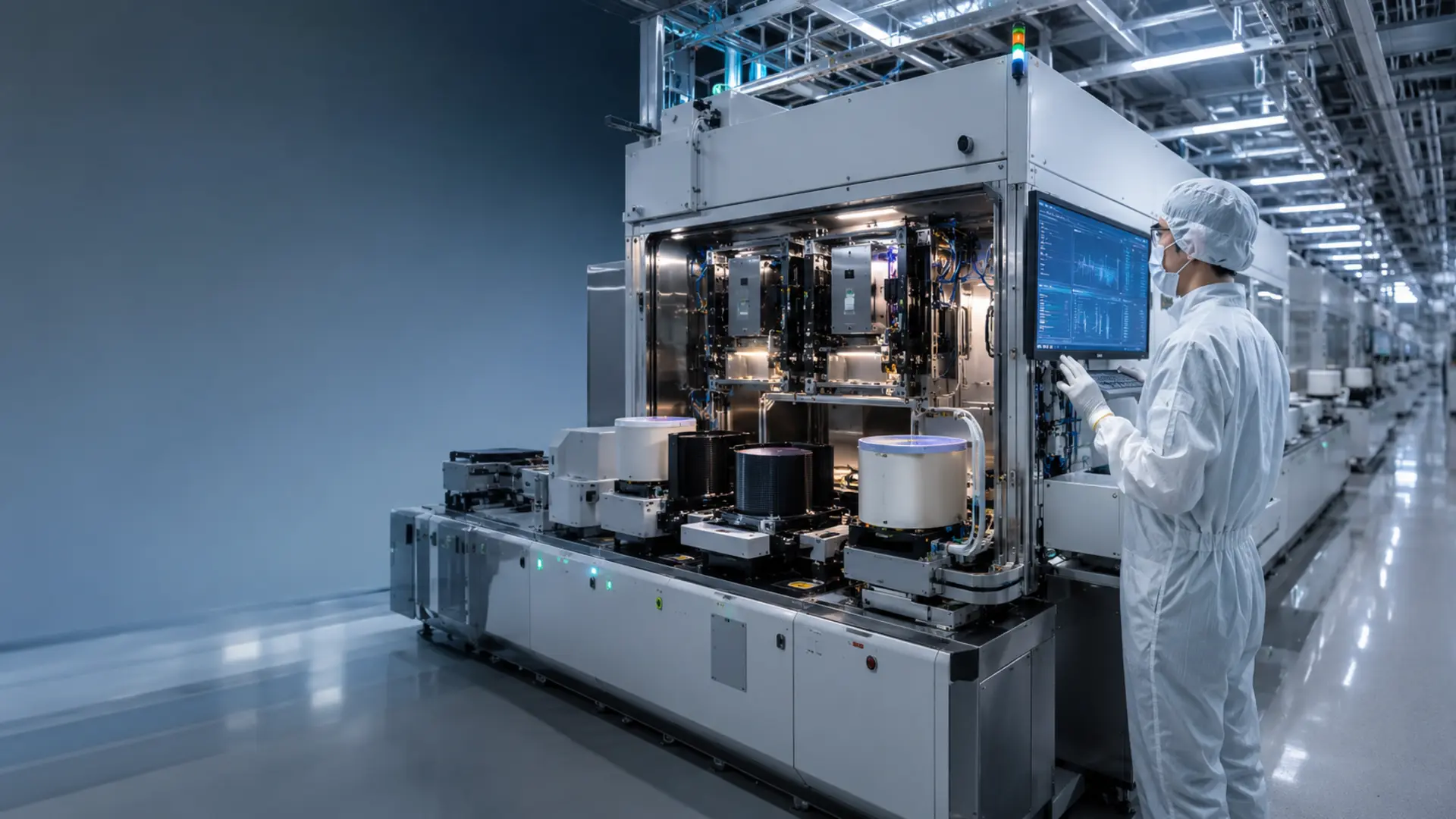
Lam Research is trying to turn artificial intelligence from a demand driver for chips into a productivity layer inside the factories that make them. The company is adding sensing and AI capabilities to semiconductor manufacturing tools while preparing expanded operations in Arizona and more investment in California, linking software, service and geography more tightly to the next phase of the chip cycle.
The update matters because Lam sits deep in the industrial plumbing of the AI boom. When a supplier of etch, deposition and support equipment says the next competitive edge is better data from the tool itself, it suggests semiconductor competition is shifting from pure capacity building toward how efficiently fabs can raise yield, reduce defects and keep expensive lines running with fewer interruptions.
Why Lam Research Wants More Intelligence Inside the Tool
Chief executive Tim Archer told Reuters on May 21 that Lam’s strategic focus over the next two years is to equip more tools with sensors that generate data for AI systems to analyze. That is a practical goal rather than a branding exercise. In chipmaking, even small improvements in uptime, drift detection or process control can translate into better output on some of the world’s most expensive production lines.
The timing also fits Lam’s recent financial momentum. In its April 22 quarterly release, the company reported record March-quarter revenue of $5.84 billion and record diluted earnings per share, with Archer saying AI-driven demand is reshaping the semiconductor industry. That combination gives Lam room to invest while customers remain willing to spend on equipment that can protect throughput and yield.
Lam Research Wants More Data From Every Wafer
Archer said the point of the added sensing is to collect more information from both the machine and the wafer as production runs. The more data the tool can generate, the stronger the model can become at spotting patterns, identifying anomalies and warning engineers before small issues turn into costly process losses.
That is an important shift in semiconductor manufacturing logic. For years, fabs have relied on highly specialized process steps followed by inspection, metrology and engineering review. Lam’s approach suggests more of that intelligence can move closer to the production tool itself, allowing problems to be identified earlier and reducing the need for separate diagnostic loops after defects have already spread through a batch.
Reuters illustrated that point through Lightfinder, the Massachusetts Institute of Technology spinout that won Lam’s $250,000 venture investment competition in Fremont. The startup has miniaturized a chip-measurement tool so it can be integrated into an existing machine rather than handled as a separate step, a small example of how Lam appears to be looking for in-line visibility instead of more standalone complexity.
Yield Becomes an AI Problem as Well as a Hardware Problem
The commercial attraction is clear. As AI accelerators, high-bandwidth memory and advanced packaging grow more complex, chipmakers need to produce more good dies from each wafer rather than simply ordering more tools and hoping volume solves the problem. AI-based monitoring can help them identify process drift earlier, react faster and waste fewer materials in a tight-capacity environment.
Lam already has a large installed base to build on. Its March-quarter results showed $2.11 billion in customer support-related revenue and other sales, alongside $3.73 billion in systems revenue. That matters because intelligence features inside the tool can reinforce both sides of the business: they support new-tool demand while also strengthening recurring service, upgrades and maintenance relationships across the installed fleet.
For business readers, the broader message is that Lam is selling more than metal, chambers and process chemistry. It is trying to sell a productivity stack around them, one that uses data and AI to help fabs squeeze more output from very expensive assets during an unusually demanding part of the semiconductor cycle.
Arizona Expansion Brings Lam Research Closer to the New US Fab Map
Lam’s technology push is arriving at the same moment the geographic map of advanced chipmaking is being redrawn. Archer confirmed to Reuters that the company intends to open an additional facility in the Phoenix area to support customers such as TSMC, while also planning more investment around its California headquarters.
Those comments matter because the US chip build-out is no longer theoretical. TSMC’s Arizona expansion, Micron’s domestic manufacturing push and broader industrial-policy incentives are creating new clusters where equipment suppliers, service teams and local operations need to sit closer to customers. In that environment, proximity becomes a competitive tool in its own right.
Phoenix Puts Lam Research Near TSMC’s Expanding Arizona Presence
Reuters reported that Lam intends to add another Phoenix-area site and cited an earlier Phoenix Business Journal report saying Lam spent more than $45 million on a 148,000-square-foot building near TSMC’s large Arizona campus. Lam has not publicly detailed the full plan for that site, but the location itself tells a useful story about where supplier networks expect demand to remain concentrated.
Being near TSMC matters operationally as much as symbolically. Advanced fabs need installation support, spare parts, process tuning, engineering response and long-cycle customer relationships that are difficult to manage from far away. If more leading-edge production shifts into Arizona, suppliers that can position teams and inventory close to the fab gate may gain an advantage in speed, service quality and follow-on business.
The Arizona move also reflects a wider change in how semiconductor capital spending works. Governments may subsidize fabs, but the supply chain only becomes durable when equipment makers, component vendors, training resources and support operations follow. Lam’s local expansion suggests it sees that second layer of industrial build-out as both real and commercially worth serving now.
California Still Matters to Lam Research’s Manufacturing Base
Even as Lam adds capacity in Arizona, Archer said more investment is coming in Fremont, where the company still performs manufacturing work. That is a notable reminder that US semiconductor expansion is not just a Sun Belt construction story. It also depends on established engineering centers that hold product development expertise, supplier relationships and experienced labor.
Fremont is also where Lam staged the startup competition that highlighted Lightfinder. That pairing is revealing: the company is not separating factory hardware from innovation scouting. Instead, it appears to be using its California base as a place to keep manufacturing, engineering and early-stage technology partnerships in the same orbit while customers scale elsewhere.
That balance may prove strategically useful. Arizona offers customer proximity and growth adjacency, while California remains a deep reservoir of semiconductor process talent and corporate decision-making. Keeping both active allows Lam to support the current fab wave without hollowing out the technical center that helps it design the next generation of tools.
What the Lam Research Strategy Says About the Next Chip Cycle
Lam’s update is not a blockbuster acquisition or a new factory announcement measured in billions of dollars. Its importance is subtler. The company is showing how the semiconductor race is evolving from a simple question of who buys the most tools into a harder question of who can run tools more intelligently, support customers more locally and turn equipment fleets into long-lived software and service relationships.
That view lines up with the numbers in Lam’s latest results. Revenue rose 9 percent quarter over quarter, operating margin reached 35.0 percent and management described the March period as a record quarter driven by AI demand. When a large equipment supplier is posting that kind of performance while discussing more sensors, more AI and more domestic support investment, the implication is that the industry’s next bottlenecks are operational as much as financial.
Lam Research Is Selling Productivity, Not Just Capacity
One reason this matters is that fabs are getting more expensive and more complicated at the same time. Advanced logic, memory and packaging require tighter control over process variation, contamination and throughput. That raises the value of software-assisted decision-making inside the manufacturing flow, especially when each percentage point of yield can represent a large amount of recoverable revenue.
Lam’s strategy also broadens the meaning of AI infrastructure. Investors usually apply that label to GPUs, data centers and cloud build-outs. But the tools that manufacture leading-edge chips are infrastructure too. If Lam can make those tools smarter and more responsive, it gains exposure to the AI cycle in a way that is less visible than chip design but still central to whether the entire stack scales efficiently.
The result is a more defensible commercial pitch. Customers may delay some forms of expansion when conditions soften, but they are less likely to ignore technologies that help existing lines perform better. That makes productivity-enhancing features a useful hedge for equipment makers that want to stay relevant across both boom periods and tighter parts of the cycle.
US Manufacturing Growth Is Reordering Supplier Geography
The Arizona and California plans also underscore a second trend: the semiconductor industry is becoming more distributed geographically, but not necessarily less concentrated strategically. Manufacturing capacity is expanding in more places, yet the real leverage still sits with companies that can connect equipment, engineering and customer response across those locations.
Lam’s own revenue distribution offers a reminder that this remains a global business. In the March quarter, China accounted for 34 percent of revenue, while Korea and Taiwan each represented 23 percent. Even so, the decision to deepen US operations suggests management believes domestic support footprints will matter more as Washington-backed fab projects move from construction headlines into production and service reality.
That is why Lam’s latest comments are worth following beyond the stock itself. They show that the next semiconductor build-out will be judged not only by who announces the biggest capex number, but by who can translate AI demand into better factory performance and tighter customer support where new fabs are actually coming online.
Lam Research is not claiming that AI alone will solve semiconductor bottlenecks, and its planned US expansion will not settle every debate about supply chains or industrial policy. But the company is laying out a credible view of where value may build next: inside smarter tools, closer service networks and tighter links between fab productivity and regional manufacturing growth. For more reporting on the companies, policy moves and market shifts shaping global business, continue reading related coverage at Berrit Media.
Discover more from Berrit Media
Subscribe to get the latest posts sent to your email.