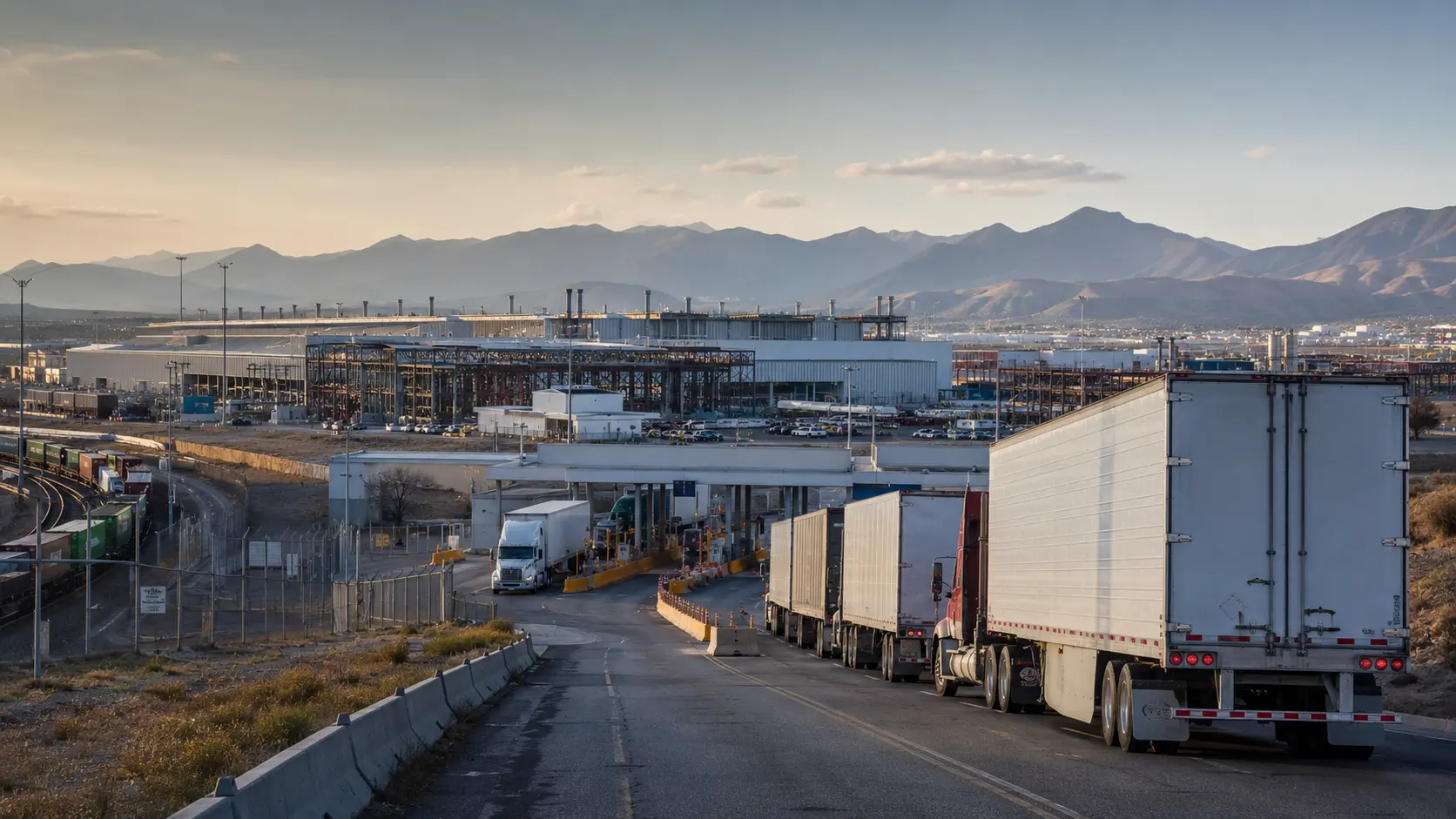
USMCA review negotiations are moving into a more confrontational phase before the formal July checkpoint even arrives. A new round of U.S.-Mexico talks scheduled for the week of May 25 in Mexico City is set to focus on stronger regional content rules and economic security provisions, according to U.S. Trade Representative Jamieson Greer, giving businesses an early signal that the 2026 review will be less about routine maintenance and more about who gets to benefit from privileged access to the North American market.
The immediate significance is not only procedural. On April 20, the Office of the United States Trade Representative said Greer and Mexican Economy Secretary Marcelo Ebrard had agreed to open a first official bilateral negotiating round and to advance discussions on economic security, complementary trade actions, stronger rules of origin for key industrial goods, critical minerals, and unresolved bilateral trade irritants ahead of the July 1 USMCA joint review. Greer then told reporters on May 22 that the next round would focus on rules of origin and economic security, adding a sharper public framing to what had previously been outlined in more diplomatic language.
That combination matters because it suggests Washington is treating the trade pact as a tool of industrial strategy as much as a conventional market-access agreement. For automakers, electronics makers, semiconductor supply-chain participants, and logistics groups, the central question is no longer whether the agreement survives in name, but how much tighter the United States may try to make the conditions for benefiting from it.
USMCA Review Starts Before the Formal July Checkpoint
By treaty design, the 2026 review was supposed to be a structured moment for the United States, Mexico, and Canada to assess whether the agreement should continue toward its 2036 sunset date. In practice, the process has become an earlier and more politically charged negotiation over manufacturing geography, supply-chain trust, and how far trade policy can be used to reshape regional production.
The official April 20 USTR statement made that clear well before Greer’s latest comments. Rather than describing a narrow calendar-setting exercise, the agency said both governments were already instructing their teams to work through rules of origin, economic security, critical minerals, and bilateral irritants. That language suggested the hardest issues were being pulled forward, not deferred to a symbolic summer meeting.
Why the USMCA Review Is Starting With Mexico
Mexico sits at the center of the economic case for the agreement and the political frustrations surrounding it. It has become an essential manufacturing platform for goods sold into the United States, especially in autos, electronics, industrial components, and other sectors where North American integration lowers costs and shortens supply chains. That position gives Mexico leverage, but it also makes it the first target when Washington argues that too much third-country content is entering under preferential rules.
The bilateral sequencing also reflects where the U.S. sees the greatest room to press for concessions. Canada remains part of the treaty and the formal joint review still matters, but Greer said next week’s talks will be between the United States and Mexico only. That does not dissolve the trilateral framework, yet it does reinforce the idea that Washington may prefer to shape outcomes through bilateral pressure where it believes sector-specific changes can be extracted faster.
For Berrit Media readers, the practical takeaway is that the review is already functioning as a negotiation over production discipline. If Washington succeeds in redefining what counts as sufficiently North American content, companies that built their regional footprints around looser interpretations could face higher compliance costs, sourcing changes, or renewed tariff risk.
Why U.S. Content Rules Matter in the USMCA Review
Greer framed the issue in direct industrial terms on May 22, saying regional content rules needed to change to help reshore U.S. manufacturing. That is a notable escalation from abstract trade language because it turns rules of origin into a tool for forcing more value creation inside the United States rather than simply preserving continental trade flows.
The political logic is straightforward. If a product qualifies for preferential treatment but relies heavily on inputs from outside North America, U.S. officials can argue the agreement is delivering tariff benefits without fully supporting domestic production goals. That concern has been particularly intense in sectors where policymakers fear that Chinese or other third-country producers can route value through Mexico while still accessing the U.S. market on favorable terms.
Industry voices have been warning about the stakes for weeks. Major auto trade groups urged the Trump administration on May 7 to extend the trade deal with Mexico and Canada, according to Reuters, underscoring how dependent vehicle production remains on integrated North American supply chains even as policymakers debate whether those same supply chains need tighter guardrails.
Economic Security Is Becoming Trade Policy
The second big signal in this story is conceptual. Economic security is no longer being treated as a separate policy conversation running alongside trade. It is increasingly becoming the rationale for trade decisions themselves, especially in sectors tied to strategic manufacturing capacity, critical minerals, advanced technology, and exposure to China-linked sourcing.
That shift is visible in the way USTR has described the review. Economic security appeared in the April 20 joint statement as one of the immediate technical priorities, not as a long-range aspiration. Greer’s public remarks then paired it directly with rules of origin, effectively linking content thresholds to broader national-security and supply-chain resilience goals.
How USMCA Review Talks Could Reshape Autos and Chips
Automotive manufacturing is the clearest area where this logic could bite first. Vehicle production under USMCA already depends on complex calculations covering regional value content, labor thresholds, steel and aluminum sourcing, and cross-border component flows. Any attempt to tighten content definitions or enforcement could ripple through assemblers, parts makers, and suppliers that rely on Mexican production for cost efficiency and scale.
Semiconductors and electronics are also likely to stay close to the center of the conversation even if they do not dominate public headlines in the first round. Greer has previously tied USMCA priorities to reshoring electronics, pharmaceuticals, and semiconductors, suggesting the administration wants trade architecture to reinforce industrial policy goals already pursued through tariffs, investment incentives, and national-security reviews.
The result is a broader business environment in which treaty access may become more conditional. Companies that once viewed the agreement as a stable operating framework may need to treat it as a moving instrument whose benefits increasingly depend on where core inputs originate, how resilient supply chains look to regulators, and whether production aligns with Washington’s strategic objectives.
What Economic Security Means for Supply Chains
In practical terms, economic security usually translates into scrutiny of dependence, control, and substitution. Policymakers ask whether critical goods rely on rival-country inputs, whether bottlenecks can be weaponized, and whether production can be redirected into trusted jurisdictions without unacceptable cost or delay. When that framework is imported into a trade agreement review, sourcing decisions start to look like strategic exposure rather than ordinary procurement choices.
That has consequences beyond factories. Logistics providers, customs advisers, trade lawyers, and procurement teams all become part of the adjustment cycle when rules tighten. A stricter interpretation of origin or a broader security screen can alter how companies certify content, structure supplier contracts, and plan inventory across borders. Even businesses that do not manufacture directly can be affected through cost pass-throughs and compliance burdens.
It also changes negotiation dynamics. Mexico can argue that integrated supply chains support regional competitiveness and keep North America attractive against Asia and Europe. The United States, by contrast, is signaling that competitiveness alone is not enough if it believes too much value leaks to third countries or if strategic industries are not being pulled closer to U.S. production priorities.
Business Will Be Watching for Signals Beyond Tariffs
For investors and executives, the most important outputs from this stage of the review may not be immediate treaty rewrites. They may instead come through signals about enforcement, interpretation, side arrangements, and political red lines. A process that starts with bilateral talks on content and security can shape capital allocation well before any final legal text changes hands.
That is especially true because North American manufacturing has already been making investment decisions on the assumption that policy support, tariff risk, and nearshoring incentives would continue. If the review now raises the bar for what counts as regionally compliant production, those investments may need to be reassessed not only on labor or transport costs, but on origin traceability and geopolitical exposure.
Why Canada’s Absence Complicates the USMCA Review
Canada’s exclusion from the first formal round with Mexico does not mean Ottawa is out of the picture, but it does complicate the message around a pact that remains trilateral on paper. Greer said he was aware of automakers’ calls to keep the agreement trilateral, a sign that business groups fear bilateral tracks could create uncertainty about how common rules will be updated or enforced.
For companies with integrated operations across all three countries, that matters immediately. A car or industrial machine rarely reflects a simple U.S.-Mexico supply chain; it often depends on Canadian materials, engineering, or subassemblies as well. If the politics of the review fragment into separate bargaining channels, businesses may struggle to predict whether one set of obligations will continue to apply evenly across the bloc.
At the same time, Canada’s temporary absence may strengthen Washington’s leverage with Mexico by narrowing the immediate negotiating field. It allows the United States to test how far it can push on rules of origin and security expectations before the broader trilateral stage becomes unavoidable.
What Companies Need From the USMCA Review Next
The next milestone for companies is not simply the opening session in Mexico City. It is whether officials begin to define more concretely what stronger origin rules and economic security commitments would mean in sectoral terms. Businesses can work around tough rules more easily than vague ones; uncertainty is often more damaging than a clearly higher threshold.
Management teams will also be watching for evidence that the review is becoming a vehicle for selective industrial bargaining. If the United States starts linking market access more explicitly to reshoring commitments, investment screening, or sourcing behavior, then trade compliance will become even more tightly tied to board-level capital planning. That would raise the strategic importance of customs, supplier audits, and location decisions across manufacturing and technology sectors.
What looks like a trade-process story today could therefore become a larger test of how North America defines trusted production in a more contested global economy. If Washington succeeds in rewriting expectations around content and security, the agreement may remain intact while operating on much stricter terms than many businesses had assumed.
The USMCA review is shaping up as a defining negotiation over how North America balances integration with control, and the first U.S.-Mexico round suggests Washington wants stricter answers on both. Readers can continue following related trade, policy, and industry coverage at Berrit Media.
Discover more from Berrit Media
Subscribe to get the latest posts sent to your email.