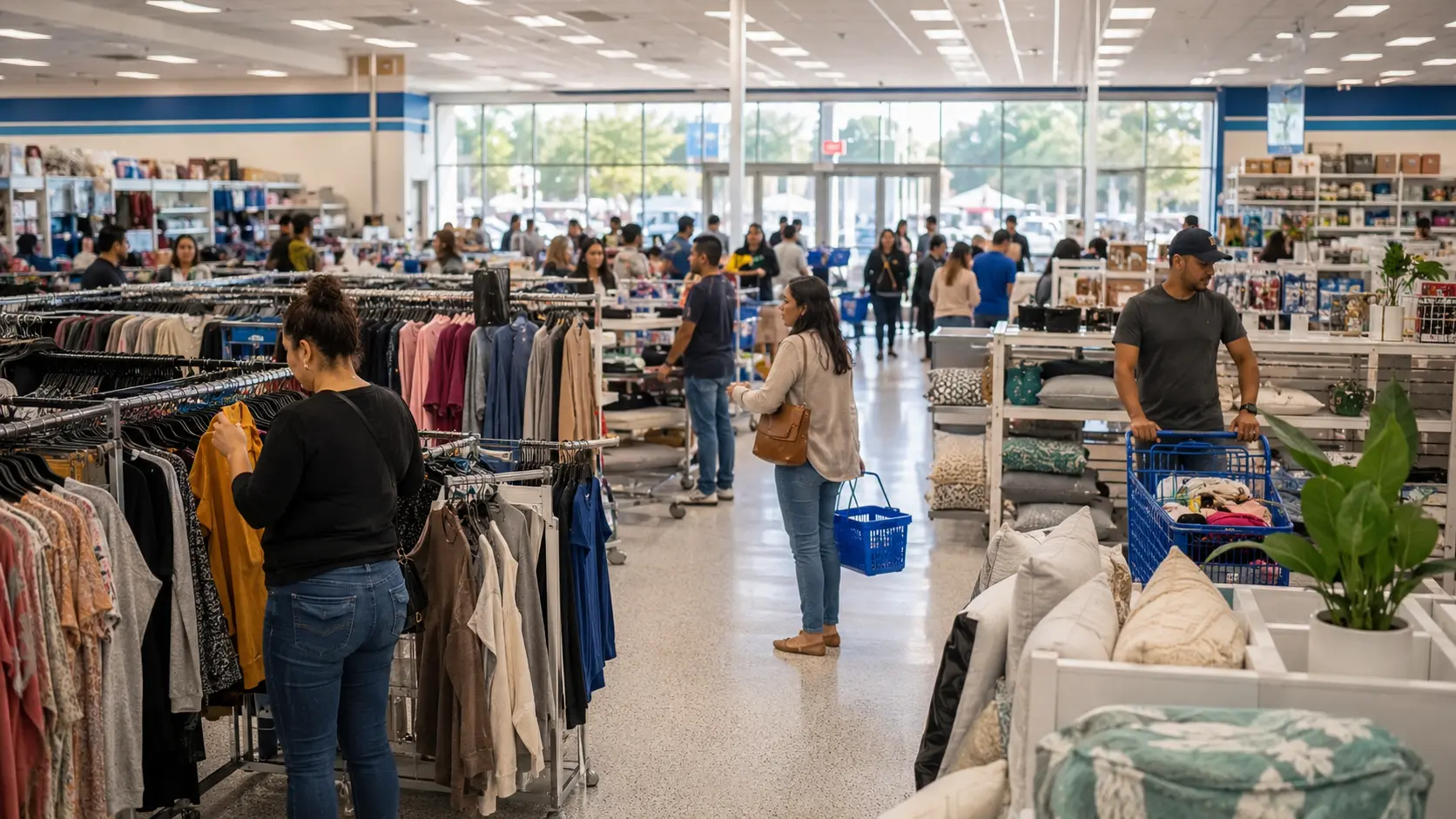
Ross Stores has raised its full-year outlook after posting a blowout first quarter, giving investors a fresh signal that value-focused retail is still taking share even as the broader U.S. consumer remains selective. The company said comparable store sales rose 17% in the quarter ended May 2, while total sales increased 21% to $6.0 billion and earnings per share climbed 37% to $2.02.
The update matters beyond one retailer. Reuters reported that Ross Stores lifted its annual comparable-sales and profit outlook as discounted apparel and accessories continued to attract budget-conscious shoppers, while management said customer counts improved across income levels, ethnicities, and age groups, including younger consumers. That combination suggests the value trade is not only holding up under macro uncertainty, but widening its reach.
Ross Stores Turned a Strong Quarter Into a Broader Consumer Signal
Ross Stores did more than beat expectations. It translated a strong spring quarter into a sharper message about where U.S. households are still willing to spend, and what kind of retail formats are best positioned to capture that spending.
The company said first-quarter operating margin reached 13.4%, ahead of its own plan of 11.8% to 12.1%, helped by stronger sales and better leverage across the business. That matters because it shows Ross Stores did not need to sacrifice profitability to drive traffic, a distinction that becomes more important when investors are looking for evidence of durable consumer demand rather than one-off promotional bursts.
Ross Stores Brought More Shoppers Through the Door
In its earnings release, Ross Stores said customer traffic was the primary driver of the quarter’s strong sales trend. Management credited compelling assortments, higher customer acquisition, ongoing marketing initiatives, and an improved in-store experience for helping the company resonate with shoppers.
That traffic-led growth is especially notable in a consumer environment where many retailers are still talking about caution, uneven demand, and selective purchasing behavior. When a chain can point to higher visits rather than just bigger baskets or aggressive markdowns, it suggests the format itself is gaining relevance with shoppers.
Reuters added another important detail from the earnings call: Ross Stores saw a healthy increase in customer counts across income groups and age brackets, including younger customers. That widens the significance of the quarter because it implies the chain is not relying only on financially pressured households, but is also pulling in shoppers who may have more discretion yet still prefer value.
Ross Stores Lifted Margins While It Chased Volume
Ross Stores also showed that strong traffic did not come at the expense of discipline. The company reported first-quarter net income of $650 million, up from $479 million a year earlier, while earnings per share rose well above the guidance range of $1.60 to $1.67 that management had given earlier.
That spread between internal guidance and actual results tells investors something important about execution. Ross Stores appears to have handled merchandise flow, seasonal transition, and store operations better than expected, which gives credibility to management’s claim that the business entered the second quarter with solid momentum rather than simply benefiting from a short-lived demand spike.
The quality of the quarter also helps explain why the market responded favorably. Reuters reported the stock rose about 6% in extended trading after the announcement, a sign that investors saw the update as more than routine earnings maintenance. The numbers suggested Ross Stores had strengthened both its sales narrative and its operating leverage at the same time.
Value Retail Is Winning Across Income Bands
The bigger strategic read from Ross Stores is that value retail remains one of the clearest winners in an uneven consumer market. Inflation pressures, tariff uncertainty, and choppy household sentiment have not shut off spending altogether, but they have changed where that spending goes.
In that environment, off-price retailers are positioned differently from many full-price chains. They benefit when consumers still want apparel, accessories, and home goods but feel less willing to pay traditional department-store prices. Ross Stores is now offering one of the clearest current examples of that shift.
Value Retail Is Pulling In Younger and Higher-Income Shoppers
One of the most revealing details from the Ross Stores update was management’s comment that customer growth came across income levels and age groups. That suggests the appeal of value retail is broadening from a defensive choice into a more mainstream shopping behavior.
For younger shoppers in particular, off-price retail can work as both a savings channel and a discovery channel. Ross Stores and its peers are not only selling lower prices; they are also selling the possibility of finding branded merchandise in a format that feels opportunistic and fast-moving. That can create demand that is less dependent on pure necessity than traditional discount narratives imply.
For higher-income shoppers, the draw is different but still meaningful. Selective consumers often become even more value-conscious during uncertain periods, especially when headlines about inflation, trade policy, and slower discretionary spending remain in circulation. Ross Stores appears to be benefiting from that mindset shift without having to reposition itself away from its core model.
Value Retail Benefits When Consumers Stay Selective
Ross Stores is also benefiting from a market where consumers have not stopped spending, but have become more deliberate. Reuters framed the story as one of resilient demand for discounted apparel and accessories despite looming macroeconomic uncertainty, which is a fair description of the broader retail backdrop.
That backdrop helps explain why management raised full-year same-store sales guidance to 6% to 7%, up from the previous 3% to 4% range. Ross Stores also raised its fiscal 2026 earnings-per-share outlook to $7.50 to $7.74 from $7.02 to $7.36, showing confidence not just in one quarter of demand but in the operating model’s ability to carry momentum forward.
Importantly, Ross Stores said its second-quarter forecast also calls for 6% to 7% comparable-sales growth, with earnings per share projected at $1.85 to $1.93. That forward guide makes the first-quarter result more credible because it indicates management is seeing enough continuity in traffic and merchandising trends to sustain a stronger outlook into the next reporting period.
What the New Ross Stores Outlook Means for Retail Strategy
For the wider retail sector, the Ross Stores update is a reminder that market share shifts can happen even when the macro picture remains cloudy. Companies that offer clear price-value propositions, keep assortments fresh, and maintain a good in-store experience are still finding ways to grow.
That does not mean all retailers will share the benefit equally. In fact, Ross Stores may highlight the growing divide between value-led operators and businesses that rely on more discretionary or brand-premium spending without offering enough pricing flexibility in return.
Ross Stores Is Expanding From Strength, Not Distress
Another important part of the Ross Stores story is that management is presenting the year as a growth opportunity rather than a defensive holding pattern. In the earnings release, Chief Executive Jim Conroy said the company believes it is well positioned to capture additional market share and drive profitable growth over the long term.
That matters because the strongest off-price operators often expand when other parts of retail are under pressure. If full-price chains face slower inventory turns or more cautious shoppers, value retailers can gain access to attractive branded merchandise at better economics, reinforcing the model’s advantage.
Ross Stores is therefore not just responding to consumer caution. It is using that environment to strengthen its competitive position. Strong traffic, higher engagement from marketing, and improved store execution together suggest a company leaning into structural opportunity rather than merely weathering a difficult season.
Ross Stores Gives Investors a Cleaner Read on the U.S. Consumer
Retail earnings are often used as quick proxies for the health of the consumer, but not all signals are equally useful. Ross Stores offers a more specific reading: shoppers are still active, but they are rewarding formats that combine affordability, branded product, and a sense of discovery.
That reading fits with other recent evidence from the sector, while also sharpening it. Instead of a vague claim that the consumer is either weak or resilient, Ross Stores points to a middle ground in which people continue to spend, but do so with more scrutiny and a stronger bias toward value.
For investors, that makes Ross Stores relevant beyond its own ticker. The company’s results help define the current contours of consumer demand, retail pricing power, and market-share movement in U.S. discretionary categories. If that pattern persists, value-led chains may continue to outperform even without a full rebound in broad consumer confidence.
Ross Stores has given the market a clearer picture of where spending momentum still exists and why value-led formats remain strategically important. Readers can continue following related retail, strategy, and consumer coverage at Berrit Media.
Discover more from Berrit Media
Subscribe to get the latest posts sent to your email.