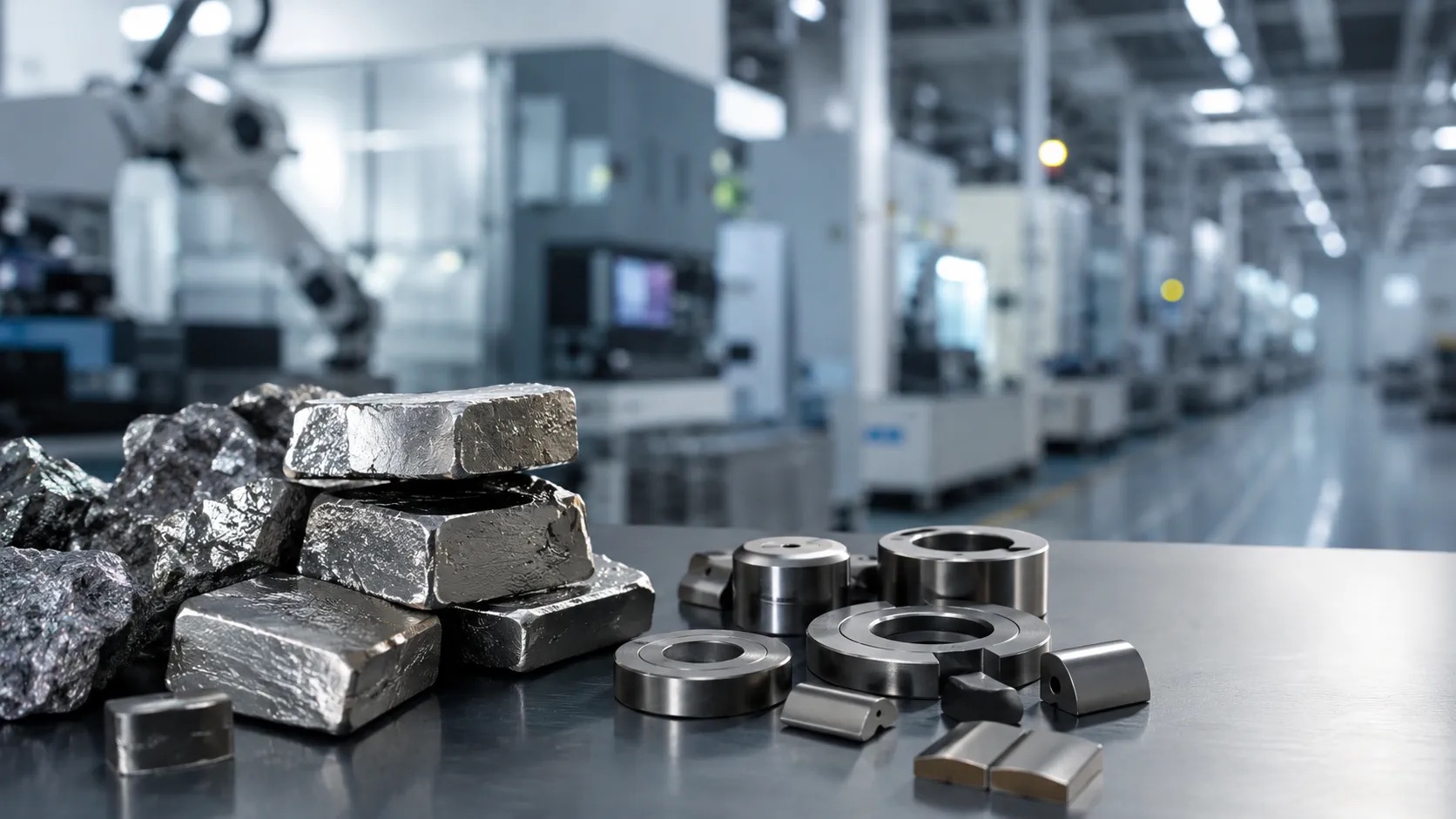
Rare earths returned to the center of U.S.-China economic policy after the White House said Beijing would address American concerns over shortages and restrictions tied to critical minerals following last week’s summit between President Donald Trump and President Xi Jinping.
That language gave Washington a concrete talking point from a meeting that otherwise produced a broad package on trade, investment, aircraft, and agricultural access. But it did not amount to a clear dismantling of the Chinese licensing and approval system that has made rare earth supplies a recurring pressure point for global manufacturers.
For business leaders, the distinction matters. Rare earths and the technologies used to process them sit inside supply chains that affect aerospace, semiconductors, medical equipment, industrial machinery, and other advanced manufacturing segments. The latest pledge therefore looks less like a clean resolution and more like a test of whether diplomatic commitments can turn into dependable industrial flows.
Rare Earths Became a Concrete Test of the Summit
The White House presented the Beijing summit as a deliverable-heavy meeting that would stabilize the bilateral relationship and produce practical gains for American workers, farmers, and industry. In that package, rare earths stood out because they touch production capacity rather than just trade balances.
That helps explain why the issue carried unusual weight. Tariff reductions and headline purchase commitments can influence sentiment quickly, but manufacturers care just as much about whether the inputs and equipment they need will actually move across borders without delays, uncertainty, or political interruption.
White House Tied Rare Earths to Supply Chain Relief
In its May 17 fact sheet, the White House said China would address U.S. concerns regarding supply chain shortages related to rare earths and other critical minerals, naming yttrium, scandium, neodymium, and indium. It also said China would address concerns about prohibitions or restrictions on the sale of rare earth production and processing equipment and technologies.
That wording was important because it widened the issue beyond raw material shipments alone. Washington was signaling that the bottleneck includes both mineral availability and the industrial know-how and equipment required to refine, process, and scale those materials into commercial supply.
At the same time, the fact sheet did not spell out a timetable, a specific mechanism, or any automatic rollback of the broader control regime. For companies that must plan capital spending and procurement months ahead, the gap between a political pledge and an operational process is where risk still sits.
Rare Earths Still Depend on Chinese Approval
China’s own public language has remained more procedural than expansive. In April, a Ministry of Commerce spokesperson said export applications involving rare earths that meet relevant requirements for genuine civilian use would be approved in accordance with the law.
That formulation matters because it frames trade as permission-based rather than unconditional. Even when Beijing emphasizes that it is taking civilian needs into account, the state keeps case-by-case authority over what moves, when it moves, and under what compliance conditions.
Reuters reported after the summit that the latest understanding fell short of removing the system that has disrupted some U.S. manufacturers. That leaves companies in a familiar position: encouraged by diplomatic easing, but still waiting for evidence that shipments and approvals will become more predictable in practice.
Why Rare Earths Still Matter to Industry
The business significance of the issue is larger than the rare earth market itself. These materials are embedded in high-value manufacturing chains, which means small regulatory disruptions can ripple outward into factory schedules, customer commitments, and long-term investment choices.
The U.S. Trade Representative underscored that point in its 2026 National Trade Estimate report. The report said China’s export controls on rare earths had a dramatic impact across multiple global industries and noted that numerous factories in the United States and other countries temporarily shut production in 2025 because they could not secure needed shipments on time.
Rare Earths Reach Far Beyond the Mining Sector
Rare earths are often discussed as a mining story, but for manufacturers they are really an industrial capability story. Access to processed materials, magnets, components, and specialist production pathways can shape whether downstream factories operate smoothly or face expensive delays.
The USTR report said the impact has extended across automotive, aerospace, medical-device, wireless-technology, and other advanced manufacturing industries. That list helps explain why the latest summit language landed as a market-relevant development rather than a narrow commodities update.
It also explains why governments now treat rare earths as strategic leverage. A country that dominates mining, processing, and export approvals can influence not only commodity supply, but also the location, timing, and competitiveness of higher-value industrial activity farther down the chain.
Rare Earths Matter to Semiconductor Equipment Planning
The White House’s reference to restrictions on rare earth production and processing equipment broadened the conversation into technology infrastructure. For semiconductor and electronics supply chains, reliable access is not only about buying material. It is also about ensuring the industrial tools and processing capabilities behind those materials remain available.
That is one reason the dispute has resonated beyond miners and metal traders. Semiconductor-adjacent manufacturers, advanced equipment suppliers, and industrial technology companies all have to think about whether input constraints could slow expansion plans or raise the cost of building capacity outside China.
Reuters said the current restrictions have disrupted U.S. aerospace and semiconductor manufacturing. Even without a new formal escalation, that history makes companies cautious about treating summit language as the same thing as fully restored supply security.
Rare Earths Now Move Into an Implementation Phase
For policymakers, the next stage is less about declaring success and more about proving that the summit produced a workable process. The new U.S.-China boards on trade and investment may provide a venue for that, but businesses will judge the outcome by approvals, shipment timing, and the clarity of the rules they face.
That creates a high bar for both governments. If the diplomatic message is stability while the operational reality remains slow approvals and selective restrictions, corporate procurement teams will keep planning around disruption instead of trusting that the pressure point has been resolved.
Rare Earths Need Measurable Follow-Through
A meaningful improvement would show up quickly in practical indicators. Export applications would move faster, buyers would gain better visibility into what qualifies, and restrictions affecting production and processing equipment would ease in a way companies could incorporate into contracts and delivery schedules.
Until then, executives are likely to treat the summit outcome as a directional positive rather than a settled solution. That is especially true for industries where a missed shipment can hold up an entire production line or delay a costly expansion project.
The White House won a fresh commitment it can point to, but the industrial world still needs proof in the form of actual flows. In supply chains this tight, implementation is the story, not the headline.
Rare Earths Will Stay Central to De-Risking Strategy
Even if near-term flows improve, the broader strategic lesson is unlikely to change. Companies and governments have spent the past two years treating rare earth dependence as a structural vulnerability, not a temporary inconvenience.
The USTR report argued that China’s restrictions have improved the competitiveness of domestic manufacturers while pressuring foreign producers to move operations, technologies, and jobs toward China. That means the current debate is not only about shortages, but also about the industrial balance of power.
As a result, diversification efforts in mining, refining, magnet production, and industrial processing are likely to continue even if the summit reduces immediate stress. The latest pledge may lower the temperature, but it does not erase the strategic incentive to build alternative supply options.
Rare earths remain one of the clearest tests of whether a calmer U.S.-China tone can produce real relief for manufacturers rather than just a temporary diplomatic pause. Readers can continue following related coverage at Berrit Media for more on critical minerals, trade policy, and industrial supply chains.
Discover more from Berrit Media
Subscribe to get the latest posts sent to your email.