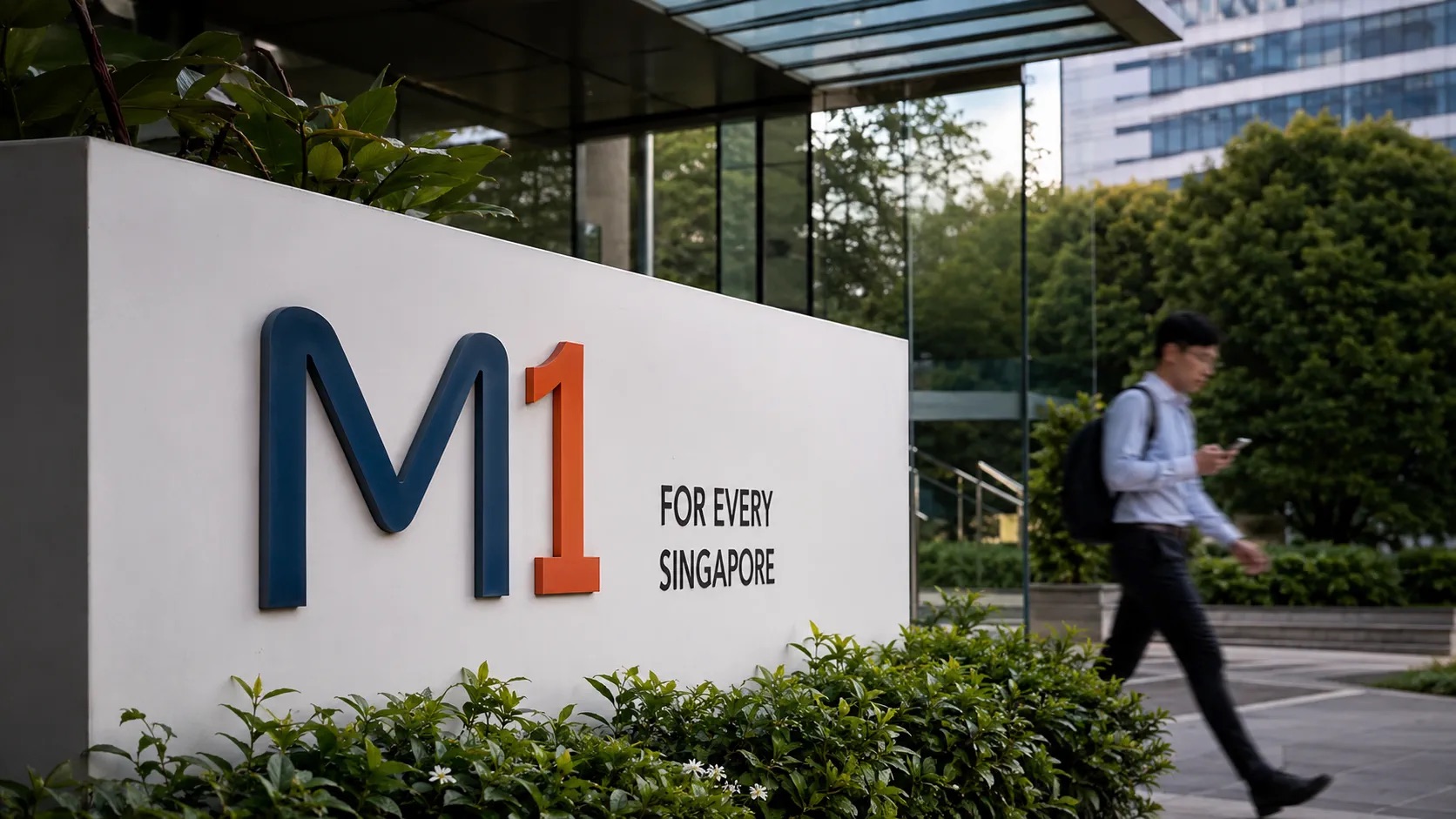
M1 sale plans in Singapore are heading for collapse after the country’s telecom regulator suspended its review of Simba Telecom’s proposed acquisition of Keppel-owned M1, citing a possible unauthorized use of radio frequency spectrum by Simba.
The move turns what had been one of Singapore’s most consequential telecom consolidation efforts into a regulatory and governance test with immediate implications for Keppel’s capital-recycling strategy, Tuas’ growth story, and the structure of competition in the city-state’s mobile market.
Why the M1 sale stalled
The Infocomm Media Development Authority said on May 18 that it had suspended its assessment of the proposed consolidation between M1 and Simba until further notice. The regulator said its review had covered not only competition effects but also public-interest concerns and the operation of critical telecommunications infrastructure in a period of heightened cyber risk.
That framing matters because the transaction was never just a simple asset transfer. M1 runs major mobile and broadband networks in Singapore, so any buyer would have to satisfy the regulator on competition, operational resilience, and the stewardship of infrastructure that carries broader economic and security significance.
The spectrum issue behind the M1 sale
IMDA said it learned during the review that Simba could have been using radio frequency bands that had not been assigned to it in order to provide mobile services. If established, the regulator said, that would amount to unauthorized use of spectrum and a breach of both Singapore’s Telecommunications Act 1999 and the conditions attached to Simba’s facilities-based operations licence.
Rather than ring-fencing that issue from the transaction review, IMDA linked the two. It said the findings of its investigation could be material to the consolidation assessment, which is why it chose to pause the merger review instead of allowing the process to continue in parallel.
That decision sharply changes the balance of risk around the deal. A review that had already taken months now faces an open-ended delay, and the suspension introduces uncertainty not only about timing but also about the buyer’s regulatory standing if the allegations are ultimately substantiated.
Why regulators treated the M1 sale as critical infrastructure
IMDA’s statement underscored that its examination of the merger had been detailed and thorough because M1 operates large mobile and broadband networks. In practical terms, that means the regulator was looking at more than pricing power or subscriber overlap. It was also considering how essential network assets would be controlled and secured.
Singapore has been especially alert to cyber-resilience and infrastructure governance issues as digital networks become more central to commerce, cloud connectivity, public services, and business continuity. In that context, a telecom merger naturally attracts a broader lens than a conventional consumer-market transaction.
The suspension therefore signals that compliance and operational trust can become decisive variables in telecom consolidation. Even before any enforcement outcome is announced, the review pause shows that spectrum discipline and licence conditions can reshape the fate of a billion-dollar deal.
What the suspension means for Keppel and Tuas
The business fallout was immediate. Reuters reported that shares in Australia-listed Tuas, Simba’s parent, fell as much as 60% after the announcement, while Keppel shares also dropped as investors marked down the probability that the sale would close on the terms previously expected.
The transaction, first announced in August 2025, valued M1’s telecom business at S$1.43 billion. Keppel had said the deal would unlock close to S$1.0 billion in net cash from the sale of its effective 83.9% stake, fitting into the group’s broader effort to recycle capital and sharpen its portfolio.
Keppel loses a near-term M1 sale exit
Keppel chief executive Loh Chin Hua said on May 18 that the company would allow the sale and purchase agreement with Simba to lapse when the long-stop date arrives on May 21. The deadline had already been extended in March to give the regulatory process more time, so Monday’s suspension effectively closed the remaining path to near-term completion.
Keppel also said it had been preparing a backup plan in case it retained majority ownership of M1. According to the company’s public comments, that plan now shifts toward improving M1’s efficiency, including cost reductions and operational measures aimed at lifting run-rate EBITDA without damaging customer experience.
For Keppel, the setback is more than a delayed divestment. It interrupts a monetization event that could have strengthened balance-sheet flexibility and, according to Reuters, might have supported a special dividend of about S$0.07 to S$0.11 per share if the sale had proceeded.
Tuas faces a sharper market test after the M1 sale shock
Tuas said in a filing cited by Reuters and regional media that it was cooperating fully with the regulator and reviewing the circumstances surrounding the alleged unauthorized use of spectrum. That response may help contain immediate uncertainty, but it does not remove the deeper issue confronting the company.
The planned M1 acquisition had been central to Tuas’ attempt to expand Simba from a disruptive challenger into a stronger scaled operator in Singapore. By combining Simba with M1’s network and customer base, the deal promised a faster route to operating leverage and a bigger role in the local market.
Now investors have to consider a more difficult scenario: a prolonged regulatory inquiry, a lapsed transaction, and renewed questions about whether Simba can pursue the same strategic ambition organically. Monday’s share-price move suggests the market sees the lost deal optionality as highly significant.
What changes for Singapore’s telecom market
The immediate question is whether the proposed transaction can be revived later, either after the investigation concludes or in a different form. Keppel has said there is nothing to prevent discussions with other parties once the current agreement lapses, which keeps open the possibility of a new process rather than a definitive end to consolidation.
Even so, the episode resets the conversation around telecom competition in Singapore. Instead of focusing mainly on whether a combination of Simba and M1 would change pricing dynamics in a crowded market, the debate now extends to compliance credibility, infrastructure oversight, and the standards buyers must meet before they can take control of a major network.
Competition questions around the M1 sale return
When Keppel announced the transaction in 2025, the strategic case rested partly on consolidation. Singapore’s telecom market has faced intense competition for years, and a combination of M1 and Simba was presented as a way to create a stronger operator with greater scale and scope.
That logic has not disappeared, but it now competes with a different regulatory reality. A buyer that is itself under investigation for possible spectrum misuse will struggle to argue that it is ready to assume ownership of infrastructure that the state treats as strategically important.
As a result, the market may return to a broader set of scenarios. Those could include Keppel running M1 for longer, reopening talks with other interested parties, or waiting for a more stable regulatory environment before pursuing another large transaction.
Singapore telecom strategy after the M1 sale setback
For Singapore policymakers, the case reinforces a familiar principle: telecom competition policy cannot be separated from operational compliance. Spectrum is a scarce public resource, and the legitimacy of any consolidation review depends in part on whether market participants are following the rules that govern access to it.
For companies and investors, the episode is also a reminder that strategic transactions in regulated sectors can unravel quickly when a licensing or enforcement issue surfaces late in the process. Corporate logic, financial synergies, and shareholder expectations can all become secondary once regulatory confidence is in doubt.
The M1 sale setback does not settle the long-term future of Singapore’s telecom market. It does, however, make clear that any next chapter will be shaped not just by consolidation math, but by credibility, compliance, and the ability to manage critical digital infrastructure under close public scrutiny.
For now, Singapore’s suspended M1 sale has become a live example of how regulatory trust can matter as much as transaction value, and readers can continue following related business, policy, and technology coverage at Berrit Media.
Discover more from Berrit Media
Subscribe to get the latest posts sent to your email.