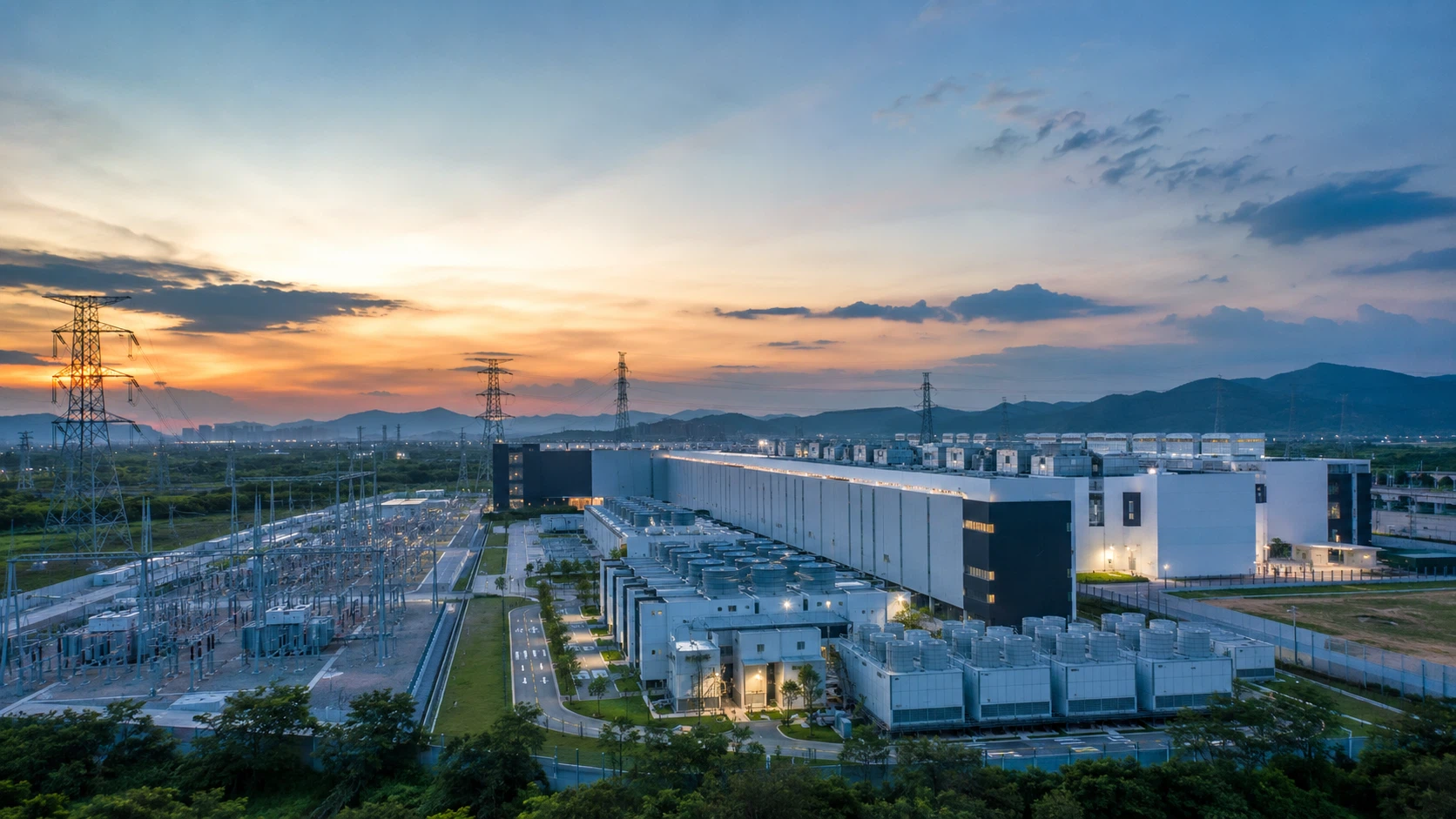
Data centers are moving closer to the center of China’s power reform after three large clusters in Guangdong entered electricity spot trading for the first time, linking artificial intelligence infrastructure more directly to real-time energy prices and grid conditions. Bloomberg reported on May 16 that the move involved facilities operated by China United Network Communications Group and China Mobile Communications Group, which joined the market on May 14 through a Guangdong Power Grid Energy Investment Co. platform.
The development matters because it pushes data centers beyond the role of passive electricity consumers. According to Bloomberg, the facilities entered the spot market as virtual power plants, giving them a more active relationship with power procurement at a time when China is trying to scale computing capacity without losing control of system costs or grid stability.
On its own, one pilot does not rewrite the economics of AI infrastructure. However, it offers a clear signal that Beijing increasingly sees data centers as infrastructure that must be coordinated with energy markets, renewable supply and grid management rather than simply connected to the network and left to draw power at will.
Why Data Centers Are Becoming Power-Market Participants
The immediate significance of the Guangdong move is practical. China’s AI buildout is increasing electricity demand just as policymakers are trying to make power prices more market-based and more responsive to real supply and demand conditions.
That combination creates a new policy question. If data centers are becoming one of the country’s most strategically important forms of industrial infrastructure, should they behave like inflexible loads, or should they be integrated more intelligently into the power system?
Guangdong gives data centers a live market test
Bloomberg said three data center clusters in Guangdong entered the spot market on May 14 through a Guangdong Power Grid Energy Investment Co. platform after the move was reported by China Electric Power News, an official industry publication. The report said the arrangement allows data centers to buy electricity based on real-time prices.
That detail is central to the story. Real-time pricing means data centers are no longer insulated from changing market conditions in the same way they often are under more static procurement models. Instead, operators can potentially adjust computing loads, purchasing behavior or scheduling decisions in response to price swings and supply patterns.
For a province such as Guangdong, where industrial demand is heavy and grid balancing is already a live issue, that makes the experiment more than a symbolic gesture. It is an early test of whether computing demand can be treated as a flexible part of the electricity system rather than as a one-way claim on scarce capacity.
Data centers now face a sharper price signal
That change could alter how developers and operators think about growth. In the AI era, the commercial logic of data centers has often centered on land, fiber, cooling and long-term customer demand. Power has always mattered, but the Guangdong model suggests the pricing mechanism itself may become part of the competitive equation.
If operators can respond intelligently to spot pricing, they may be able to lower power costs when supply is abundant or shift certain workloads to periods when electricity is cheaper. On the other hand, greater market exposure can also make returns more volatile if capacity is added faster than supply arrangements and grid flexibility can keep up.
The story therefore sits at the intersection of technology and market design. China is not only adding more data centers. It is also experimenting with rules that could determine how profitable, resilient and scalable those data centers are once AI workloads start competing more aggressively for electricity.
Data Centers Fit a Broader China Power Reform
The Guangdong pilot also makes more sense when placed inside China’s national power-market agenda. On February 11, 2026, the State Council said the country would work to improve cross-regional power allocation and build a unified national power market by 2030, with fuller implementation expected by 2035.
Those official guidelines said China would develop spot markets that better reflect prices and balance supply and demand, while also improving medium- and long-term power trading. In other words, the policy structure for the Guangdong move was already being built at the national level months before the data center pilot emerged.
China wants spot markets to play a larger role for data centers
The State Council language matters because it frames spot trading as a system tool, not as an isolated provincial experiment. The goal is not simply to let more companies buy electricity differently. It is to build a market in which prices, regional transfers and power planning work together more efficiently.
Data centers fit neatly into that framework. They are large loads, they are strategically important to China’s technology ambitions, and some of their computing tasks may be more flexible in timing or location than traditional industrial demand. That makes them useful candidates for a market structure that rewards responsiveness.
At the same time, policymakers appear to be trying to avoid a future in which AI infrastructure expands with little regard for local grid stress. Treating data centers as power-market participants gives regulators and grid operators a better chance to align digital growth with broader system constraints.
The grid story is becoming part of the data centers story
That is a meaningful shift in narrative. For much of the past several years, data centers were discussed mainly as real estate, connectivity and cloud-capacity assets. Now the conversation increasingly includes dispatchability, clean power access, regional transmission and price formation.
The market effect could extend beyond China. Investors in digital infrastructure are already paying closer attention to whether a proposed campus has firm power, renewable access and credible interconnection timing. Guangdong’s pilot suggests that the next stage may also include scrutiny of how intelligently a data center can operate inside a live power market.
For China, that could become a competitive advantage if it allows operators to scale computing capacity while keeping energy use more coordinated. Yet it also raises a harder question: whether the country can move from headline AI expansion to a more disciplined compute-and-power model without slowing growth.
What Investors Should Watch in Data Centers and Power
The significance of this development is not limited to a single trade on a provincial platform. It points to a broader operating model in which data centers may be judged not only by occupancy and capacity, but by how well they fit into an evolving energy system.
That matters because AI infrastructure is becoming physically heavier. The more computing clusters are built, the more the economics of data centers depend on power availability, energy sourcing and the ability to manage loads without triggering bottlenecks or political backlash.
Direct renewable supply adds another layer for data centers
China is already experimenting on that front. South China Morning Post reported on May 3, citing state broadcaster CCTV, that a 500-megawatt solar project in Ningxia had begun operating as the country’s first large-scale green energy project designed to supply a data center cluster directly.
According to that report, the project is intended to coordinate energy supply and computing demand so workloads can shift toward times or places where renewable electricity is more available or cheaper. SCMP said a further 1.5 gigawatts of wind capacity was planned by the end of the year, illustrating the scale at which China is linking digital infrastructure to power planning.
Taken together with the Guangdong pilot, that points to a larger strategic pattern. China is testing both market-based and physical ways to connect data centers to the energy system, from spot trading in coastal demand centers to direct renewable supply in inland resource hubs.
Execution risks still matter for data centers
None of this guarantees a smooth outcome. Data centers may be able to respond to price signals, but not every workload is flexible, and not every operator will welcome greater exposure to volatile electricity markets. Some facilities will still need predictable baseload supply, especially for high-value AI inference or enterprise workloads that cannot easily be shifted.
There is also the question of whether the benefits seen in a pilot can be replicated at much larger scale. A handful of data centers participating in spot trading is one thing. Making that model work across multiple provinces, operators and customer types is another, particularly if regional power shortages or price spikes reappear.
Still, the direction is clear enough to matter. China is signaling that data centers will be treated less as isolated digital buildings and more as strategic infrastructure that must interact with energy markets in real time. Readers can continue following how that relationship develops across technology, policy and investment coverage at Berrit Media.
Discover more from Berrit Media
Subscribe to get the latest posts sent to your email.