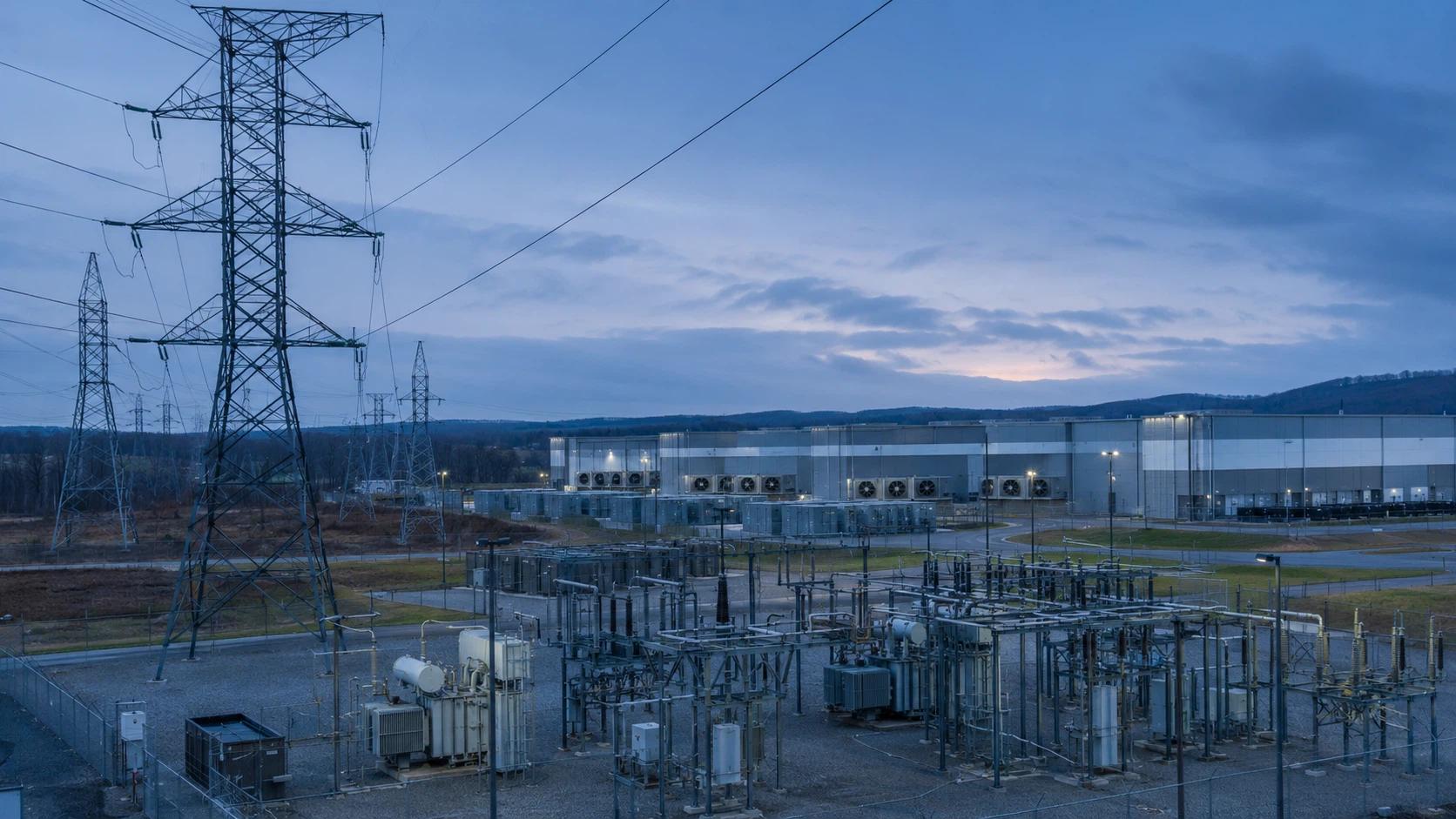
PJM power costs are rising fast enough to turn the U.S. data-center buildout into a live political and regulatory problem. A new quarterly report from Monitoring Analytics, the independent market monitor for PJM Interconnection, shows wholesale power costs across the 13-state grid climbed sharply in the first quarter as forecast demand from data centers pushed deeper into capacity planning.
The timing matters well beyond the electricity sector. PJM serves one of the most important regions for U.S. data-center growth and helps set prices and reliability signals across a large stretch of the Mid-Atlantic and Midwest, so its response will shape how AI infrastructure gets financed, where new computing clusters are built, and how much households and smaller businesses end up paying.
Why PJM Power Became More Expensive
Monitoring Analytics said the total cost of wholesale power in PJM rose by $58.75 per megawatt-hour in the first three months of 2026 from a year earlier, climbing from $77.78 to $136.53. The market monitor said energy, capacity and transmission together made up more than 98% of the total cost in the quarter, with the heaviest jump coming from energy and capacity.
The report also pointed to a sharp move in underlying power prices. PJM’s real-time load-weighted average locational marginal price increased by $35.37 per megawatt-hour, or 67.8%, from the first quarter of 2025 to the first quarter of 2026, a rise that the monitor broke into fuel, transmission-constraint, market-power, emissions and scarcity components.
What the Quarterly Numbers Show About PJM Power
The most striking figure in the report was the speed of the total-cost increase rather than a single fuel shock. Monitoring Analytics said wholesale power costs rose 75.5% year on year, while capacity costs alone increased 398.1%, showing how the market is already pricing in scarcity and forward reliability concerns.
That matters because capacity costs are designed to secure power supply ahead of peak-demand periods. When those costs surge this aggressively, the burden does not stay inside wholesale markets for long. It eventually works its way into retail bills, procurement strategies and investment decisions across a broad stretch of the U.S. economy.
The monitor did not describe the entire energy market as broken. On the contrary, it said the PJM energy market produced competitive results in the first quarter. The warning was narrower and more consequential: the capacity auctions for the 2025/2026, 2026/2027 and 2027/2028 delivery years were not competitive, primarily because forecast demand from data centers had become such a powerful driver.
How Forecast Demand Changed the Cost Structure
That distinction is important for investors and policymakers. Current electricity usage is only part of the story. PJM is being forced to make forward decisions based on expected large-load additions, which means the economics of the AI buildout are now affecting prices before many facilities are fully operating.
Monitoring Analytics said average real-time load in the first quarter rose 3.1% from a year earlier, to 98,749 megawatt-hours from 95,801. That increase on its own would already matter in a constrained grid, but the political pressure comes from the much larger forecast attached to future data-center connections and the supply that will be needed to serve them.
The result is a more expensive and more contested market. Utilities, power producers, hyperscalers and regulators are all trying to answer the same question: whether data-center demand should be absorbed through the existing auction framework or handled through a different set of long-term commercial arrangements.
What Data Center Demand Means for PJM Power Markets
PJM itself has already acknowledged that the issue is no longer theoretical. In a Reuters interview published on May 6, the grid operator said it was considering market reforms because data-center demand was outstripping energy supplies and raising the risk of shortages across its system.
The grid operator said its markets influence electricity prices for roughly one in five Americans, which is why the debate has widened from an industry problem into a public-policy fight. For Berrit Media readers, the bigger point is that AI infrastructure is no longer only a chip, cloud or venture-capital story. It has become a power-market story as well.
PJM Power and the AI Buildout
The surge in demand is tightly linked to the next phase of artificial intelligence deployment. Training clusters, inference-heavy cloud services and enterprise AI tools all require more computing capacity, and more computing capacity eventually means more substations, transmission upgrades and generation commitments.
That helps explain why a regional grid operator has become so important to technology investors. If PJM cannot create a credible way to price new load and attract new supply, the region could face slower data-center approvals, more volatile project economics and a higher risk that developers seek alternative structures or different geographies.
PJM warned Reuters that it could face an electricity shortfall as early as 2027. That timetable is short enough to affect corporate planning now, especially for companies committing billions of dollars to multi-year campuses, chip clusters and cloud expansion in the eastern U.S.
Who Pays for PJM Power Expansion
The hardest question is not whether new power infrastructure is needed, but who should pay for it. If the cost is broadly socialized through existing market rules, households and smaller commercial customers may absorb part of a buildout driven by some of the world’s largest technology companies.
That trade-off is exactly why the report landed so forcefully. Monitoring Analytics tied the pressure in capacity auctions to forecast data-center demand, sharpening the affordability debate around how AI-era infrastructure should be financed.
For policymakers, that creates a narrow path. They need to keep the grid reliable enough to support economic growth and data-center investment, but they also need to show voters and businesses that AI infrastructure will not simply be financed through higher bills with too little transparency.
Why the Policy Fight Is Intensifying
Political pressure was already building before the latest quarterly report. Reuters reported that governors led by Pennsylvania’s Josh Shapiro pushed last year for a limit on PJM capacity prices after the market posted a record rise, underscoring how quickly wholesale mechanics can become a kitchen-table issue when consumer bills move.
That tension now sits at the center of PJM’s strategic rethink. High prices are supposed to encourage new generation and grid investment, but if those spikes prompt repeated political intervention, developers may doubt whether strong prices will last long enough to justify major new projects.
PJM Power Reform Options on the Table
PJM said it is exploring three broad pathways for reform. One would rely much more heavily on long-term contracts between suppliers and wholesale buyers, leaving the existing capacity market to play a smaller role.
A second option would let stakeholders, including states, choose limits on what they are willing to pay for capacity in exchange for lower reliability. A third would significantly shrink the capacity market and recover more revenue through separate energy markets, a change that could alter how risk is shared across suppliers, utilities and large customers.
None of those pathways is simple, and PJM said the trade-offs are real for different parties. But the existence of the options shows that the operator no longer sees the current framework as sufficient for an era in which data-center demand can reshape regional power economics in only a few auction cycles.
What Businesses and Investors Should Watch Next
The immediate signal to watch is whether the next round of stakeholder talks produces a framework that gives power developers confidence without inflaming the political backlash over affordability. If that balance fails, PJM could end up with the worst of both worlds: not enough new supply and not enough policy legitimacy.
Investors should also watch how corporate data-center strategies evolve. Companies that can secure dedicated power arrangements, negotiate long-term supply or bring more flexibility into their load profiles may be better positioned than operators that depend entirely on an already stressed auction system.
For now, the quarterly report has done something important. It has made PJM power a boardroom issue for technology, utilities and policymakers at the same time, because the economics of AI infrastructure are now colliding directly with the economics of electricity affordability.
PJM’s latest warning does not end the argument over who should fund the next wave of grid expansion, but it does make that argument harder to avoid. Keep following related coverage at Berrit Media as we track how AI infrastructure, electricity markets and policy are being forced into the same conversation.
Discover more from Berrit Media
Subscribe to get the latest posts sent to your email.