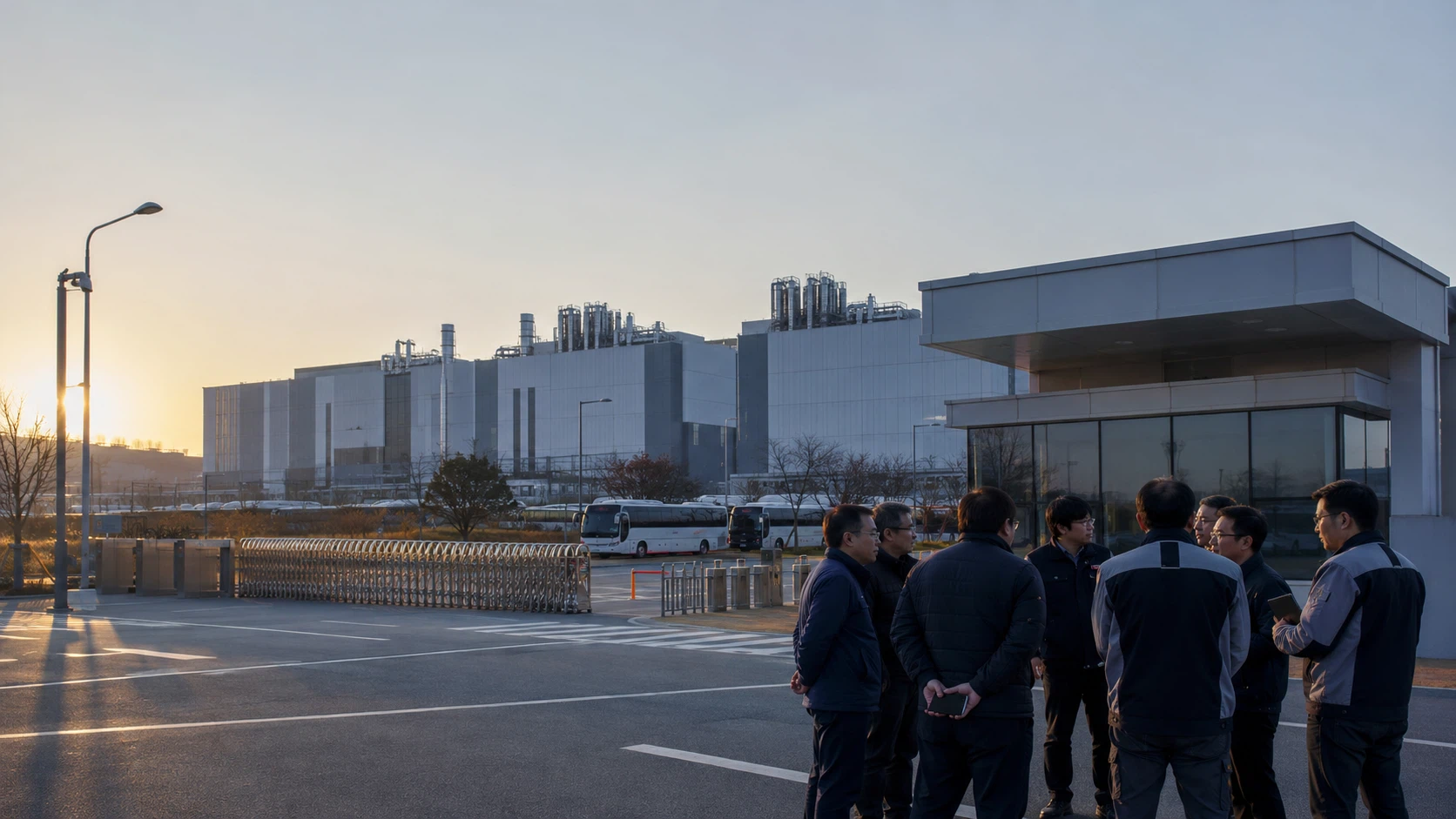
Samsung strike risks moved closer to a national policy issue on Sunday as South Korea’s prime minister said the government would pursue all options, including emergency arbitration, to avoid a walkout at Samsung Electronics and limit any damage if one takes place. The warning came as Samsung and its largest labour union agreed to resume pay talks on Monday with a government mediator, offering a narrow chance to defuse a confrontation at the world’s biggest memory chipmaker.
The dispute is no longer just a wage story. It now sits at the intersection of industrial policy, artificial intelligence supply chains and investor confidence in one of Asia’s most important technology groups. Prime Minister Kim Min-seok said even a one-day shutdown at Samsung’s semiconductor factories could cause direct losses of up to 1 trillion won, while longer disruption could cascade through production lines for months.
The timing makes the stakes especially high. Samsung’s semiconductor division has just posted record first-quarter profit on the back of AI-driven memory demand, and the company has been positioning itself as a key supplier of high-bandwidth memory and related components for the next wave of data-center expansion. A prolonged stoppage would therefore land at a moment when Samsung is trying to turn strong demand into durable leadership.
Why the Samsung Strike Matters Beyond Wages
For South Korea, Samsung is not simply another large employer. The company has become so central to exports, capital markets and supplier networks that a strike at its chip operations now raises questions about national economic resilience as much as corporate labour relations.
That is why the government’s language has become unusually direct. Kim said Samsung accounts for 22.8 percent of the country’s exports and 26 percent of domestic stock-market capitalization, while employing more than 120,000 people and working with 1,700 suppliers. Those figures help explain why Seoul is openly considering extraordinary intervention instead of treating the dispute as a routine private-sector negotiation.
Samsung strike could ripple through AI memory supply
The immediate business concern is supply. Reuters reported that the union and management are heading back into mediated talks just days before a planned strike that could disrupt output at a company whose customers include Nvidia, AMD and Google. In the current AI cycle, Samsung’s role goes far beyond commodity chips. It is a core supplier in a market where advanced memory availability remains strategically important.
Samsung said in its first-quarter 2026 results that the memory business set record quarterly revenue and operating profit by meeting high-value AI demand despite limited supply availability. The company also said it had begun mass product sales of HBM4 and expects demand to remain strong in the second quarter as AI infrastructure expands. That means any operational interruption would hit a segment where buffers are already thin.
The prime minister also warned that the real risk is not limited to a single lost shift. Semiconductor manufacturing is continuous, capital-intensive and difficult to restart cleanly once lines are disturbed. Kim said temporary pauses can lead to months of inactivity, and he raised the possibility of far larger losses if in-process materials must be discarded during a prolonged stoppage.
Seoul sees export and market risks
The government’s concern also reflects how deeply Samsung is woven into South Korea’s macro story. Finance Minister Koo Yun-cheol said earlier this week that a strike would pose a significant risk to growth, exports and financial markets. Those remarks signaled that the dispute had already moved from an industrial issue into a broader policy concern.
Markets have been sensitive to that possibility. Reuters reported on Friday that Samsung shares fell as much as 5.9 percent after the union said it would stick with its strike plan despite the company’s offer to resume talks without conditions. The price reaction suggested investors were not treating the dispute as symbolic. They were beginning to price operational and strategic risk.
Emergency arbitration remains the sharpest tool available to the government. Under South Korean labour rules, it can suspend industrial action for 30 days while the National Labor Relations Commission handles mediation and arbitration. Reuters noted that the mechanism is rarely used, making Seoul’s willingness to mention it a sign of how seriously officials view the threat to a nationally important industry.
How the Negotiations Broke Down and Returned
The latest round of talks follows several days of rapid escalation. Government-mediated negotiations broke down last week, heightening the risk that the union would carry through with a planned strike starting next week. Yet by Saturday and Sunday, both sides had edged back toward the table under growing political and public pressure.
The fresh meeting set for Monday does not guarantee a resolution. Even so, it changes the immediate outlook by creating one more formal opportunity to close the gap before the planned walkout begins. Seoul has clearly decided that the dispute is too consequential to leave unattended.
Samsung strike talks collapsed over bonus formulas
At the center of the dispute is how the company shares the gains from its semiconductor rebound. According to Korea JoongAng Daily, the union wants Samsung to remove the cap on annual bonuses and commit 15 percent of annual operating profit to workers. Management, by contrast, previously proposed performance bonuses equal to 607 percent of annual salary for employees in the memory semiconductor business, with lower payouts for staff in loss-making non-memory units.
That disagreement matters because Samsung’s recovery has been uneven inside the company. The most profitable momentum has come from memory linked to AI infrastructure, while other parts of the semiconductor business remain under more pressure. The union’s position effectively argues that workers across the operation deserve a larger, more formula-based share of the current upcycle.
Reuters previously reported that after talks collapsed, union leaders said they would remain committed to a strike starting next week even if Samsung reopened discussions. That stance reinforced the sense that the conflict had become as much about trust and bargaining structure as about the size of the bonus itself.
New negotiators and public apologies reopen the door
Saturday brought the first signs of movement. Reuters reported that the union said Samsung had replaced the company’s representative for the negotiations and that the two sides would also hold a separate meeting before Monday’s mediated talks. The union said the new company negotiator apologized for a breakdown in trust and pledged to engage sincerely.
Samsung chairman Jay Y. Lee also made his first public comments on the dispute, apologizing to customers and the public for the anxiety caused by issues inside the company. While an apology does not settle a wage dispute, it can change the tone around internal accountability and help create room for negotiators to resume contact without appearing to retreat.
Korea JoongAng Daily reported that Monday’s session is now being framed by officials as effectively the last chance to avoid a damaging strike. That framing increases the pressure on both sides. Management must show it is serious about a revised proposal, while the union must decide whether it gains more by pressing its leverage or by locking in a tangible win before state intervention becomes more likely.
What a Walkout Would Mean for Samsung’s AI Strategy
The strategic question is larger than the immediate cost of a labour stoppage. Samsung is trying to convert an AI-led memory boom into stronger long-term leadership across advanced memory, packaging and foundry capacity. Any disruption now could weaken execution at a time when customers are moving quickly and rivals are not standing still.
That is why the story resonates well beyond South Korea. Investors, cloud companies and semiconductor customers are all watching whether Samsung can preserve operational stability while balancing labour demands during a period of unusually high profitability and strategic importance.
Samsung strike pressure lands during a record earnings rebound
Samsung’s first-quarter results show why the union believes it has leverage. The company reported consolidated revenue of 133.9 trillion won and operating profit of 57.2 trillion won, both all-time quarterly highs. The Device Solutions division, which houses the semiconductor business, generated 81.7 trillion won in revenue and 53.7 trillion won in operating profit.
The company said the memory business delivered record sales by addressing high-value AI demand and benefiting from higher average selling prices. It also expects server memory demand to remain strong in the second half as hyperscalers respond to enterprise adoption of AI and large language model services. In other words, the business is performing well at precisely the moment labour relations are becoming a threat.
From the union’s perspective, that strengthens the case for a richer compensation framework. From management’s perspective, however, locking operating profit too tightly to bonus formulas could reduce flexibility in a cyclical industry that still faces uneven performance across divisions. That tension helps explain why the dispute has proven difficult to resolve despite the obvious pressure to find a compromise.
Why customers and investors are watching closely
For customers, the issue is continuity. Samsung has been promoting itself as a supplier capable of serving the next phase of AI infrastructure demand with products such as HBM4 and future HBM4E samples. Buyers that depend on stable roadmaps will want reassurance that labour turbulence will not spill into delivery schedules or slow product ramps.
For investors, the concern is slightly different. A strike would not only threaten near-term output. It could also complicate the narrative that Samsung is fully capitalizing on AI demand just as global competition in memory and advanced semiconductor manufacturing intensifies. Even a temporary disruption could shift sentiment toward rivals if customers begin to question execution certainty.
Monday’s talks therefore matter as a signal as much as a negotiation. If the sides produce even a limited framework for continued bargaining, markets may conclude that the most severe outcome has been pushed back. If they fail again, however, the dispute could become one of the clearest reminders that the AI hardware boom still depends on old-fashioned industrial stability as much as it does on cutting-edge technology.
Whether the Samsung strike is resolved this week or escalates into government intervention, it has already become a test of how resilient the AI chip supply chain really is when labour, politics and technology collide. Readers can follow more business, technology and policy coverage like this across Berrit Media.
Discover more from Berrit Media
Subscribe to get the latest posts sent to your email.