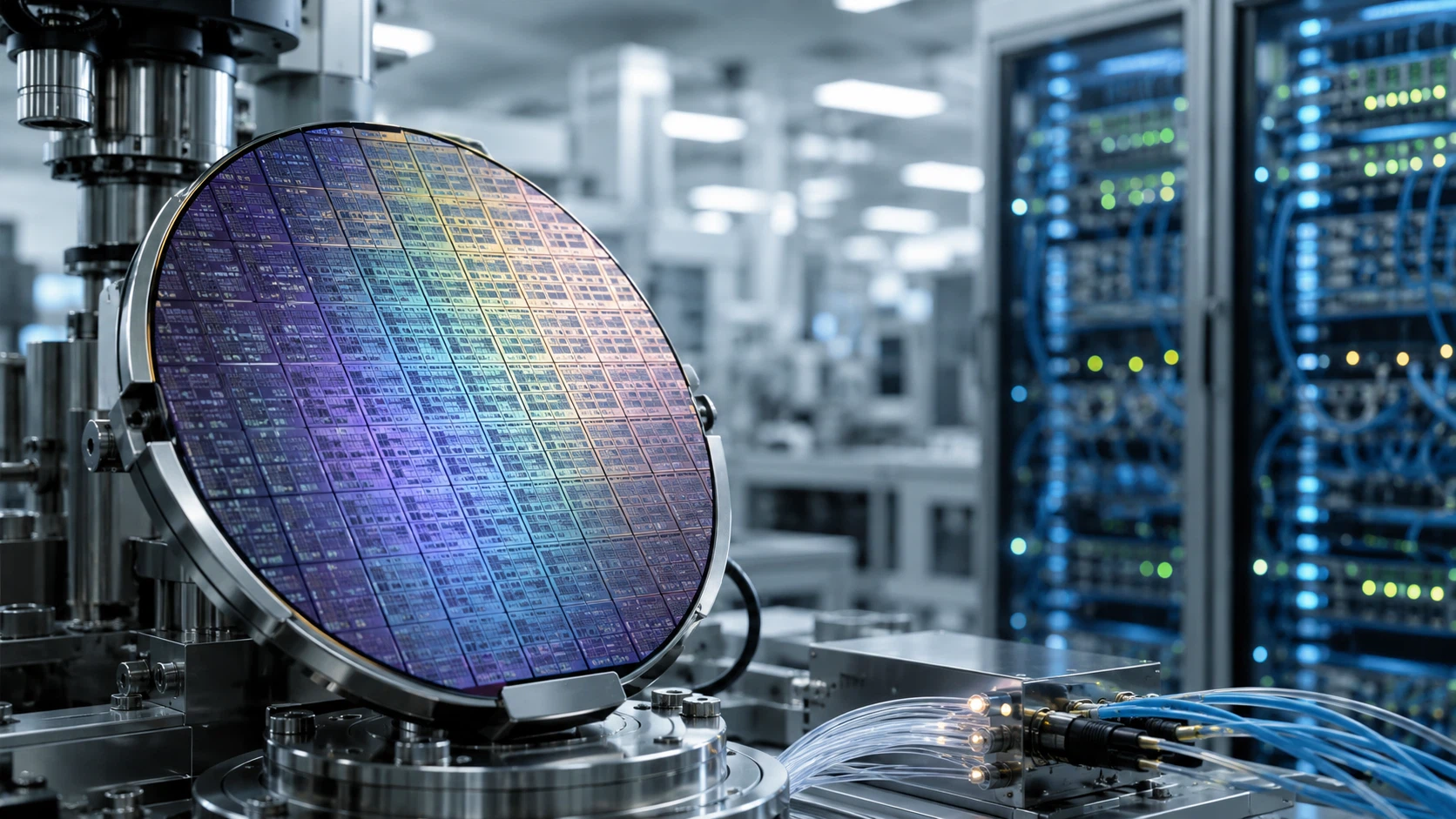
Silicon photonics is becoming a more central part of the AI infrastructure buildout after Tower Semiconductor said it signed $1.3 billion of 2027 contracts with major customers and received $290 million in prepayments to reserve capacity. The Israeli specialty foundry paired that announcement with first-quarter results and a record second-quarter revenue forecast, giving investors a sharper view of how demand for optical interconnects is moving from technical promise to contracted spending.
The announcement matters because the next phase of AI expansion is no longer only about training chips and data-center power. It is also about how quickly data can move between processors, memory, switches, and storage without overwhelming energy budgets. In that environment, suppliers of optical components and the foundries that manufacture them are starting to occupy a more strategic position in the semiconductor stack.
Silicon Photonics Moves to the Center of AI Infrastructure
Tower’s update suggests that optical networking demand is becoming easier to measure in financial terms. Rather than talking in broad terms about future adoption, the company disclosed signed commitments for 2027 revenue and said customers have already paid to secure capacity. That turns a technology trend into a more concrete business signal.
The company also said the initial commitments are reinforced by even larger contractual wafer commitments for 2028, with additional prepayments due by January 2027. Combined with a customer base of more than 50 active silicon photonics customers across a range of applications, the picture is one of an ecosystem moving beyond experimentation and into long-duration procurement.
Why Silicon Photonics Matters
Silicon photonics uses light rather than only electrical signals to move data across and between computing systems. For AI operators, that matters because model training and inference workloads depend on moving enormous amounts of information with low latency and manageable power consumption. As clusters scale, the cost of poor connectivity rises quickly.
That is why optical links are becoming more important inside data-center architectures. Faster movement between accelerators and adjacent systems can help support larger model sizes, more distributed computing, and higher utilization of expensive AI hardware. In practical terms, better interconnects can make the difference between buying more compute and using existing compute more efficiently.
Tower specifically pointed to demand tied to pluggable optical transceivers as well as next-generation near-packaged optics and co-packaged optics. Those are not consumer-facing buzzwords. They describe real attempts across the industry to reduce bandwidth constraints and power penalties as AI systems become denser and more performance-sensitive.
What Tower Secured
According to the company’s May 13 contract announcement, Tower signed silicon photonics agreements worth $1.3 billion for 2027 revenue with its largest customers. It also said it had received $290 million in customer prepayments for capacity reservation. That structure is notable because it pushes customers to commit capital earlier in exchange for supply assurance.
Tower added that the prepaid reservations reflect contractual commitments, while full demand and shipment forecasts are higher. In other words, the disclosed number may not represent the outer limit of the opportunity. It is a floor shaped by signed agreements, not a ceiling for all possible optical-connectivity demand tied to its platform.
The company said those commitments are supported by a broader customer base and by a substantial capacity ramp across its worldwide multi-fab silicon photonics footprint. That combination of prepayments, multi-year commitments, and global capacity expansion helps explain why investors treated the announcement as more than a routine quarterly talking point.
Tower Semiconductor Turns Demand Into Visibility
The contract news landed alongside stronger financial results, which helped reinforce the argument that Tower is not waiting years to benefit from AI-related demand. For the first quarter ended March 31, the company reported revenue of $414 million, up 15% from a year earlier. Gross profit rose 52% and operating profit rose 96%, according to the company’s earnings release.
Management then guided for second-quarter revenue of $455 million, which it described as a company record. Reuters reported that the forecast was above the average analyst estimate compiled by LSEG, and that Tower’s U.S.-listed shares rose more than 17% in early trading after the update. That market reaction reflected both earnings strength and a new level of confidence in the photonics pipeline.
Revenue Growth Around Silicon Photonics
Tower is not a pure-play AI stock in the way some headline semiconductor names are. Its chips serve automotive, industrial, communications, consumer, and medical uses. That makes the photonics story more interesting, because it shows AI demand lifting a company that sits deeper in the manufacturing chain and serves multiple end markets.
The broader context is that hyperscalers and cloud operators are spending heavily not only on processors but also on the infrastructure around them. When that spending starts to influence specialty foundries, it suggests the AI investment cycle is broadening through the supply network. Tower’s results indicate that optical-connectivity demand is now meaningful enough to shape revenue visibility and capital planning.
Chief executive Russell Ellwanger said the company remains confident in reaching its financial model target of $2.8 billion in annual revenue and $750 million in net profit in 2028. That is an ambitious objective, but the company is now supporting that ambition with signed customer commitments rather than only thematic optimism.
Capacity Becomes the Strategic Question
The prepayment structure says almost as much about the market as the headline revenue number does. Customers generally do not reserve fabrication capacity years in advance unless they are concerned about scarcity, execution risk, or the strategic cost of waiting. In the AI era, those concerns are becoming more common across the semiconductor chain.
Tower said it is ramping worldwide multi-fab capacity to support accelerating silicon photonics demand. That sounds straightforward, but it carries operational pressure. Expanding capacity while maintaining yields, delivery schedules, and process consistency is a test for any foundry, especially when customers are betting on the supplier for next-generation optical architectures.
The company’s own disclosures acknowledge the complexity. Its earnings materials include risks tied to demand fluctuations, execution bottlenecks, equipment timing, and broader geopolitical or trade disruptions. The new contracts improve visibility, but they also raise expectations. Investors will now watch whether Tower can convert committed demand into reliable volume production without sacrificing profitability.
Silicon Photonics Redraws the Competitive Map
The Tower story also says something larger about where value may accumulate in the AI supply chain over the next several years. For much of the last cycle, investor attention centered on model developers, cloud platforms, and graphics processors. The next layer of differentiation may come from the less glamorous infrastructure that keeps large systems connected and efficient.
That shift creates room for specialty manufacturers, packaging providers, materials suppliers, and optical-component ecosystems to capture more strategic importance. As AI deployments scale from experimental clusters to industrial infrastructure, the performance of the network around the compute becomes harder to ignore. Tower’s update is one of the clearer recent signs of that transition.
A Different Semiconductor Bottleneck
For years, the market’s default AI bottleneck was compute availability. That remains important, but it is no longer the only choke point. Once companies can procure accelerators, they still need a way to connect them at scale, manage heat and power, and keep data moving with minimal losses. Optical systems increasingly sit inside that answer.
That is why silicon photonics may become one of the more important enabling technologies of the AI buildout, even if it receives less public attention than the chips doing the actual model computation. Better optical connectivity can reduce system inefficiencies, improve bandwidth density, and help operators stretch the value of very expensive training and inference hardware.
For foundries, this creates a more specialized competitive arena. It is not enough to offer generic wafer capacity. Suppliers need process know-how, customer trust, and the ability to ramp advanced manufacturing in step with changing architecture roadmaps. Tower is arguing that it has built that position, and its customers appear willing to validate the claim with cash commitments.
What Investors and Customers Will Watch
The next checkpoints will be execution and follow-through. Investors will look for evidence that second-quarter performance matches the record guidance, that 2028 commitments translate into additional prepayments on schedule, and that silicon photonics demand continues to expand without crowding out the company’s other business lines.
There are also side issues to monitor. Reuters noted that GlobalFoundries sued Tower in March over patents related to semiconductor manufacturing. That dispute is separate from the photonics contract win, but it is a reminder that fast-growing technology niches often become more legally and competitively contested as strategic value increases.
Still, the larger takeaway is that Tower has given the market a rare quantitative read on an emerging AI infrastructure segment. A company that manufactures the less visible plumbing of advanced computing has suddenly offered one of the more visible signals that optical interconnect demand is becoming investable, contract-backed, and operationally urgent.
Tower Semiconductor’s latest update does not settle the longer-term race for AI networking leadership, but it does make one point harder to dismiss: silicon photonics is moving from supporting technology to strategic business driver. Readers can follow more market-moving technology coverage and related supply-chain stories at Berrit Media.
Discover more from Berrit Media
Subscribe to get the latest posts sent to your email.