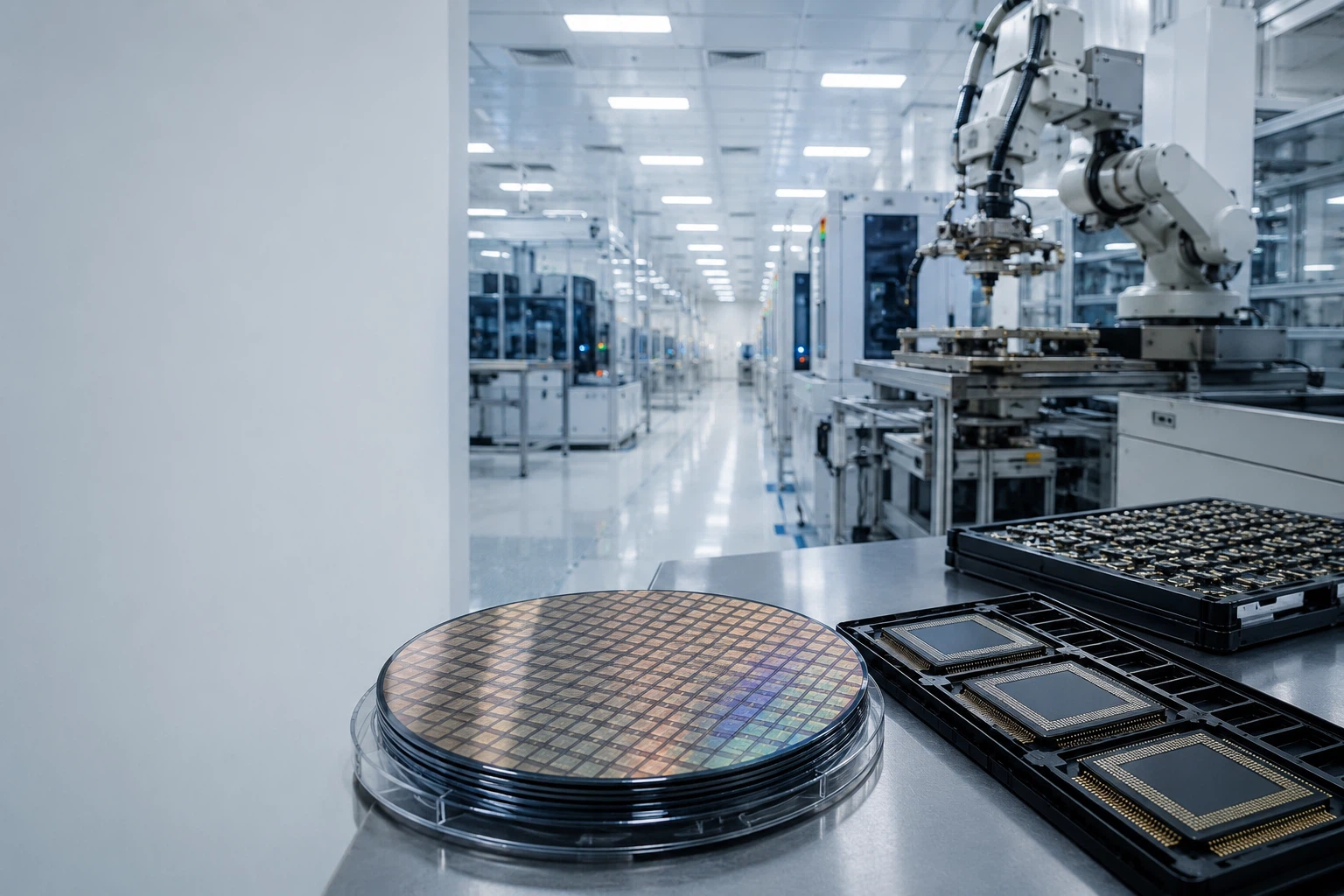
TSMC AI is becoming a shorthand for how quickly artificial intelligence is redrawing the economics of the semiconductor industry. Taiwan Semiconductor Manufacturing Co. said ahead of its 2026 Taiwan Technology Symposium that the global chip market is now on track to exceed $1.5 trillion by 2030, up from its earlier $1 trillion forecast.
The revised outlook matters well beyond one company because TSMC sits at the center of the global supply chain for advanced processors. When the largest contract chipmaker raises its long-range demand assumptions so sharply, it signals that customers are committing more capital to data centers, advanced packaging and next-generation manufacturing capacity than the market expected only a year ago.
Why TSMC AI Is Redrawing the Demand Map
TSMC’s new forecast is not just a top-line number. It also reorganizes which end markets the company expects to drive growth through the rest of the decade, with AI and high-performance computing moving decisively ahead of smartphones.
That shift is important for investors, equipment suppliers and governments because it changes where profits, bottlenecks and policy attention are likely to concentrate. It suggests the next semiconductor race will be defined less by handset cycles and more by compute intensity, packaging complexity and long-duration infrastructure spending.
TSMC AI Rewrites the 2030 Growth Curve
According to Reuters, TSMC expects AI and high-performance computing to account for 55 percent of the global semiconductor market by 2030. Smartphones are projected at 20 percent, while automotive applications are expected to contribute 10 percent.
That mix shows how fast AI has moved from a promising application layer into the main engine of chip demand. At the company’s Taiwan symposium, Deputy Co-COO Kevin Zhang said AI had advanced faster than expected and was rapidly reshaping the technology industry.
Focus Taiwan reported that TSMC now sees the global foundry sector alone reaching $500 billion by 2030. Read together, those figures imply a much larger role for outsourced manufacturing as chip design grows more expensive and more tightly linked to large AI systems.
TSMC AI Pushes Smartphones Into a Supporting Role
For more than a decade, smartphones helped define semiconductor roadmaps, pricing power and production scale. Zhang said that role is changing, with AI expected to become the industry’s main growth driver over the coming years.
That does not mean handsets are disappearing from the story. Focus Taiwan said Zhang still expects smartphones built with TSMC’s 2-nanometer chips to become commercially available later this year, which shows mobile devices remain important as a destination for advanced silicon.
Even so, the center of gravity is shifting toward workloads that demand far more compute and memory bandwidth. That pushes spending toward data-center processors, interconnects and packaging technologies that can handle higher performance per watt at industrial scale.
Capacity Plans Follow the TSMC AI Outlook
TSMC’s presentation did more than lift a market forecast. It also laid out how the company is trying to build enough front-end and back-end capacity to meet the AI wave without ceding ground to shortages that have already become familiar across the sector.
The operational details matter because semiconductor demand is only valuable if manufacturers can translate it into timely output. TSMC’s updates suggest the company believes the current AI cycle is durable enough to justify unusually aggressive expansion across fabs, nodes and packaging lines.
TSMC AI Is Driving the Packaging Build-Out
Reuters reported that TSMC expects capacity for CoWoS, its advanced packaging technology used in AI chips such as those designed by Nvidia, to grow at a compound annual rate of more than 80 percent from 2022 to 2027. That is a striking figure for a process that has become one of the industry’s most visible bottlenecks.
The company also said AI accelerator wafer demand is projected to rise eleven-fold between 2022 and 2026. In practical terms, that means the pressure is no longer limited to transistor fabrication; it extends into how chips are stacked, connected and delivered as larger computing systems.
TSMC’s latest quarterly materials help explain why this matters. In the first quarter of 2026, high-performance computing already accounted for 61 percent of the company’s revenue, far ahead of smartphones at 26 percent, showing that AI-related demand is not only a future forecast but a present commercial reality.
New Fabs Show Where TSMC AI Demand Is Landing
Reuters said TSMC plans to build nine phases of wafer fabs and advanced packaging facilities in 2026 while ramping capacity for its 2-nanometer and next-generation A16 chips at a projected compound annual growth rate of 70 percent from 2026 to 2028. That is an unusually strong build signal from a company known for disciplined capacity planning.
The global footprint update was equally revealing. TSMC said its first Arizona fab is already in production, the second fab is scheduled for tool move-in in the second half of 2026, a third fab is under construction, and work on a fourth fab plus the site’s first advanced packaging facility is expected to start this year.
Beyond the United States, the company said its first Japan fab is in volume production for 22-nanometer and 28-nanometer products and that the second Japan fab has been upgraded to 3-nanometer because of strong demand. Germany’s fab is also progressing as planned, starting with 28-nanometer and 22-nanometer technologies before moving to 16-nanometer and 12-nanometer production.
What the TSMC AI Forecast Means for Business
The broader business significance of the forecast lies in what it says about confidence across the supply chain. TSMC is effectively telling customers, equipment vendors and policymakers that the AI build-out is becoming a longer and more capital-intensive industrial cycle than earlier semiconductor forecasts assumed.
That message will resonate because TSMC’s assumptions affect a wide circle of companies, from chip designers and cloud operators to packaging specialists and industrial suppliers. When its demand picture changes, investment plans across the sector often change with it.
TSMC AI Strengthens Taiwan’s Position in the Supply Chain
At the symposium, Zhang said Taiwan has the world’s strongest AI supply chain, pointing to the network that connects TSMC with electronics manufacturers and downstream system builders. That claim is strategic as much as promotional because it frames Taiwan not just as a manufacturing location but as a coordination point for AI-era production.
Focus Taiwan also reported that TSMC customers across the Asia-Pacific region used more than 2.1 million 12-inch equivalent wafers last year, according to company executive Ray Wan. That figure helps show how demand is spreading geographically even as the manufacturing know-how remains concentrated in a relatively small set of ecosystems.
For governments trying to secure technology supply chains, this creates a complicated picture. TSMC is diversifying across Arizona, Japan and Germany, yet the company’s own messaging still underscores how deeply AI manufacturing capabilities remain anchored in Taiwan’s industrial base.
TSMC AI Raises the Stakes for Customers and Rivals
The forecast also raises the bar for competitors and customers alike. If TSMC is right that the semiconductor market can exceed $1.5 trillion by 2030, companies across the stack will need to make larger decisions on capital expenditure, design partnerships and procurement far earlier than in a typical cycle.
For customers, the risk is less about whether AI demand exists and more about whether access to advanced nodes and packaging becomes constrained. Reuters said TSMC expects Arizona output to increase 1.8 times year on year by 2026, with yields comparable to Taiwan, a sign that overseas capacity is becoming more relevant to supply assurance.
For rivals, the challenge is sharper still. A market increasingly led by AI and HPC rewards process leadership, advanced packaging expertise and execution at scale, which are areas where TSMC already holds structural advantages. That does not guarantee a straight path forward, but it does make the company’s latest forecast one of the clearest signals yet that the next semiconductor expansion will be larger, faster and harder to contest than the last one.
TSMC’s revised market outlook does not settle every question about valuation, geopolitics or eventual demand discipline, but it does make one point hard to ignore: the AI build-out is pulling more of the semiconductor industry into a deeper, longer capital cycle. For more reporting on the companies, policy moves and market shifts shaping global business, continue reading related coverage at Berrit Media.
Discover more from Berrit Media
Subscribe to get the latest posts sent to your email.