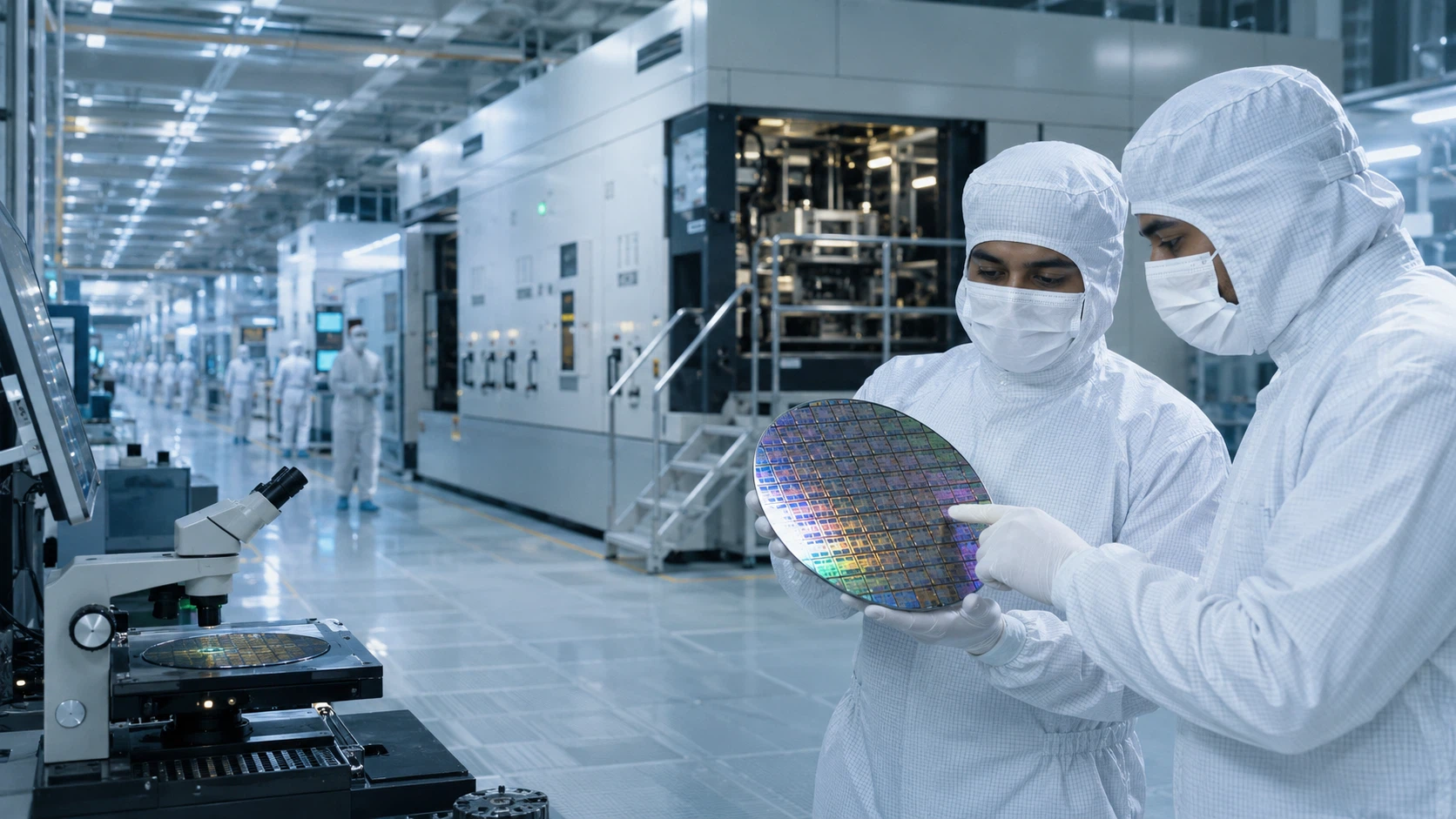
India fab ambitions gained a concrete industrial partner on May 16 when Tata Electronics and ASML signed a strategic agreement to support India’s first commercial 300 mm semiconductor fabrication plant in Dholera, Gujarat. The move gives Tata access to the lithography expertise and equipment framework it needs for a project that New Delhi sees as central to building a domestic chip manufacturing base.
The agreement matters because it links a private-sector factory plan to a broader state-backed push for supply-chain resilience, industrial capability, and technology credibility. Reuters reported the signing on May 16, while ASML and Tata described the arrangement as a long-term partnership covering fab ramp-up, local skills development, research support, and supply-chain work.
Why the India Fab Project Matters
Tata Electronics says the Dholera facility carries a planned investment of $11 billion and is intended to produce chips for automotive, mobile-device, artificial-intelligence, and other industrial uses. The company also said it has partnered with Taiwan’s PSMC for access to manufacturing processes spanning 28nm, 40nm, 55nm, 90nm, and 110nm technologies.
That range is important because India does not need to begin with the world’s most advanced logic nodes to become strategically relevant. Mature and mid-range process technologies still underpin large volumes of electronics, industrial systems, communications hardware, and vehicles, which means a well-run fab could matter commercially even without competing directly with the most cutting-edge foundries.
India Fab Moves Beyond Assembly
India has spent years trying to convert its strength in chip design talent, electronics assembly, and policy incentives into deeper semiconductor manufacturing capacity. A front-end wafer fabrication plant is a much harder step because it demands not only capital, but also equipment integration, yield discipline, utility stability, cleanroom precision, and a reliable supplier base.
That is why the ASML link carries more weight than a typical memorandum. Lithography is one of the most technically sensitive parts of chipmaking, and access to a credible equipment partner can help move a project from an industrial ambition into something global customers are willing to examine seriously.
The agreement still does not mean the factory is finished or commercially proven. However, it does show that Tata is assembling the kind of ecosystem relationships that large semiconductor projects need before customers, employees, and suppliers fully commit.
India Fab Economics Depend on Scale and Customers
Tata Electronics says the Dholera site is being built to serve customers globally, not only India’s domestic market. That matters because fab economics depend on high utilization, predictable customer demand, and enough volume to justify large fixed costs across multiple years of operation.
For India, the attraction is clear. A domestic fab can reduce dependence on imported chips in strategically important sectors while also giving multinational customers another geography to consider as they rethink concentration risk across Asia.
Even so, the business case will rest on execution rather than symbolism. Winning customers, holding yields, and keeping costs competitive will determine whether the India fab story becomes an enduring industrial asset or simply another well-funded strategic announcement.
ASML Gives the India Fab Project Its Core Machinery Logic
ASML is not a generic industrial supplier. It occupies a critical position in the semiconductor equipment chain because lithography tools are central to how chip patterns are transferred onto wafers, making the company one of the most important technology partners any new fab can secure.
In their joint statement, Tata Electronics and ASML said the collaboration would deploy ASML’s holistic suite of lithography tools and solutions for the Dholera plant. They also said the partnership would support successful ramp-up, local research capabilities, and the development of domestic talent needed for long-term operations.
India Fab Needs More Than Machines
The most credible part of the announcement may be that it went beyond equipment. Reuters and the companies both emphasized workforce development, supply-chain resilience, and research support, which suggests the project is being framed as an ecosystem build rather than a simple purchase order.
That framing is realistic. Semiconductor plants do not succeed because machines arrive at the loading dock. They succeed when process engineers, maintenance teams, chemicals suppliers, software systems, quality controls, and logistics networks all work with very low tolerance for disruption.
For India, building that capability domestically could prove as important as the fab itself. If Dholera creates a durable talent pipeline and a dependable vendor network, the spillover effects could extend well beyond one site and strengthen the country’s position in later semiconductor investments.
India Fab Timeline Still Carries Execution Risk
The announcement was notable, but it was also careful. Neither the ASML release nor Reuters’ report presented the plant as production-ready, and the companies did not publicly promise a near-term manufacturing start date in the material reviewed for this draft.
That caution is appropriate because fab ramp-ups often encounter delays tied to installation, qualification, yield learning, supplier coordination, or customer certification. In semiconductor manufacturing, the difference between construction progress and profitable output can be measured in many difficult quarters.
As a result, investors and industry watchers should read the India fab partnership as an enabling milestone rather than an end-state achievement. It improves the odds of execution, but it does not remove the operational risk that defines every new chip plant.
The India Fab Bet Is Also a Supply-Chain Strategy
The timing of the Tata-ASML agreement adds another layer to its significance. It was signed alongside a wider India-Netherlands diplomatic upgrade, with both governments issuing a joint statement that elevated the relationship to a strategic partnership and highlighted semiconductors, critical technologies, and talent cooperation.
That broader political context matters because semiconductor manufacturing now sits at the intersection of industrial policy, economic security, and international alignment. Governments increasingly care not only about where chips are designed and sold, but also where tools, skills, and production capacity are anchored.
India Fab Fits a Trusted Technology Agenda
For the Netherlands, deeper semiconductor engagement with India offers a way to expand ties with a large growth market while supporting trusted supply-chain diversification. For India, partnership with ASML strengthens the credibility of its ambition to become more than a demand market or packaging location.
The official bilateral statements also pointed to longer-term collaboration between the Dutch semiconductor ecosystem and India’s own semiconductor mission. That suggests the relationship is being treated not as a one-off corporate announcement, but as part of a broader technology corridor linking policy, training, and industrial development.
In a market shaped by export controls, geopolitical rivalry, and repeated supply shocks, trusted partnerships carry commercial value. Customers want capacity, but they also want predictability, governance, and a lower chance that one regional disruption will halt production everywhere else.
What the India Fab Story Means for Markets
For ASML, the Tata project does not immediately transform its revenue base, but it does reinforce the company’s position at the center of any serious semiconductor expansion plan. When new manufacturing regions emerge, ASML’s role tends to be foundational because advanced lithography remains one of the hardest capabilities to replicate.
For Tata Electronics, the benefit is more immediate in strategic terms. The partnership improves the project’s industrial credibility, helps reassure future customers and ecosystem partners, and signals that Tata is serious about building a semiconductor platform that can plug into global supply chains instead of serving only a protected domestic market.
For the wider industry, the lesson is that the next phase of chip competition may be defined less by headline subsidies alone and more by who can assemble durable ecosystems of tools, talent, process know-how, and diplomatic trust. On that test, the India fab effort has taken a meaningful step forward, and readers can continue following related technology and industry coverage at Berrit Media.
Discover more from Berrit Media
Subscribe to get the latest posts sent to your email.