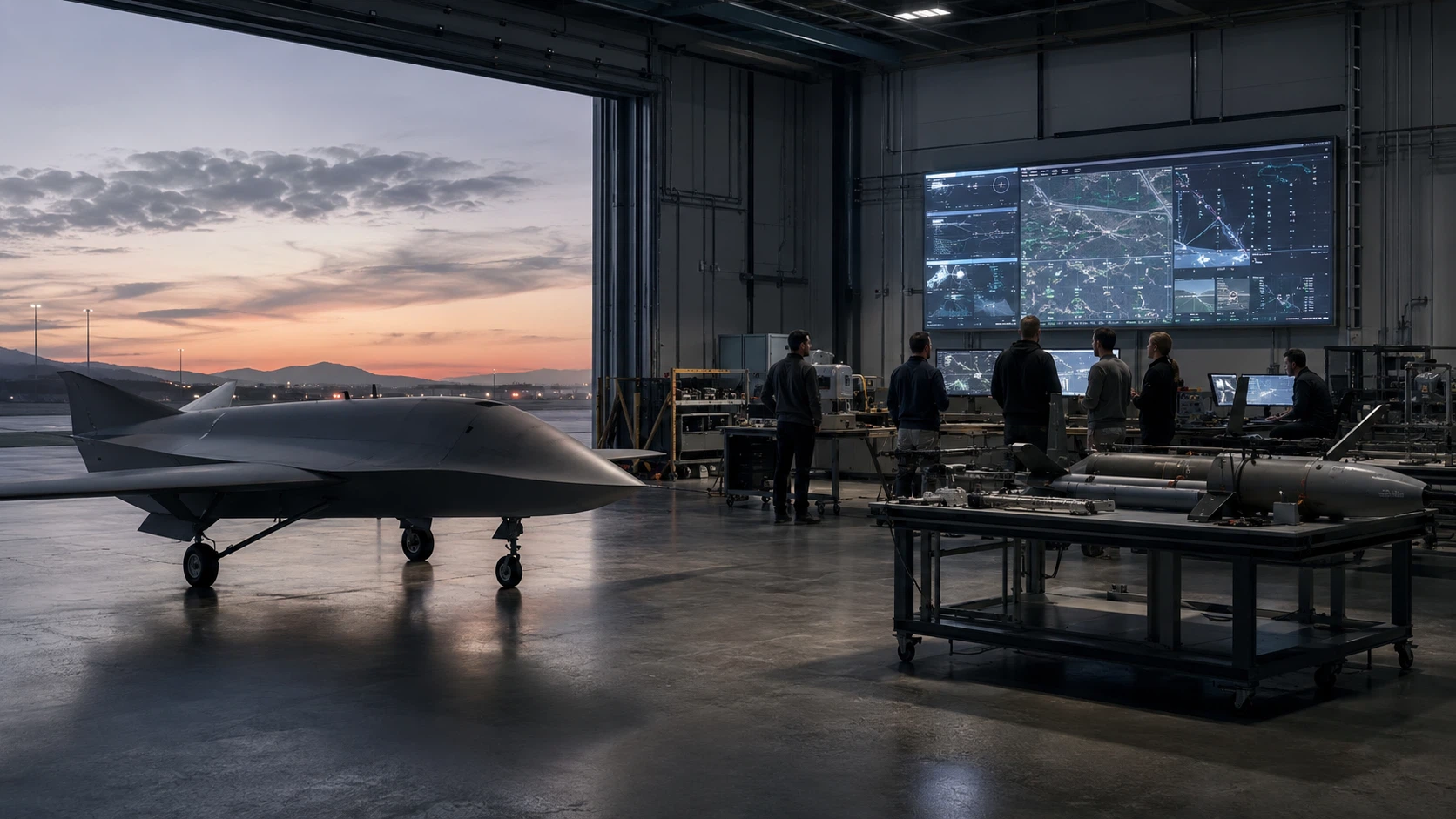
Anduril funding reached a new level this week after the U.S. defense technology company said it had raised $5 billion in a Series H round at a $61 billion valuation. The scale of the financing matters beyond one company because it shows how quickly venture capital has moved defense technology from a niche category into one of the market’s largest and most strategic bets.
The round was led by Thrive Capital and Andreessen Horowitz, according to Anduril and independent reporting. Reuters said the new valuation doubles the company’s worth from a year earlier, while TechCrunch reported that the business also doubled revenue in 2025 to $2.2 billion and nearly doubled its workforce over the same period.
Anduril Funding Becomes a Market Signal
Large private rounds often say as much about investor conviction as they do about a company’s balance sheet. In this case, the size of the raise suggests that investors now see defense technology as a long-duration platform market rather than a short tactical trade.
That shift has been building for several years, but Anduril has become one of its clearest symbols. Founded in 2017, the company built its name around autonomous systems, sensors, software, and lower-cost military technologies that fit an era of faster procurement cycles and persistent geopolitical tension.
A Larger Round Than Investors Expected
Reuters had reported in March that Anduril was seeking roughly $4 billion at a valuation near $60 billion. The company ultimately came in above both numbers, closing a $5 billion round at $61 billion. That matters because it suggests appetite remained strong even after months of public discussion around the deal.
TechCrunch said the round was led by returning investors Thrive Capital and Andreessen Horowitz, reinforcing the idea that existing backers were willing to deepen their exposure instead of waiting for public markets to set the next price. In private capital, that kind of follow-on support usually signals confidence in revenue momentum, product execution, and future contract visibility.
The jump is even more striking when set against the company’s last major round. TechCrunch noted that Anduril was valued at $30.5 billion in June 2025, which means the latest financing more than doubled its valuation in less than a year. For a hardware- and manufacturing-heavy business, that is an unusually sharp repricing.
Revenue Growth Gave the Round Credibility
Valuation alone does not sustain confidence for long, especially in sectors that depend on manufacturing capacity, testing cycles, and government procurement. What strengthens the Anduril story is that the business paired a large round with strong operating growth.
According to Reuters and TechCrunch, Anduril said revenue more than doubled to $2.2 billion in 2025, while its workforce nearly doubled as well. Those figures matter because they show investors were not simply paying for a distant geopolitical theme. They were backing a company that claims to be scaling materially in sales, staffing, and industrial ambition.
That combination helps explain why the round landed at such a large size. Investors appear to be treating Anduril less like a speculative frontier startup and more like a private defense prime in the making, even if the company still sits firmly in venture-backed territory.
Defense Tech Is Moving Into the Capital Mainstream
Anduril is not the only company benefiting from that mood, but it is the one making the trend easiest to see. The broader message from this financing is that defense technology has moved far closer to the center of venture allocation in 2026.
For years, many major investors preferred software businesses with lighter capital needs and clearer margin profiles. That preference is changing as autonomous systems, battlefield software, drones, missile defense, and security infrastructure begin to look like long-cycle growth markets supported by state demand.
Anduril Funding Sits Inside a Wider Surge
Crunchbase reported that Anduril’s total funding now stands at $11.4 billion and that defense-related startups had raised nearly $13.6 billion by mid-May 2026. If that pace continues, the sector would more than double the $8.8 billion raised in 2025, which was already a record year for defense venture funding, according to Crunchbase data.
That context matters because it shows the latest round is not just an outlier produced by one well-connected company. It fits a broader financing pattern in which investors are backing companies tied to national security, autonomy, defense manufacturing, and related infrastructure at much larger scale than before.
TechCrunch pointed to several recent examples, including fresh capital for Shield AI, Hermeus, and other defense-oriented startups. Taken together, those deals suggest that defense technology is becoming a repeatable capital category rather than an occasional exception in venture markets.
Government Demand Is Changing Investor Math
Part of the appeal is structural. Governments in the United States and allied countries are looking for lower-cost, software-led, and more autonomous military systems as procurement priorities evolve. That creates a demand backdrop that looks different from the consumer internet cycles venture investors traditionally chased.
Reuters said Anduril has gained prominence as calls have grown for affordable autonomous defense products. TechCrunch also noted that the company has recently announced contract activity tied to U.S. missile defense, the Dutch Ministry of Defence, and U.S. Army battle-management software, indicating that its growth story is connected to real procurement pathways rather than abstract research ambition alone.
When capital markets see that kind of demand alignment, valuation logic changes. Investors begin to think less about short-term software multiples and more about the possibility that a company could become an enduring systems supplier across several defense domains.
What the Raise Means for the Sector
The implications of this round stretch beyond Anduril itself. A financing this large resets expectations for founders, rivals, employees, and late-stage investors across the defense technology ecosystem.
It also sharpens an old venture question in a new setting: what happens when private capital is abundant enough to fund industrial-scale ambition without the immediate discipline of public markets? In Anduril’s case, the answer may determine how quickly it can expand manufacturing, research, and international reach.
Anduril Funding Could Extend Private-Market Patience
One effect of a round this size is simple: it gives Anduril more room to keep building while remaining private. With $5 billion in fresh capital, the company can invest aggressively in production capacity, research and development, and the infrastructure needed to deliver systems at scale, as its chief executive said in the company announcement.
That matters because defense businesses often require longer build cycles than typical enterprise software firms. More patient capital can help management prioritize contracts, supply chains, testing, and deployment instead of rushing toward a listing before those systems are ready.
At the same time, bigger private rounds can raise the bar for governance, execution, and delivery. Investors may tolerate longer timelines, but they will expect Anduril to prove that high valuation, revenue growth, and manufacturing expansion can move together without breaking the model.
Rivals Now Face a Tougher Benchmark
The latest financing also changes the competitive landscape. When one company raises at this scale, it becomes easier for customers, recruits, and investors to see it as the category leader, even in a market where no single player has locked up every program.
That does not mean rivals are shut out. TechCrunch noted that the U.S. Department of Defense has shown little interest in relying on one emerging contractor alone, including in work that connects Anduril platforms with software from other suppliers. Still, a $61 billion valuation and a $5 billion war chest give Anduril a stronger position in the race for talent, factory expansion, and future contracts.
For the wider market, the more important conclusion is that defense technology is no longer being funded as a side theme. It is increasingly being financed as a major industrial and strategic sector, with Anduril funding now the clearest private-market example of that shift in 2026.
Anduril funding is therefore more than a headline number. It is a sign that venture capital, government demand, and defense manufacturing are moving closer together in a way that could reshape how this sector is built over the next several years. For more business, investment, and technology coverage, continue reading related stories at Berrit Media.
Discover more from Berrit Media
Subscribe to get the latest posts sent to your email.