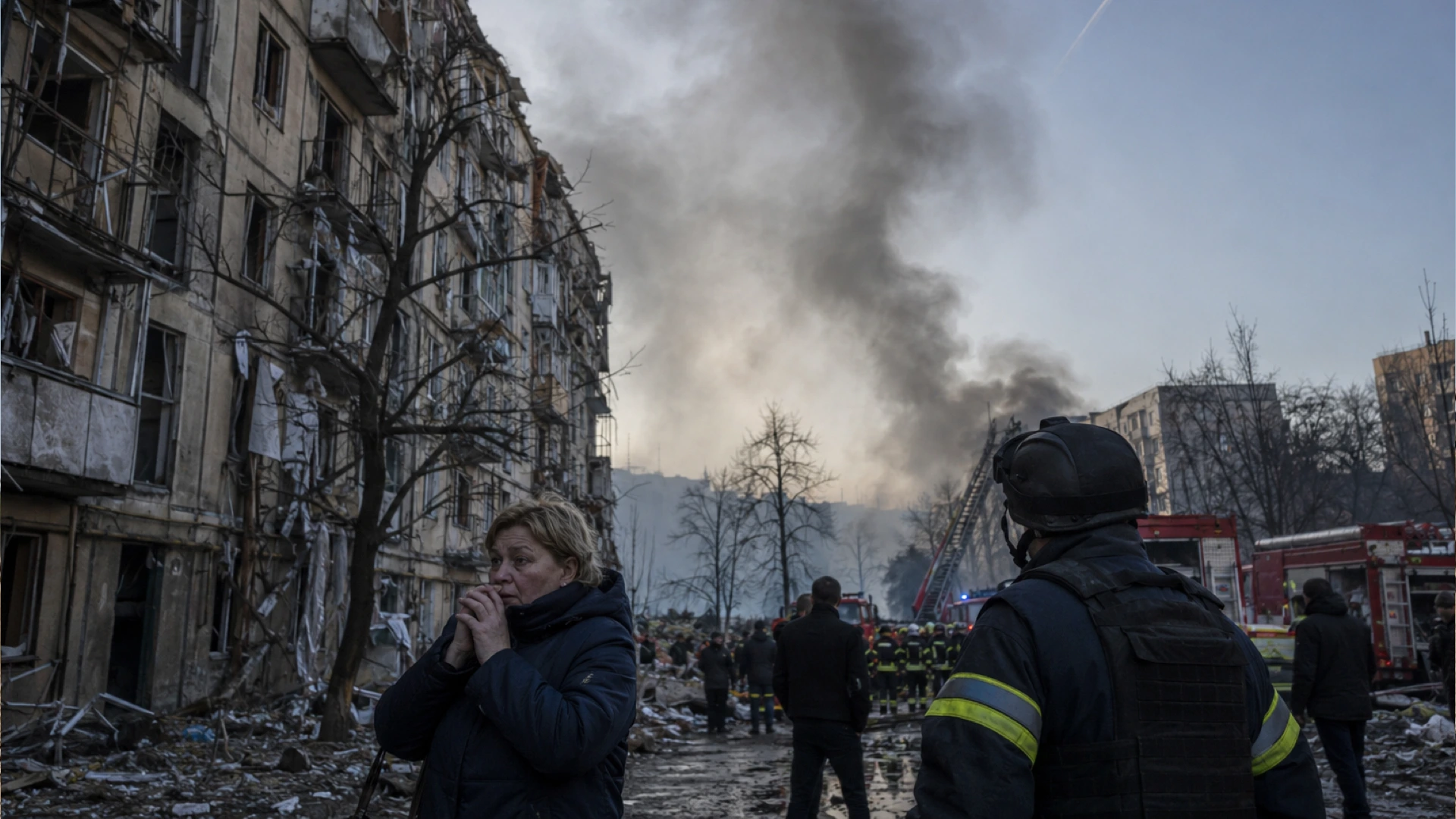
Drone barrage attacks across Ukraine on May 13 marked one of the broadest daytime assaults of the war, with President Volodymyr Zelenskyy saying Russia launched at least 800 drones toward about 20 regions. The strikes killed at least six people, wounded dozens more, and once again pushed Ukrainian air defenses into a prolonged nationwide response.
The attack unfolded from midmorning and stretched for hours over Kyiv, Lviv, Odesa, and other population centers. Zelenskyy said the scale and duration of the operation showed that Moscow was not only targeting infrastructure and civilians, but also trying to wear down the systems Ukraine depends on to intercept repeated waves of aerial threats.
Drone Barrage Stretches Ukraine’s Defenses
The latest assault stood out for both timing and reach. Russia has often relied on overnight attacks, but this barrage developed in broad daylight and affected regions far from the front line. That expanded the sense of pressure on civilians as air raid alerts and defensive fire spread across the country.
Ukrainian officials said the bombardment lasted into the late afternoon, making it one of the longest such attacks since Moscow’s full-scale invasion began in 2022. The prolonged tempo forced emergency responders, local authorities, and military units to stay on high alert well beyond the usual rhythm of a single strike window.
How The Drone Barrage Hit Multiple Regions
Kyiv was again among the cities under threat, though local officials said falling debris landed in an open area of the capital’s Obolonskyi district without causing casualties there. Air defense systems remained active over the city as authorities tracked successive waves of incoming drones.
Elsewhere, the damage proved more severe. Regional officials reported deaths and injuries in several locations, with the Rivne region in western Ukraine among the hardest hit. The attack underscored how far Russia’s drone campaign can now reach, including areas closer to NATO territory.
Moreover, the geographic spread carried political weight as well as military significance. By striking around 20 regions, Russia signaled that no part of Ukraine should feel insulated from sustained pressure, even when front-line shifts have slowed and Moscow’s land offensive has produced fewer gains.
Why Air Defense Remains Central
Zelenskyy argued that the purpose of the operation was clear: to overload Ukraine’s air defense network. In his account, the barrage was designed less as a single blow and more as a test of endurance, forcing defenders to track, intercept, and prioritize targets over many hours.
That assessment fits a broader pattern in the war. Russia has repeatedly mixed drones with the threat of cruise and ballistic missiles, creating uncertainty over whether an initial wave is only the opening stage of a larger strike package. Therefore, even successful interceptions can come at a significant operational cost.
In addition, prolonged attacks strain ammunition stocks, radar coverage, and personnel. They also heighten anxiety for civilians who must decide whether to shelter for extended periods while basic services and local transport remain vulnerable to disruption.
Casualties Add To Civilian Pressure
The death toll from the May 13 attack reached at least six, while dozens of people were reported injured, including children. Those figures offered an early measure of the human cost, though casualty counts in large attacks often shift as regional authorities complete damage assessments.
Emergency crews were dispatched across several regions to respond to fires, damaged structures, and debris fields. Even where direct hits did not produce mass casualties, the scale of the barrage forced local services to operate under unusual stress for much of the day.
Regional Death Toll Shows The Reach Of The Attack
Officials in Rivne said three people were killed there in a drone strike, making the western region one of the clearest symbols of how widely the operation spread. For many Ukrainians, attacks that reach deep into the country’s west carry a distinct psychological effect because those areas have often been seen as relatively safer than the east and south.
However, the latest barrage suggested that Russia remains willing to use volume and range to unsettle that assumption. When drones appear over multiple regions at once, they create a sense of constant exposure that extends beyond the immediate blast zones.
Meanwhile, injuries reported across the country reflected the secondary dangers that accompany drone warfare. Falling debris, shattered glass, localized fires, and damaged utility lines can all turn an intercepted attack into a deadly event on the ground.
Civilians Face Long Hours Of Uncertainty
For residents in cities placed under repeated alerts, the pressure came not only from explosions but from duration. A strike that lasts for hours disrupts work, school, transport, and emergency access, while also increasing the risk that people will make dangerous choices about when it is safe to leave shelter.
That uncertainty has become part of daily life in Ukraine, yet the scale of this barrage still stood out. Daytime attacks are particularly disruptive because they unfold while roads are busy, public services are active, and businesses are operating under normal schedules.
On the other hand, officials and local communities have also built routines for response that can reduce the toll. Early warnings, mobile alerts, and rapid coordination by emergency teams remain crucial when attacks are designed to be broad, persistent, and difficult to predict.
Russia’s Tactics And The Wider War
The May 13 attack came at a moment when questions about diplomacy and battlefield momentum were again in focus. Public talk about possible peace openings has persisted in recent days, but the scale of the drone assault showed that Russia is still prepared to apply heavy military pressure while negotiations remain uncertain.
At the same time, Ukrainian officials have argued that the correlation of forces has shifted somewhat in recent months. Russia still retains greater mass and firepower, yet its ground advances have slowed, while Ukraine has expanded its own long-range drone capabilities and contested Moscow’s operational initiative in some areas.
Drone Barrage Sends A Strategic Signal
Large drone attacks serve several purposes at once. They can inflict direct damage, test defensive coverage, force expensive interceptions, and shape public perception by suggesting that the attacker can sustain pressure across a broad national map.
Therefore, the May 13 operation carried meaning beyond its immediate casualty count. It acted as a reminder that aerial warfare remains one of the conflict’s most flexible tools, especially for a military seeking leverage even when territorial advances on the ground have slowed.
Moreover, repeated barrages can shape diplomatic timing. They place Ukraine and its partners under pressure to replenish air defense systems quickly, while also reminding foreign governments that any discussion of peace is unfolding against the backdrop of continued attacks on civilian areas.
What Comes Next For Ukraine’s Defense
Zelenskyy warned that a drone barrage can also foreshadow cruise and ballistic missile strikes, making each wave part of a larger defensive puzzle. That means Ukraine must prepare not only for high numbers of relatively low-cost drones, but also for the possibility of more destructive follow-on weapons.
This dynamic helps explain why air defense remains one of Kyiv’s most urgent strategic needs. Interceptors, radar integration, rapid repair capacity, and decentralized response systems are all essential if Ukraine is to keep limiting the damage from attacks that are designed to be cumulative as much as spectacular.
In the near term, officials are likely to keep stressing resilience as much as retaliation. The ability to keep cities functioning, maintain civilian morale, and preserve defensive readiness may matter as much as any single battlefield gain when Russia chooses to fight through prolonged aerial pressure.
The latest drone barrage reinforced a central reality of the war: Russia can still impose wide disruption even as Ukraine adapts, and the contest over air defense is becoming more decisive with each new wave. Follow Berrit Media for more global policy and conflict coverage.
Discover more from Berrit Media
Subscribe to get the latest posts sent to your email.