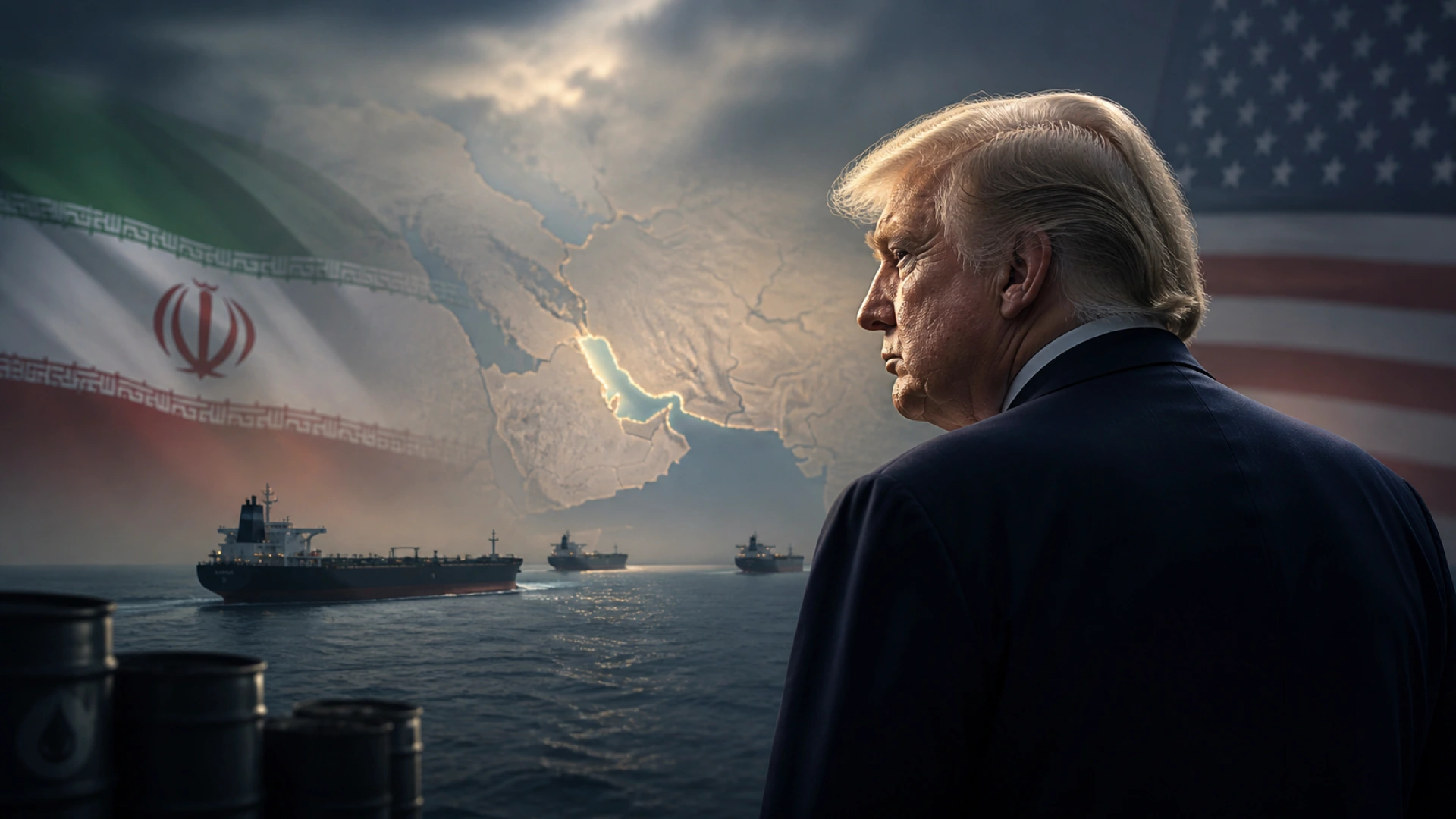
The Trump Iran standoff has entered its most dangerous phase yet. A fragile ceasefire brokered through Pakistani mediators remains intact on paper. However, beneath the surface, diplomatic pressure has reached a critical boiling point and the world is watching closely.
Washington and Tehran are locked in a war of words and ultimatums. The US maintains a naval blockade on Iranian ports, oil prices have surged past $116 a barrel, and global supply chains face mounting disruption. The stakes could not be higher.
The Trump Iran Ceasefire Crisis Deepens
The ceasefire between the United States and Iran, announced on April 8, 2026, was always described as fragile. It was mediated by Pakistan after a brutal two-month war that began on February 28, 2026. The conflict, launched jointly by the US and Israel, targeted Iran’s military infrastructure, nuclear sites, and key leadership figures including Supreme Leader Ali Khamenei.
Now, three weeks into the truce, cracks have widened into chasms. Trump warned that “a whole civilization will die tonight” if Iran failed to agree to end the war and reopen the Strait of Hormuz. That dramatic statement set the tone for a ceasefire negotiation that has never felt fully stable. The Trump Iran conflict is not simply a military standoff, it is a high-stakes diplomatic gamble playing out in real time.
Trump Iran Nuclear Demands Remain Non-Negotiable
At the heart of the dispute lies Iran’s nuclear programme. To end the war, the US is seeking a complete shutdown of Iran’s nuclear programme, limits on its missile production, and an end to its support for regional allies including Hezbollah and Hamas. These demands form the core of what Washington considers a minimum threshold for any lasting deal.
Tehran, however, refuses to budge on the fundamental question. Iran has insisted on its right to enrich uranium domestically as part of a civilian nuclear programme. It has also ruled out offering its military capabilities or regional alliances as bargaining chips. The gap between the two positions is vast, and neither side appears ready to narrow it without major concessions.
Trump stated at a press conference: “There will be no enrichment of Uranium, and the United States will, working with Iran, dig up and remove all of the deeply buried Nuclear ‘Dust.'” This uncompromising language signals that the Trump Iran position is not simply about weapons, it is about complete denuclearisation. That is a line Iran has categorically refused to cross.
Adding further complexity, Trump has claimed that Tehran agreed to the US extracting nuclear material from bombed sites. But Iran has said it will not allow the uranium to leave the country. These conflicting accounts have deepened mutual distrust and made the prospect of a comprehensive deal even more remote.
Meanwhile, US envoy Witkoff stated that the US and Iran were engaging in both direct and mediated discussions aimed at returning to negotiations for a comprehensive peace agreement. He also stressed that the American position requires Iran to halt all uranium enrichment a position that, as analysts have noted, the White House had not consistently maintained in earlier rounds of talks.
Islamabad Talks Fail to Break the Deadlock
The most significant diplomatic attempt to end the Trump Iran standoff took place in Islamabad, Pakistan. US and Iranian officials met for face-to-face talks lasting 21 hours on April 11. The length of those talks suggested both sides were serious about finding common ground. But the outcome told a different story.
US Vice President JD Vance announced that the sides had “not reached an agreement,” largely because of Iran’s refusal to abandon its nuclear programme. Vance’s blunt assessment reflected the deep structural divide between the two nations. He also stated that Iran must “act like a normal country” before the US would treat it economically as one — a comment that drew sharp criticism from Tehran.
The second round of talks was supposed to follow in Islamabad as well. However, Iranian foreign ministry spokesperson Esmaeil Baghaei said they had “no plans for the next round of negotiations,” adding: “We don’t believe in deadlines or ultimatums to secure Iran’s national interests.” The statement effectively placed talks in limbo.
Pakistan’s Prime Minister Shehbaz Sharif attempted to bridge the gap. He expressed hope that both sides would observe the ceasefire and reach a comprehensive peace deal during a second round of scheduled talks in Islamabad. However, with Iran refusing to commit and the US naval blockade firmly in place, Islamabad’s optimism appeared increasingly difficult to sustain.
The Strait of Hormuz and Its Toll on the Global Economy
The Strait of Hormuz has become the physical symbol of the Trump Iran standoff. In peacetime, one-fifth of the world’s oil and liquefied natural gas supplies are shipped through the narrow passage, which links Gulf oil producers to the open ocean. Its closure has sent shockwaves through global markets.
Iran effectively shut the strait to shipping after the US imposed a naval blockade on Iranian ports. Tehran offered to reopen the Strait of Hormuz on the condition that the US lifts its naval blockade and agrees to end the war. Washington, in turn, refused to lift the blockade without a resolution to the nuclear question. The result is a strategic deadlock with severe economic consequences.
Trump Iran Policy Drives Oil Prices to Record Highs
The economic fallout from the Trump Iran confrontation has been swift and severe. Energy prices soared on negative signals from Washington. National gas price averages hit a new high of $4.18 per gallon, up from $4.11 a day earlier. The international benchmark price for oil, Brent crude, reached a three-week high above $111 a barrel.
Iran’s parliament speaker Mohammad Bagher Ghalibaf pointed the finger directly at US policy. He said the US blockade on the Strait of Hormuz had contributed to oil prices rising toward $120 a barrel, with Brent crude trading at $116 at one point. He also mocked what he called “junk advice” given to the Trump administration by Treasury Secretary Scott Bessent.
The disruption to shipping is already visible. According to MarineTraffic, only eight ships transited the strait in one overnight period, including four tankers and two cargo ships. For a waterway that normally handles millions of barrels of oil daily, that figure represents a near-complete collapse of normal maritime activity.
Analysts warn that further escalation could push energy prices even higher. Ghalibaf warned prices could hit $140 a barrel — a level that would represent a massive shock to both developed and emerging market economies. Countries across Asia and Europe, heavily dependent on Gulf energy, have begun contingency planning. The Trump Iran energy crisis is no longer just a bilateral conflict — it has become a global economic threat.
Trump, however, appeared unmoved. He suggested that the naval blockade strategy was designed to force Iran into an unsustainable position by preventing it from exporting oil while also creating conditions where Tehran might have nowhere to store its surplus production.
China, Russia, and the Shifting International Response
The Trump Iran crisis has also reshuffled international alignments in significant ways. China and Russia have emerged as key voices advocating for de-escalation, though for very different reasons.
China has opposed the reimposition of sanctions against Iran, as has Russia. Russia has welcomed the ceasefire agreement and called for a “comprehensive settlement.” In February, Russia offered to take Iran’s enriched uranium as part of any political settlement. These positions reflect not only geopolitical interests but also economic ones — both Beijing and Moscow have significant stakes in stable energy markets and regional influence.
Putin and Trump discussed the war in Ukraine alongside the Iran file, with Putin raising the possibility of a ceasefire to coincide with Victory Day on May 9. Kremlin aide Yuri Ushakov said Putin believes Trump’s decision to extend the Iran ceasefire is correct, describing it as an opportunity for negotiations that could stabilise the broader situation.
China’s role, meanwhile, has drawn attention in a different way. China detained nearly 70 Panamanian-flagged ships after a Supreme Court ruling on the Panama Canal, with US officials criticising the move. The incident highlighted how the Trump Iran conflict is creating ripple effects far beyond the Middle East, drawing in global shipping lanes and international maritime law.
Washington’s Political Landscape and Europe’s Growing Alarm
The Trump Iran war has not only reshaped global diplomacy — it has also created new fault lines within the Western alliance. European leaders who have long viewed Iran cautiously now find themselves at odds with Washington’s approach. Their criticism has been blunt, and Trump’s response has been equally sharp.
At home, Trump faces a Republican Party that is increasingly shaped by his will. Yet even within that controlled environment, the Iran conflict has exposed the limits of consensus. Budget cuts and reductions in the federal workforce have raised questions about whether Washington’s institutions can sustain a prolonged military and diplomatic campaign simultaneously.
Trump Iran Strategy Draws Fire from German Chancellor
European frustration with the Trump Iran approach came into sharp focus when German Chancellor Friedrich Merz publicly criticised Washington’s conduct of the war. Merz accused US officials of entering a war without a clear strategy, calling the whole affair “ill-considered.” He also said that Iran was proving more skillful at non-negotiation than Washington had anticipated.
Trump responded with characteristic force, posting on Truth Social: “The Chancellor of Germany, Friedrich Merz, thinks it’s OK for Iran to have a Nuclear Weapon. He doesn’t know what he’s talking about!” He also announced that the US was reviewing the possibility of reducing the number of troops stationed in Germany — a direct warning that European dissent carries strategic consequences.
Germany is home to Ramstein Air Base, which serves as headquarters for US Air Forces in Europe and plays a critical logistical role in NATO operations. Trump’s suggestion that Washington is studying a possible troop reduction in Germany sent a clear signal that the Trump Iran strategy is being tied to broader questions of alliance loyalty.
The episode illustrates a broader pattern. Trump has made clear that allies who question his Middle East strategy risk paying a price in terms of military partnership, trade relations, and diplomatic standing. For European nations trying to balance solidarity with Washington and their own economic interests — particularly in energy — the Trump Iran confrontation has become a deeply uncomfortable dilemma.
GOP Primaries and Trump’s Expanding Political Grip
Even as the Trump Iran crisis unfolds on the world stage, the US president is managing an equally assertive domestic political campaign. Trump’s effort against Republican lawmakers who crossed him faces big tests in May, with primaries in Kentucky, Indiana, and Louisiana offering the president his best chances at ousting Republican apostates on issues from redistricting to Jeffrey Epstein to impeachment.
Trump has issued endorsements in a slew of races. His political machine encouraged some candidates to run and others to drop out, deployed top lieutenants to outside groups, and spent millions of dollars on the airwaves. The operation is vast, sophisticated, and deeply personal — a demonstration of just how complete his control over the Republican Party has become.
In Louisiana, the dynamics have been particularly revealing. A candidate in the Republican Senate primary told NBC News that someone “around” the Trump administration offered him a job as an enticement to drop out, which could have eased another candidate’s path against Senator Cassidy. Whether that constitutes political pressure or ordinary dealmaking, the episode underscores how total Trump’s grip on the Republican Party has become.
The combination of foreign policy aggression and domestic political consolidation defines the current Trump presidency. Whether managing the Trump Iran standoff or reshaping the Republican Party in his own image, the 47th president continues to operate with a boldness that generates as much alarm as admiration, depending on where one stands.
The Trump Iran confrontation remains one of the defining crises of 2026 — a conflict that began as a military operation, evolved into a diplomatic labyrinth, and has now become a test of global economic resilience. With oil prices elevated, the Strait of Hormuz barely operational, and peace talks stalled, the coming days will be critical. For deeper analysis on how this crisis is reshaping global geopolitics and investment strategies, continue reading related coverage only at Insimen.
Discover more from Berrit Media
Subscribe to get the latest posts sent to your email.