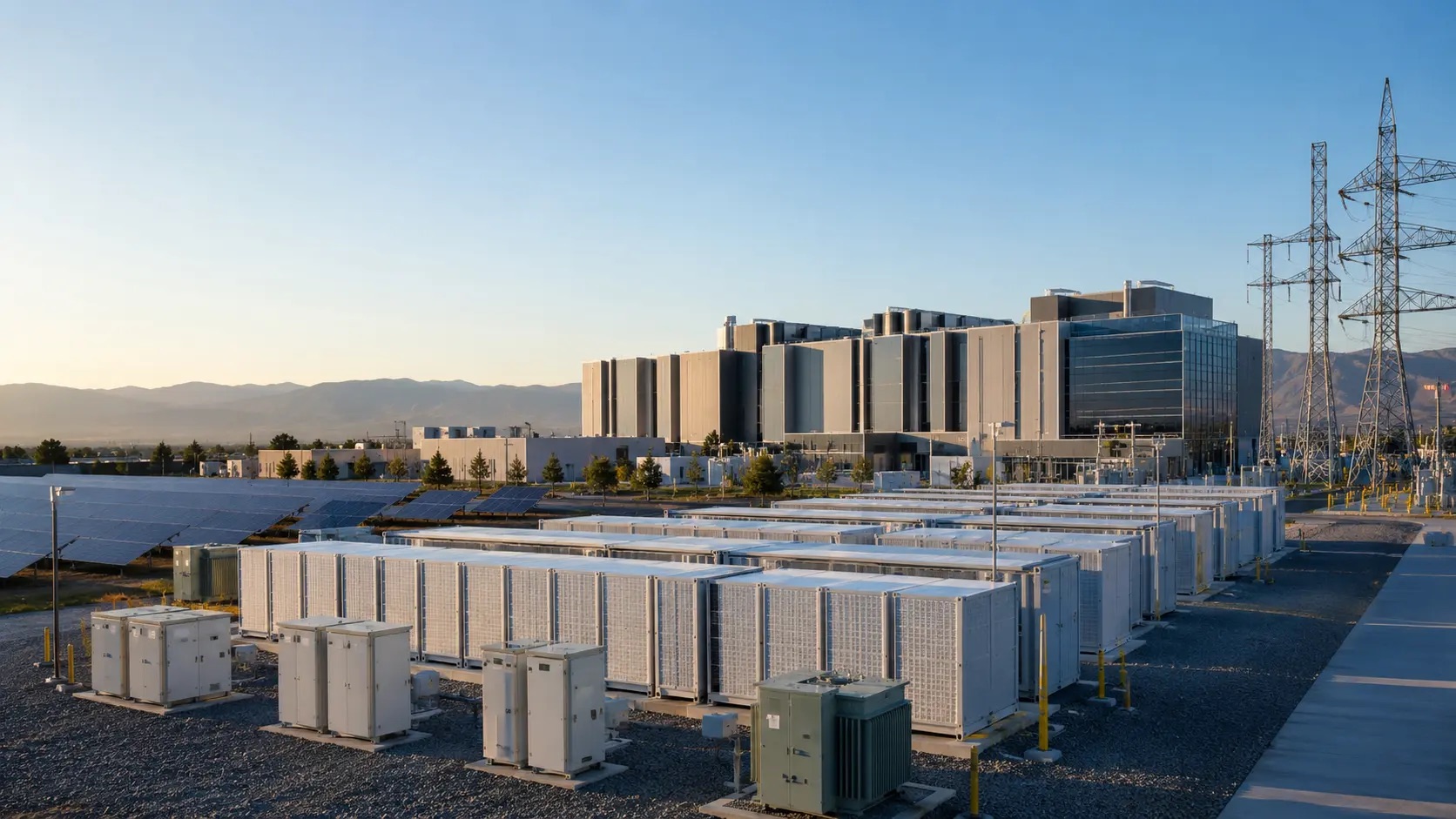
Energy Storage has moved deeper into the AI infrastructure race after Nextpower agreed to buy Prevalon Energy in a deal worth up to $365 million, giving the solar power technology company a battery platform aimed at utility grids, industrial power systems and data centers.
The Fremont, California-based company disclosed the transaction in a May 28 Form 8-K filed with the U.S. Securities and Exchange Commission. Under the agreement, Nextpower LLC will buy all issued and outstanding equity interests of Prevalon Energy from Emerald Energy Storage, with consideration split between roughly $150 million in cash at closing, $50 million in stock to be issued one year after closing and as much as $165 million in contingent cash consideration.
The acquisition is notable because it turns a familiar AI infrastructure problem into a corporate strategy move. Data centers increasingly need firm, responsive power that can smooth rapid load changes, protect uptime and reduce stress on grids. Nextpower is betting that battery energy storage systems, software and power controls can become part of the same industrial stack as solar structures, electrical systems and power conversion equipment.
Energy Storage Becomes A Data Center Strategy
Nextpower said the Prevalon acquisition would extend its technology platform into battery energy storage systems and intelligent controls for critical power infrastructure. The company framed the move around demand from customers that want more integrated firm-power solutions rather than separate procurement of solar hardware, conversion equipment, storage and controls.
The deal also reflects how AI data centers are changing the commercial logic of power equipment. Hyperscale facilities are no longer treated only as large electricity customers. They are becoming anchor loads whose volatility, capacity requirements and uptime needs influence investment across batteries, substations, grid services, backup systems and energy-management software.
Energy Storage Links Solar Hardware To Firm Power
Nextpower built its public-company identity around solar tracking and related technology for utility-scale plants, but it has been widening its platform. Earlier in May, it entered a separate agreement to acquire power-conversion technology, and PV Tech noted that the company has been repositioning since its November 2025 rebrand from Nextracker to Nextpower.
Prevalon gives that strategy a storage layer. The company, a U.S.-headquartered joint venture tied to Mitsubishi Power Americas and EES, has deployed more than 6 GWh of battery energy storage systems globally, according to Nextpower’s announcement. It also holds 1.3 GW of firm supply contracts supporting AI and hyperscaler data center infrastructure deployments.
That installed base matters because energy storage is becoming less of an optional add-on for power developers and more of a way to shape electricity delivery. For large users, the issue is not simply whether power is available. It is whether power can be delivered with the quality, response time and stability required by increasingly dense compute workloads.
Prevalon Adds Controls, Software And Service
Prevalon’s portfolio includes the Hybrid Power Stabilizer, HD5 DC block and HD5 AC block products, supported by insightOS controls, monitoring, diagnostics and long-term service capabilities, according to the company release included in Nextpower’s filing. Those systems are positioned for applications that require power quality and fast response, including AI data centers, private grids, grid-connected storage and industrial power systems.
The strategic value is in the combination of hardware and control software. A battery installation that only stores and discharges power has one role. A system that also manages rapid load shifts, contingency events and grid-stability services has a broader place in infrastructure planning, especially where data-center loads can move quickly.
Nextpower’s management described the transaction as a way to meet customer demand for integrated firm-power solutions. That phrasing is important. It suggests the company wants to sell a wider power architecture, not just individual equipment pieces, as customers confront electricity constraints linked to AI, industrial electrification and grid congestion.
Financial Outlook Rises With Acquisition Plan
The transaction is also material because Nextpower raised its fiscal 2027 outlook in connection with the proposed acquisition. The company said the new forecast assumes the deal closes successfully and includes planned incremental costs tied to its acceleration into the power-conversion market.
Nextpower now expects fiscal 2027 revenue of about $4.0 billion to $4.4 billion, up from the previous range of $3.8 billion to $4.1 billion. It also lifted adjusted EBITDA guidance to roughly $845 million to $930 million, compared with the earlier outlook of $825 million to $900 million.
Energy Storage Broadens The Revenue Base
The guidance update gives the deal a clearer investor angle. Nextpower is not presenting Prevalon only as a technology acquisition. It is tying the move to a larger addressable market and to a financial outlook that assumes storage and power conversion can expand what the company sells to energy infrastructure customers.
According to the company, global demand for battery energy storage systems outside China could represent an opportunity of up to $35 billion by 2030, with the United States accounting for up to $15 billion. Those projections are forward-looking and depend on power demand, policy, grid investment, supply chains and customer adoption, but they explain why storage is becoming strategically important for companies serving utility-scale energy markets.
For investors, the question is whether Nextpower can convert its existing customer relationships into a broader platform business. The company will need to integrate Prevalon’s operations, retain customers and employees, manage transaction costs and compete in a storage market where utilities, developers, battery suppliers, software companies and power-equipment manufacturers are all trying to capture the same demand.
Deal Terms Leave Execution Risk
The SEC filing makes clear that the acquisition is not yet complete. Closing is subject to customary conditions, including antitrust regulatory review. The stock component will be issued one year after closing and priced using the average of daily volume-weighted average prices for Nextpower’s Class A common stock over the 60 complete trading days ending May 27, 2026.
The contingent-cash portion of up to $165 million also means the final cost will depend on terms set out in the purchase agreement. That structure can help align payment with performance or milestones, but it also adds complexity for investors assessing the full economics of the deal.
Nextpower’s own filing cautioned that forward-looking statements could differ from actual results. The listed risks include integration challenges, unexpected costs, possible changes in business relationships, market demand, retention of key employees and customers, and wider economic or regulatory developments.
AI Power Demand Shapes Industrial Competition
The broader significance of the Prevalon acquisition is that AI infrastructure is pulling adjacent industries into the same competitive field. Chip demand, data-center construction, electricity generation, power conversion, batteries, grid services and industrial software are increasingly linked by one practical constraint: reliable power.
This makes the Nextpower deal more than a clean-energy equipment story. It sits inside a wider corporate race to control the parts of the power system that allow compute-heavy customers to expand without waiting for slower grid upgrades or accepting greater operational risk.
Energy Storage Moves Up The Value Chain
Battery storage has often been discussed in terms of renewable integration, peak shifting and grid balancing. Those use cases remain central, but the AI data-center boom is adding another layer. Large compute customers need infrastructure that can handle abrupt load patterns while meeting strict uptime and power-quality requirements.
That shift can move storage suppliers closer to strategic infrastructure decisions. Instead of being selected late in a project as a supporting asset, storage and controls may be evaluated earlier alongside site selection, power procurement, grid interconnection and backup architecture.
For Nextpower, that is the logic of building an integrated energy technology platform. If the company can combine structures, electrical systems, power conversion, storage and software, it may be able to compete for larger and more complex infrastructure packages. The risk is that integration across several acquired technologies is difficult, especially in markets where customers demand reliability and bankability.
Data Centers Turn Power Quality Into A Boardroom Issue
AI data centers are making power quality a business issue, not only an engineering issue. A facility that cannot secure dependable electricity may face delayed deployment, higher costs or weaker customer economics. A power system that cannot absorb sudden changes in load may also create wider grid concerns for utilities and regulators.
Prevalon’s technology is being pitched directly at those pressures. Nextpower said the platform can help with inertia support, grid stabilization, contingency management and smoothing of GPU AI workloads. Those are technical functions, but the business implication is straightforward: data-center operators and power developers are looking for systems that reduce operational volatility.
This is why the deal has relevance beyond one company. As AI infrastructure expands, suppliers that can package generation, conversion, storage and controls may gain strategic importance. At the same time, customers and investors will need to separate credible operating capabilities from broad claims about AI-related demand.
Regulatory And Supply Chain Questions Remain
The proposed acquisition still needs regulatory clearance and successful closing. That is routine language for a transaction of this kind, but the storage market now sits at the intersection of energy policy, industrial strategy, trade exposure and critical infrastructure planning.
PV Tech reported that Prevalon’s main BESS contract manufacturer is China-based Clou Electronics, part of Midea Group. Nextpower’s public release did not frame the acquisition around supply-chain risk, but any storage platform serving U.S. utilities, industrial power systems and AI data centers will be watched against a backdrop of policy scrutiny over power equipment, batteries and technology supply chains.
Energy Storage Faces Policy Scrutiny
Energy storage is strategically attractive because it supports renewables, backup capacity and grid flexibility. It is also increasingly sensitive because batteries, power electronics and control systems can depend on global manufacturing networks. That creates both cost advantages and geopolitical questions.
For Nextpower, the immediate test is closing and integrating the business. Over time, the company may also have to show customers how it manages sourcing, compliance, cybersecurity, service reliability and product support across a platform that serves critical power infrastructure.
Those issues could become more important as data-center operators, utilities and industrial customers demand clearer assurances around resilience. The more storage is embedded into mission-critical energy systems, the more buyers will care about who manufactures components, who maintains software, and how vendors manage long-term availability.
Nextpower Must Prove Platform Discipline
Acquisitions can quickly broaden a company’s market story, but they do not automatically create an integrated platform. Nextpower is moving across solar structures, electrical infrastructure, power conversion, energy storage, controls, automation and software. That gives it a larger opportunity, but also a larger execution burden.
The company has a clear industrial thesis: power demand is rising, AI data centers need faster and more reliable infrastructure, and customers want fewer disconnected systems. Prevalon gives Nextpower a more complete answer to that problem, assuming the deal closes and the acquired capabilities fit smoothly into the wider business.
For the energy and technology sectors, the transaction is another sign that the AI buildout is reshaping capital allocation beyond chips and cloud services. The new competitive edge may belong to companies that can make electricity usable at the speed and reliability that AI infrastructure demands.
Nextpower’s Prevalon agreement puts energy storage at the center of that shift, linking battery systems, grid stability and AI data-center growth in one acquisition. Readers can continue following related coverage on power infrastructure, technology investment and industrial strategy at Berrit Media.
Discover more from Berrit Media
Subscribe to get the latest posts sent to your email.