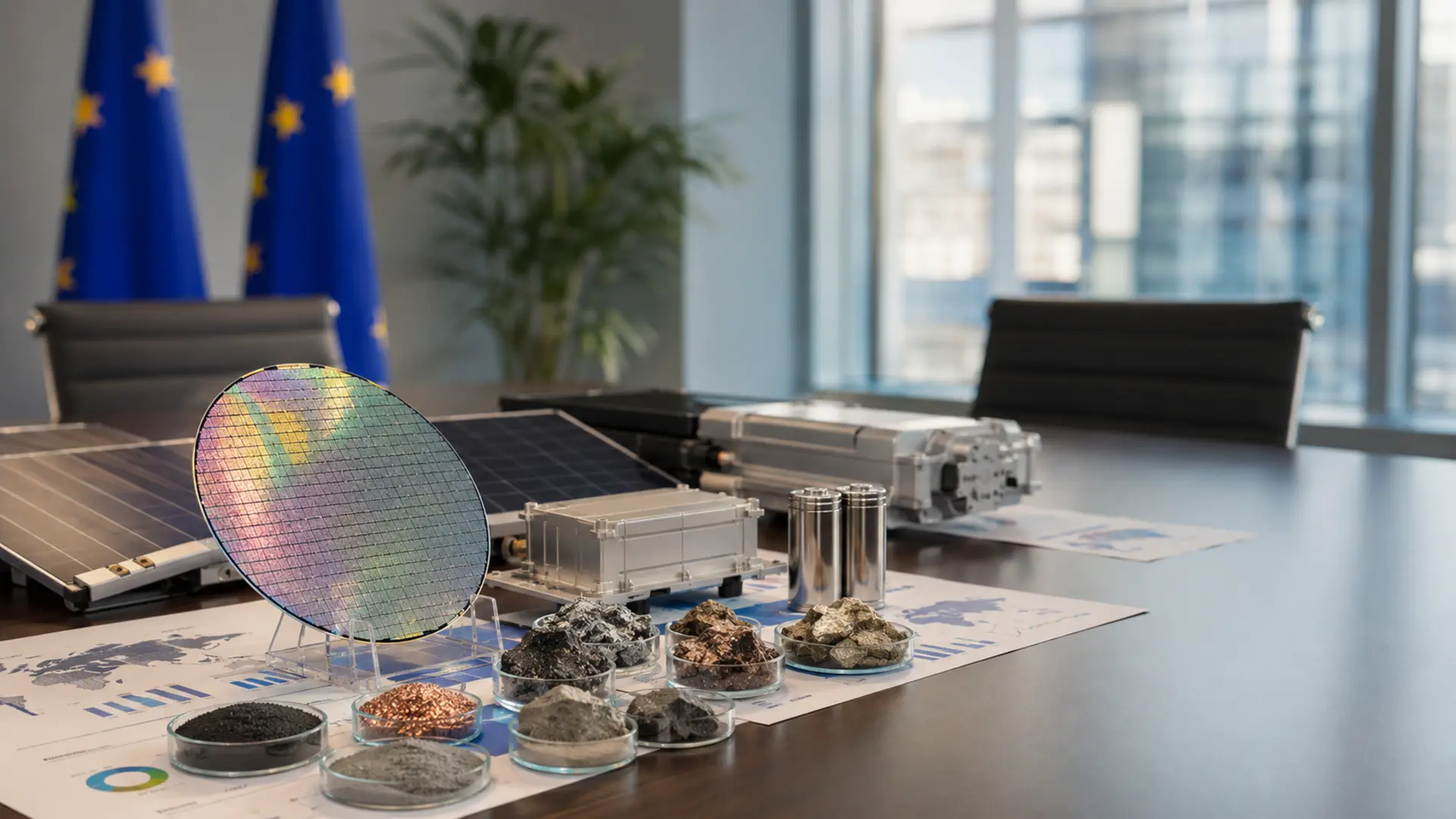
EU China policy is moving into a more forceful phase as the European Commission weighs how to protect industrial capacity from rising import pressure and strategic supply risks.
Reuters reported on May 29, 2026, that European commissioners met in Brussels to discuss a stronger response to surging Chinese imports, including possible measures tied to supply chain diversification, critical minerals, chemicals, metals and clean energy technology. The discussion comes before a June 18-19 EU leaders’ summit, where industrial resilience and trade imbalances are expected to be central themes.
EU China Policy Moves From Diagnosis To Possible Action
The latest debate shows that Brussels is no longer treating dependence on China as a narrow trade complaint. The Commission’s concern now spans manufacturing capacity, security of supply, clean technology, critical raw materials and the ability of European companies to compete when global rivals operate with different subsidy, energy and regulatory conditions.
According to Reuters, the Commission said the EU’s trade and investment relationship with China is “not sustainable” and that economic and security interests will require a more robust and coherent response. Concrete proposals are not expected until the third quarter, but the direction is already significant for companies exposed to Chinese inputs or Chinese competition.
EU China Policy Could Reach Supply Contracts
One possible route is a diversification requirement for companies in critical sectors. Reuters reported that ideas under discussion could include forcing EU firms to diversify supply chains, a step that would move industrial policy directly into procurement and risk management rather than stopping at tariffs or subsidies.
That would matter because many European manufacturers depend on China not only for finished goods, but also for intermediate materials, components and processing capacity. If Brussels eventually asks companies to reduce single-country exposure, firms may need to reassess supplier qualification, inventory strategy, contract terms and long-term capital spending.
The political logic is clear. Europe has spent years identifying strategic dependencies, but many supply chains still reflect earlier assumptions that cost efficiency and market access were more important than resilience. EU China policy is now testing whether that balance should change, even if the adjustment raises costs for companies and consumers.
Critical Minerals Turn Dependence Into An Industrial Risk
Critical minerals are central to the debate because they sit underneath batteries, renewable power, defense systems, electronics and automotive supply chains. The Commission’s Critical Raw Materials Act framework designates strategic projects to expand EU extraction, processing and recycling capacity while diversifying supplies from third countries.
The Commission says those projects are of public interest because they support security of supply and safeguard the functioning of the internal market. That language helps explain why critical minerals have moved from a specialist commodity issue into mainstream industrial policy.
China’s strength in rare earths and other processed inputs gives Beijing leverage in sectors Europe considers essential for the green and digital transitions. For investors, that turns mineral security into a practical question about where factories can be built, which suppliers can be trusted, and how quickly alternative sources can scale.
Why EU China Policy Is A Business Story
The Commission’s shift is not only about diplomacy. It could affect pricing, sourcing, market access and competitive strategy across European industries that have relied on Chinese production networks or that face Chinese competitors in Europe.
Reuters reported that possible proposals could include new trade mechanisms to curb China’s access to the EU market in chemicals, metals and clean energy technology. Those sectors are exposed to the same broad tension: European policymakers want domestic capability, while businesses still need affordable inputs and access to global markets.
EU China Policy Adds Pressure On Clean Technology
Clean technology is a particularly sensitive area because Europe wants to lead the energy transition while avoiding a deeper dependence on imported equipment. Solar panels, batteries, electric vehicles, grid components and related materials all sit inside the same strategic question.
The EU has already imposed tariffs on subsidized Chinese electric vehicles, but Reuters noted that hybrid models were not covered and that China’s market share in Europe has continued to rise. That experience illustrates the difficulty of designing trade measures that protect industry without creating loopholes or damaging consumer choice.
If EU China policy becomes more systematic, clean technology companies may face a more complex operating environment. European producers could receive stronger political support, but importers, retailers and project developers may face higher costs or tighter compliance checks when supply chains rely heavily on China.
European Industry Faces A Cost Gap
The Commission’s tougher language also reflects a competitive problem that businesses know well. European industry faces higher energy costs, stricter regulation and fragmented capital markets compared with some U.S. and Chinese rivals.
Those pressures make trade policy politically attractive, but they also make implementation difficult. Tariffs or procurement preferences can protect some producers, yet they do not automatically solve high input costs, slow permitting, skills shortages or the capital intensity of advanced manufacturing.
That is why the policy debate will matter beyond headline measures. Investors will watch whether Brussels pairs tougher China rules with financing, permitting reform, demand support and practical supply chain tools. Without that wider package, companies may see new compliance burdens without enough help to rebuild capacity inside Europe.
Technology Sovereignty Sits Behind The EU China Debate
The trade discussion is closely tied to technology sovereignty. Europe wants more control over the systems that underpin artificial intelligence, communications, defense, automotive production and industrial automation.
The European Chips Act is one of the clearest examples. The Commission says the framework is designed to reinforce Europe’s semiconductor ecosystem, improve supply chain resilience and reduce external dependencies, with a target of doubling Europe’s global semiconductor market share to 20%.
EU China Policy Links Chips To Procurement
Semiconductors show how EU China policy can overlap with broader concerns about non-European technology dependence. Chips are essential for cars, data centers, smart devices, defense systems, medical equipment and industrial controls, making them a strategic input rather than a single-sector product.
The Commission says the Chips Act supports pilot lines, competence centers and first-of-a-kind facilities. It has also approved state aid decisions tied to more than 31.5 billion euros in public and private semiconductor investment, according to its Chips Act information page.
Those programs are intended to improve Europe’s position, but they take time. In the near term, Brussels may consider demand-side tools, including procurement preferences or supply security requirements, to help European suppliers gain scale. That would turn technology sovereignty from a funding slogan into a buying decision.
Startup And Scaleup Policy Adds Another Layer
The Commission’s startup and scaleup strategy also fits into the same agenda. Brussels has said Europe needs to close the innovation gap with global competitors and help technology-driven companies grow without relocating outside the EU.
The Commission has noted that only a small share of global scaleups are based in the EU compared with North America and China, and that Europe’s share of global venture capital remains far below those larger markets. Those figures matter because industrial resilience increasingly depends on software, chips, automation, robotics and advanced materials companies that can scale quickly.
If EU China policy becomes more assertive, European startups may gain new opportunities in procurement, infrastructure and strategic supply chains. But they will also need larger domestic customers, deeper financing and less fragmented regulation if they are expected to compete with established suppliers from China and the United States.
Political Divisions Could Slow The Response
The Commission can set the agenda, but major measures will still need to navigate member-state politics. France and Germany do not always approach China from the same starting point, particularly because German industrial groups retain deep commercial exposure to China’s market.
Reuters cited analysis from Teneo noting that Paris sees Europe’s open market as absorbing the effects of Chinese subsidies and U.S. protectionism, while Germany’s position is more conflicted because of manufacturing exposure to China. That split could shape how far Brussels can go and how quickly.
EU China Policy Must Balance Protection And Retaliation Risk
China has rejected the idea that its trade practices are unfair. Reuters reported that China’s Foreign Ministry accused the EU of using trade data selectively and has threatened countermeasures if Brussels adopts Buy European and revised technology sovereignty policies.
That response highlights the main risk for European companies. A tougher EU position may protect some industries at home, but it could also expose exporters, luxury groups, automakers, chemical companies and industrial suppliers to pressure in China.
EU China policy therefore has to balance resilience with escalation risk. A narrow measure can be too weak to change corporate behavior, while a broad measure can invite retaliation or split member states whose companies have different exposure to the Chinese market.
The June Summit Becomes A Strategic Test
The June 18-19 leaders’ summit will not necessarily produce final legislation, but it can set the political mandate for the Commission’s third-quarter proposals. That makes the summit important for companies trying to anticipate sourcing rules, trade defenses and procurement strategy.
Businesses will be looking for clarity on whether Brussels intends to use existing trade tools more systematically, create new instruments, or push member states toward coordinated buying and stockpiling practices. Each option would create different costs and opportunities.
For investors, the signal is that European industrial policy is becoming more interventionist and more explicitly linked to geopolitical risk. Companies that can document resilient sourcing, European production capacity or exposure to strategic sectors may receive a different valuation lens than firms dependent on fragile or politically exposed supply chains.
The central issue is whether Brussels can turn EU China policy into a practical industrial strategy rather than a reactive trade stance. Readers can continue following related coverage on global trade, supply chains and industrial policy at Berrit Media.
Sources: Reuters reporting on the European Commission’s May 29, 2026 policy debate; European Commission materials on the Chips Act, the Critical Raw Materials Act and the EU Startup and Scaleup Strategy.
Discover more from Berrit Media
Subscribe to get the latest posts sent to your email.